Medicine LibreTexts

20.6: Anatomical Atlas - Respiratory System

  • Page ID
    64261
    • Jennifer Lange et al.

    \( \newcommand{\vecs}[1]{\overset { \scriptstyle \rightharpoonup} {\mathbf{#1}} } \)

    \( \newcommand{\vecd}[1]{\overset{-\!-\!\rightharpoonup}{\vphantom{a}\smash {#1}}} \)

    \( \newcommand{\dsum}{\displaystyle\sum\limits} \)

    \( \newcommand{\dint}{\displaystyle\int\limits} \)

    \( \newcommand{\dlim}{\displaystyle\lim\limits} \)

    \( \newcommand{\id}{\mathrm{id}}\) \( \newcommand{\Span}{\mathrm{span}}\)

    ( \newcommand{\kernel}{\mathrm{null}\,}\) \( \newcommand{\range}{\mathrm{range}\,}\)

    \( \newcommand{\RealPart}{\mathrm{Re}}\) \( \newcommand{\ImaginaryPart}{\mathrm{Im}}\)

    \( \newcommand{\Argument}{\mathrm{Arg}}\) \( \newcommand{\norm}[1]{\| #1 \|}\)

    \( \newcommand{\inner}[2]{\langle #1, #2 \rangle}\)

    \( \newcommand{\Span}{\mathrm{span}}\)

    \( \newcommand{\id}{\mathrm{id}}\)

    \( \newcommand{\Span}{\mathrm{span}}\)

    \( \newcommand{\kernel}{\mathrm{null}\,}\)

    \( \newcommand{\range}{\mathrm{range}\,}\)

    \( \newcommand{\RealPart}{\mathrm{Re}}\)

    \( \newcommand{\ImaginaryPart}{\mathrm{Im}}\)

    \( \newcommand{\Argument}{\mathrm{Arg}}\)

    \( \newcommand{\norm}[1]{\| #1 \|}\)

    \( \newcommand{\inner}[2]{\langle #1, #2 \rangle}\)

    \( \newcommand{\Span}{\mathrm{span}}\) \( \newcommand{\AA}{\unicode[.8,0]{x212B}}\)

    \( \newcommand{\vectorA}[1]{\vec{#1}}      % arrow\)

    \( \newcommand{\vectorAt}[1]{\vec{\text{#1}}}      % arrow\)

    \( \newcommand{\vectorB}[1]{\overset { \scriptstyle \rightharpoonup} {\mathbf{#1}} } \)

    \( \newcommand{\vectorC}[1]{\textbf{#1}} \)

    \( \newcommand{\vectorD}[1]{\overrightarrow{#1}} \)

    \( \newcommand{\vectorDt}[1]{\overrightarrow{\text{#1}}} \)

    \( \newcommand{\vectE}[1]{\overset{-\!-\!\rightharpoonup}{\vphantom{a}\smash{\mathbf {#1}}}} \)

    \( \newcommand{\vecs}[1]{\overset { \scriptstyle \rightharpoonup} {\mathbf{#1}} } \)

    \(\newcommand{\longvect}{\overrightarrow}\)

    \( \newcommand{\vecd}[1]{\overset{-\!-\!\rightharpoonup}{\vphantom{a}\smash {#1}}} \)

    \(\newcommand{\ket}[1]{\left| #1 \right>}\)
    \(\newcommand{\bra}[1]{\left< #1 \right|}\)
    \(\newcommand{\braket}[2]{\left< #1 \vphantom{#2} \right| \left. #2 \vphantom{#1} \right>}\)
    \(\newcommand{\braopket}[3]{\left< #1 \vphantom{#2}\vphantom{#3} \right| #2 \vphantom{#1}\vphantom{#3} \left| #3 \vphantom{#1}\vphantom{#2} \right>}\)
    \(\newcommand{\qmvec}[1]{\mathbf{\vec{#1}}}\)
    \(\newcommand{\op}[1]{\hat{\mathbf{#1}}}\)
    \(\newcommand{\expect}[1]{\langle #1 \rangle}\)
    \(\newcommand{\dfn}[1]{\emph{\textbf{#1}}}\)

    \(\newcommand{\avec}{\mathbf a}\) \(\newcommand{\bvec}{\mathbf b}\) \(\newcommand{\cvec}{\mathbf c}\) \(\newcommand{\dvec}{\mathbf d}\) \(\newcommand{\dtil}{\widetilde{\mathbf d}}\) \(\newcommand{\evec}{\mathbf e}\) \(\newcommand{\fvec}{\mathbf f}\) \(\newcommand{\nvec}{\mathbf n}\) \(\newcommand{\pvec}{\mathbf p}\) \(\newcommand{\qvec}{\mathbf q}\) \(\newcommand{\svec}{\mathbf s}\) \(\newcommand{\tvec}{\mathbf t}\) \(\newcommand{\uvec}{\mathbf u}\) \(\newcommand{\vvec}{\mathbf v}\) \(\newcommand{\wvec}{\mathbf w}\) \(\newcommand{\xvec}{\mathbf x}\) \(\newcommand{\yvec}{\mathbf y}\) \(\newcommand{\zvec}{\mathbf z}\) \(\newcommand{\rvec}{\mathbf r}\) \(\newcommand{\mvec}{\mathbf m}\) \(\newcommand{\zerovec}{\mathbf 0}\) \(\newcommand{\onevec}{\mathbf 1}\) \(\newcommand{\real}{\mathbb R}\) \(\newcommand{\twovec}[2]{\left[\begin{array}{r}#1 \\ #2 \end{array}\right]}\) \(\newcommand{\ctwovec}[2]{\left[\begin{array}{c}#1 \\ #2 \end{array}\right]}\) \(\newcommand{\threevec}[3]{\left[\begin{array}{r}#1 \\ #2 \\ #3 \end{array}\right]}\) \(\newcommand{\cthreevec}[3]{\left[\begin{array}{c}#1 \\ #2 \\ #3 \end{array}\right]}\) \(\newcommand{\fourvec}[4]{\left[\begin{array}{r}#1 \\ #2 \\ #3 \\ #4 \end{array}\right]}\) \(\newcommand{\cfourvec}[4]{\left[\begin{array}{c}#1 \\ #2 \\ #3 \\ #4 \end{array}\right]}\) \(\newcommand{\fivevec}[5]{\left[\begin{array}{r}#1 \\ #2 \\ #3 \\ #4 \\ #5 \\ \end{array}\right]}\) \(\newcommand{\cfivevec}[5]{\left[\begin{array}{c}#1 \\ #2 \\ #3 \\ #4 \\ #5 \\ \end{array}\right]}\) \(\newcommand{\mattwo}[4]{\left[\begin{array}{rr}#1 \amp #2 \\ #3 \amp #4 \\ \end{array}\right]}\) \(\newcommand{\laspan}[1]{\text{Span}\{#1\}}\) \(\newcommand{\bcal}{\cal B}\) \(\newcommand{\ccal}{\cal C}\) \(\newcommand{\scal}{\cal S}\) \(\newcommand{\wcal}{\cal W}\) \(\newcommand{\ecal}{\cal E}\) \(\newcommand{\coords}[2]{\left\{#1\right\}_{#2}}\) \(\newcommand{\gray}[1]{\color{gray}{#1}}\) \(\newcommand{\lgray}[1]{\color{lightgray}{#1}}\) \(\newcommand{\rank}{\operatorname{rank}}\) \(\newcommand{\row}{\text{Row}}\) \(\newcommand{\col}{\text{Col}}\) \(\renewcommand{\row}{\text{Row}}\) \(\newcommand{\nul}{\text{Nul}}\) \(\newcommand{\var}{\text{Var}}\) \(\newcommand{\corr}{\text{corr}}\) \(\newcommand{\len}[1]{\left|#1\right|}\) \(\newcommand{\bbar}{\overline{\bvec}}\) \(\newcommand{\bhat}{\widehat{\bvec}}\) \(\newcommand{\bperp}{\bvec^\perp}\) \(\newcommand{\xhat}{\widehat{\xvec}}\) \(\newcommand{\vhat}{\widehat{\vvec}}\) \(\newcommand{\uhat}{\widehat{\uvec}}\) \(\newcommand{\what}{\widehat{\wvec}}\) \(\newcommand{\Sighat}{\widehat{\Sigma}}\) \(\newcommand{\lt}{<}\) \(\newcommand{\gt}{>}\) \(\newcommand{\amp}{&}\) \(\definecolor{fillinmathshade}{gray}{0.9}\)

    A compendium of anatomical images: slides, models, and/or cadavers.

    Models

    Upper Respiratory System Regions - Atlas.png

    Image credit

    “Upper Respiratory System Regions" by Jennifer Lange, is licensed under CC BY-NC-SA 4.0.

    Answer Key (click to show/hide answers)

    A - Nasal bone
    B - Nasal cartilage
    C - Nose/nares
    D - Nasal cavity
    E - Pharynx
    F - Larynx
    G - Frontal sinus
    H - Sphenoid sinus
     

    Upper Respiratory Structures - Atlas.png

    Image credit

    “Upper Respiratory System Structures" by Jennifer Lange, is licensed under CC BY-NC-SA 4.0.

    Answer Key (click to show/hide answers)

    A - Middle nasal concha
    B - Inferior nasal concha
    C - Superior nasal concha
    D - Opening of auditory tube
    E - Uvula
    F - Hyoid bone
    G - Epiglottis
    H -Thyroid cartilage
    I - Cricoid cartilage
    J - Glottis
    K - vocal folds/cords
     

    Model of a human head with respiratory structures labeled.

    Image credit

    “Head Model External - Respriatory  Organs Atlas" by Jennifer Lange, is licensed under CC BY-NC-SA 4.0. Labeled by John Polos

    Answer Key (click to show/hide answers)

    A - Nasal concha
    B - Nasal meatus
    C - Pharynx
    D - Thyrohyoid membrane
    E - Thyroid cartilage
    F - Laryngeal prominence 
     

    Larynx model superior anterior and posterior

    Image credit

    “Larynx Model- Respiratory Organs Atlas" by John Polos, is licensed under CC BY-NC-SA 4.0.

    Answer Key (click to show/hide answers)

    A - Hyoid bone
    B - Thyroid cartilage
    B1 - Laryngeal prominence
    C - Epiglottis
    D - Cricoid cartilage
    E - Tracheal cartilage
    F - Annular ligament
    G - Vocal folds
    H - Corniculate cartilage
    I - Arytenoid cartilage


    Thoracic cavity

    Image credit

    “Torso Model - Respiratory Organs Atlas" by John Polos, is licensed under CC BY-NC-SA 4.0.

    Answer Key (click to show/hide answers)

    A - Larynx (thyroid cartilage)
    B - Trachea
    C - Primary bronchi (plural)
    D - Secondary bronchi (plural)
    E - Esophagus

    External anatomy of the lung

    Image credit

    “Lung model external - Respiratory Organs Atlas" by Jennifer Lange, is licensed under CC BY-NC-SA 4.0. Labeled by John Polos

    Answer Key (click to show/hide answers)

    A - Larynx
    B - Trachea
    C - Apex of left lung
    D - Apex of right lung
    E - Superior lobe of right lung
    F - Superior lobe of left lung
    G - Horizontal fissure of right lung
    H - Middle lobe of right lung.
    I - Oblique fissure of right lung
    J - Inferior lobe of right lung
    K - Oblique fissure of left lung
    L - Inferior lobe of left lung
    M - Cardiac Notch of left lung


    Internal structures of the lung

    Image credit

    “Lung model, deep - Respiratory Organs Atlas" by Jennifer Lange, is licensed under CC BY-NC-SA 4.0. Labeles by John Polos

    Answer Key (click to show/hide answers)

    A - Larynx
    B - Trachea
    C - Right primary bronchus
    D - Left primary bronchus
    E - Right secondary bronchi 
    F - Left secondary bronchi 
     

    Histology


    olfactory epi for resp number.jpg

    Image credit

    “Nasal cavity histology - Respiratory Organs Atlas" by  John Polos, is licensed under CC BY-NC-SA 4.0.

    Answer Key (click to show/hide answers)

    A - Goblet cell
    B - Pseudostratified columnar epithelium
    C - Olfactory (Bowman's) glands
    D - Artery
    E - Vein
    F - Bipolar cell nuclei
    G - Nerve
    H - Mucosal layer
    I - Submucosal layer and lamina propria

    Histology of the trachea

    Image credit

    “Trachea histology - Respiratory Organs Atlas" by Jennifer Lange, is licensed under CC BY-NC-SA 4.0.

    Answer Key (click to show/hide answers)

    A - Submucosal glands/Tracheal glands
    B - Mucosal layer/Pseudostratified columnar epithelium
    C - Submucosal layer and lamina propria
    D - Hyaline cartilage 
    E - Adventitia
     

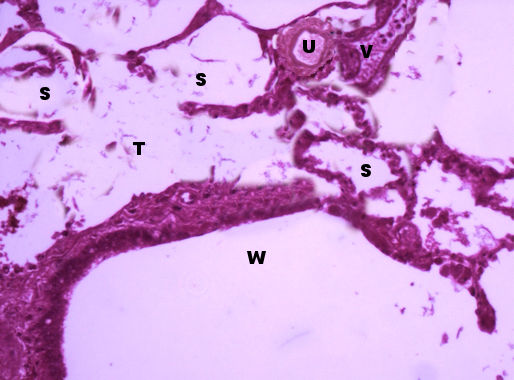
    lung numbered.jpg

    Image credit

    “Lung histology - Digestive Organs Atlas" by John Polos, is licensed under CC BY-NC-SA 4.0.

    Answer Key (click to show/hide answers)

    S - Alveoli
    T - Alveolar duct
    U - Small artery
    V - Small vein
    W - Respiratory bronchus
     

    Cadaver


    To view a larger version, right click (PC) or command click (Mac) and click open in new tab.

    Anterior view of the neck showing respiratory structures.

    Image credit

    “ Anterior Neck" provided by the regents of the University of Michigan and shared under CC 4.0 . Labeled by John Polos.

    Answer Key (click to show/hide answers)

    A - Hyoid bone
    B - Thyrohyoid membrane
    C - Thyroid cartilage 
    D - Laryngeal prominence 
    E - Cricoid cartilage
    F - Trachea
     

    Posterior view of trachea and larynx.

    Image credit

    “ Posterior larynx" provided by the regents of the University of Michigan and shared under CC 4.0 . Labeled by John Polos.

    Answer Key (click to show/hide answers)

    A - Epiglottis
    B - Thyroid cartilage/thyroid lamina
    C - Cricoid cartilage
    D - Trachea
     

    Larynx model superior anterior and posterior

    Image credit

    “ Thoracic cavity" provided by the regents of the University of Michigan and shared under CC 4.0 . Labeled by John Polos.

    Answer Key (click to show/hide answers)

    A - Larynx
    B - Trachea
    C - Right primary bronchus 
    D - Left primary bronchus
    E - Right secondary bronchus (inferior)

    Anterior  view of the lungs showing the lungs and heart

    Image credit

    “ Anterior lungs" provided by the regents of the University of Michigan and shared under CC 4.0 . Labeled by John Polos.

    Answer Key (click to show/hide answers)

    A - Horizontal fissure of right lung
    B - Cardiac notch of left lung
    C - Lingula of left lung
     

    Lateral view of a cadaver's lungs with landmarks lettered.

    Image credit

    “ Lateral Lungs" provided by the regents of the University of Michigan and shared under CC 4.0 . Labeled by John Polos.

    Answer Key (click to show/hide answers)

    A - Apex right lung
    B - Apex left lung
    C - Oblique fissure right lung 
    D - Oblique fissure left lung
    E - Horizontal fissure right lung
    F - Base right lung
    G - Base left lung
     

    This page titled 20.6: Anatomical Atlas - Respiratory System was last modified on Fri, 07 Aug 2026 18:33:11 GMT and is shared under a CC BY-NC-SA 4.0 license and was authored, remixed, and/or curated by Jennifer Lange et al..

    • Was this article helpful?