

10.4: Nutrient Needs for Athletes
- Page ID
- 152684

\( \newcommand{\vecs}[1]{\overset { \scriptstyle \rightharpoonup} {\mathbf{#1}} } \)
\( \newcommand{\vecd}[1]{\overset{-\!-\!\rightharpoonup}{\vphantom{a}\smash {#1}}} \)
\( \newcommand{\dsum}{\displaystyle\sum\limits} \)
\( \newcommand{\dint}{\displaystyle\int\limits} \)
\( \newcommand{\dlim}{\displaystyle\lim\limits} \)
\( \newcommand{\id}{\mathrm{id}}\) \( \newcommand{\Span}{\mathrm{span}}\)
( \newcommand{\kernel}{\mathrm{null}\,}\) \( \newcommand{\range}{\mathrm{range}\,}\)
\( \newcommand{\RealPart}{\mathrm{Re}}\) \( \newcommand{\ImaginaryPart}{\mathrm{Im}}\)
\( \newcommand{\Argument}{\mathrm{Arg}}\) \( \newcommand{\norm}[1]{\| #1 \|}\)
\( \newcommand{\inner}[2]{\langle #1, #2 \rangle}\)
\( \newcommand{\Span}{\mathrm{span}}\)
\( \newcommand{\id}{\mathrm{id}}\)
\( \newcommand{\Span}{\mathrm{span}}\)
\( \newcommand{\kernel}{\mathrm{null}\,}\)
\( \newcommand{\range}{\mathrm{range}\,}\)
\( \newcommand{\RealPart}{\mathrm{Re}}\)
\( \newcommand{\ImaginaryPart}{\mathrm{Im}}\)
\( \newcommand{\Argument}{\mathrm{Arg}}\)
\( \newcommand{\norm}[1]{\| #1 \|}\)
\( \newcommand{\inner}[2]{\langle #1, #2 \rangle}\)
\( \newcommand{\Span}{\mathrm{span}}\) \( \newcommand{\AA}{\unicode[.8,0]{x212B}}\)
\( \newcommand{\vectorA}[1]{\vec{#1}} % arrow\)
\( \newcommand{\vectorAt}[1]{\vec{\text{#1}}} % arrow\)
\( \newcommand{\vectorB}[1]{\overset { \scriptstyle \rightharpoonup} {\mathbf{#1}} } \)
\( \newcommand{\vectorC}[1]{\textbf{#1}} \)
\( \newcommand{\vectorD}[1]{\overrightarrow{#1}} \)
\( \newcommand{\vectorDt}[1]{\overrightarrow{\text{#1}}} \)
\( \newcommand{\vectE}[1]{\overset{-\!-\!\rightharpoonup}{\vphantom{a}\smash{\mathbf {#1}}}} \)
\( \newcommand{\vecs}[1]{\overset { \scriptstyle \rightharpoonup} {\mathbf{#1}} } \)
\(\newcommand{\longvect}{\overrightarrow}\)
\( \newcommand{\vecd}[1]{\overset{-\!-\!\rightharpoonup}{\vphantom{a}\smash {#1}}} \)
\(\newcommand{\ket}[1]{\left| #1 \right>}\)
\(\newcommand{\bra}[1]{\left< #1 \right|}\)
\(\newcommand{\braket}[2]{\left< #1 \vphantom{#2} \right| \left. #2 \vphantom{#1} \right>}\)
\(\newcommand{\braopket}[3]{\left< #1 \vphantom{#2}\vphantom{#3} \right| #2 \vphantom{#1}\vphantom{#3} \left| #3 \vphantom{#1}\vphantom{#2} \right>}\)
\(\newcommand{\qmvec}[1]{\mathbf{\vec{#1}}}\)
\(\newcommand{\op}[1]{\hat{\mathbf{#1}}}\)
\(\newcommand{\expect}[1]{\langle #1 \rangle}\)
\(\newcommand{\dfn}[1]{\emph{\textbf{#1}}}\)
Nutrition is essential to your performance during all types of exercise. As an athlete, the foods consumed in your diet are used to provide the body with enough energy and specific nutrients to fuel an activity and maximize performance. Athletes have different nutritional needs than the general population in order to support their vigorous activity levels in both practice and competition. On this page, we’ll explore the specific nutrient needs of athletes and how they differ from the nutrient needs of less active individuals.

Energy Needs
To determine an athlete’s nutritional needs, it is important to revisit the concept of energy metabolism. Energy intake is the foundation of an athlete’s diet, because it supports optimal body functions, affects intake of macronutrients and micronutrients, and assists in maintaining body composition. Energy needs for athletes increase depending on their energy expenditure. The amount of energy expended during physical activity is contingent on the intensity, duration, and frequency of the exercise. Competitive athletes may need 3,000 to over 5,000 calories daily compared to a typical inactive individual who needs about 2,000 calories per day. Energy needs are also affected by an individual’s sex, age, and weight. Weight-bearing exercises, such as running, burn more calories per hour than non-weight-bearing exercises, such as swimming, since weight-bearing exercises require your body to move against gravity. Additionally, men typically burn more calories than women for the same activity, because men have more muscle mass which requires more energy to support and move around.
Macronutrient Needs
The composition of macronutrients in the diet is a key factor in maximizing performance for athletes. As discussed on the previous page, carbohydrates, fat, and protein can all be utilized for energy production during exercise, though the amount utilized of each nutrient varies depending on the intensity and duration of the exercise.
Carbohydrates
Carbohydrates are an important fuel source for the brain and muscle during exercise. Carbohydrate storage in the liver and muscle is relatively limited, and therefore it is important for athletes to regularly consume enough carbohydrates from their diet. Carbohydrate needs should increase about 3-10 g/kg/day depending on the athlete’s type and level of training and competition (Table 10.3.).1
|
Activity Level |
Example of Exercise |
Increase of Carbohydrate (g/kg of athlete’s body weight/day) |
|---|---|---|
|
Light |
Low-intensity or skill-based activities |
3-5 |
|
Moderate |
Moderate exercise program (about 1 hour/day) |
5-7 |
|
High |
Endurance program (about 1-3 hours/day of moderate to high intensity exercise) |
6-10 |
|
Very high |
Extreme commitment (4-5 hours/day of moderate to high intensity exercise) |
8-12 |
Fat
Fat is a necessary component of a healthy diet to provide energy and essential fatty acids and to facilitate the absorption of fat-soluble vitamins. Athletes are recommended to consume the same amount of fat in the diet as the general population, 20 to 35% of their energy intake. Although these recommendations are in accordance with public health guidelines, athletes should individualize their needs based on their training level and body composition goals. Fat intakes below 20% of energy intake will reduce the availability of fat-soluble vitamins and essential fatty acids, especially omega-3 fatty acids.
Protein
Although protein accounts for only about 5% of energy expended, dietary protein is necessary to support metabolic reactions that generate ATP, which rely heavily on proteins such as enzymes and transport proteins. Additional protein also helps muscles with maintenance, growth, and repair. For these reasons, athletes have higher protein needs than the general population. It is recommended that athletes consume 1.2 to 2.0 g/kg/day of protein in order to support these functions. Higher intakes may also be needed for short periods of intense training or when reducing energy intake.1
It is important to consume adequate amounts of protein and to understand that the quality of the protein consumed affects the amount needed. Complete protein foods such as meats, dairy, and eggs contain all of the essential amino acids in relative amounts that most efficiently meet the body’s needs for growth, maintenance, and repair of muscles. Vegetarian diets contain mostly incomplete protein sources, which have lower digestibility and amino acid patterns that do not match human needs as closely as most animal proteins. To compensate for this, vegetarian athletes need to consume more dietary protein than non-vegetarians and should target the upper end of the recommended protein intake.
In addition to the amount and quality of proteins consumed, timing of protein intake has been shown to impact muscle protein synthesis. Studies show that the synthesis of muscle protein is optimized with high quality protein consumption after exercise, ideally 15 to 25 grams of protein in the early recovery phase after a workout (0-2 hours after exercise). A similar amount of protein should be consumed every 3-5 hours, spread out across the day over multiple meals within the 24 hours post-workout, so that amino acids are always available for optimal protein synthesis.2 One recommended strategy is to aim for 0.4 g/kg/meal across four meals in order to reach 1.6 g/kg/day for muscle synthesis.3
Although athletic training increases protein needs, athletes can meet their protein requirement through high quality food sources, and most do not need to consume protein supplements. Here are some examples of snacks or small meals that contain at least 15 to 25 grams of protein4:
- ½ cup of granola plus ¼ cup almonds (16 grams protein)
- 7 oz. Greek yogurt (20 grams protein)
- Peanut butter sandwich (20 grams protein)
- 2 scrambled eggs and 1 cup of milk (20 grams protein)
- 3 oz. canned tuna (½ can) with ½ cup crackers (22 grams protein)
- Turkey and cheese sandwich (32 grams protein)

These whole food options have the benefit of coming packaged with other nutrients, including carbohydrates to replenish glycogen stores, fiber, and micronutrients, and are often less costly than most protein supplements. Like all dietary supplements, protein shakes and other supplements are not well-regulated; some contain unnecessary additives such as sweeteners and herbs, and some have been found to contain unsafe levels of heavy metals like arsenic and mercury. Protein supplements do have the benefit of being convenient and shelf-stable. If you choose to use a protein supplement, look for one certified by a third-party testing organization and with a simple ingredient list.5
Micronutrient Needs
Vitamins and minerals are essential for energy metabolism, the delivery of oxygen, protection against oxidative damage, and the repair of body structures. When exercise increases, the amounts of many vitamins and minerals needed are also increased. Currently, there are no special micronutrient recommendations for athletes, but most athletes will meet their needs by consuming a balanced diet that meets their energy needs. Because the energy needs of athletes increase, they often meet their higher need for vitamins and minerals through the additional food they consume to meet energy needs. However, athletes who limit energy intake or utilize extreme weight-loss practices may put themselves at risk for vitamin and mineral deficiencies.
A Word on Dietary Supplements and Ergogenic Aids
Many athletes consider taking dietary supplements or ergogenic aids(i.e., substances used to enhance performance) in an effort to improve performance, increase energy levels, or make up for poor nutrition choices. However, it is important to remember that supplements and ergogenic aids are not regulated, leading to frequent use of false advertising and unsubstantiated claims by the supplement industry. Athletes must be careful not only in deciphering the claims of products, but also in researching their safety and efficacy, particularly in relation to any rules and regulations that govern the sport in which the athlete participates. Very few supplements that claim to have ergogenic benefits have sound evidence to back up those claims, and in some situations, consuming them could be dangerous. Most athletes can meet their nutrition needs without added supplements. Athletes who have nutrition concerns should consult with a sports dietitian or other sport science professional to make sure their individual needs are met safely.
Water and Electrolyte Needs
During exercise, being appropriately hydrated contributes to performance. Water is needed to cool the body, transport oxygen and nutrients, and remove waste products from the muscles. Water needs are increased during exercise due to the extra water losses through evaporation and sweat. Dehydration can occur when there are inadequate water levels in the body and can be very hazardous to the health of an individual. As the severity of dehydration increases, the exercise performance of an individual will begin to decline (see Figure 10.6). It is important to continue to consume water before, during, and after exercise to avoid dehydration as much as possible.
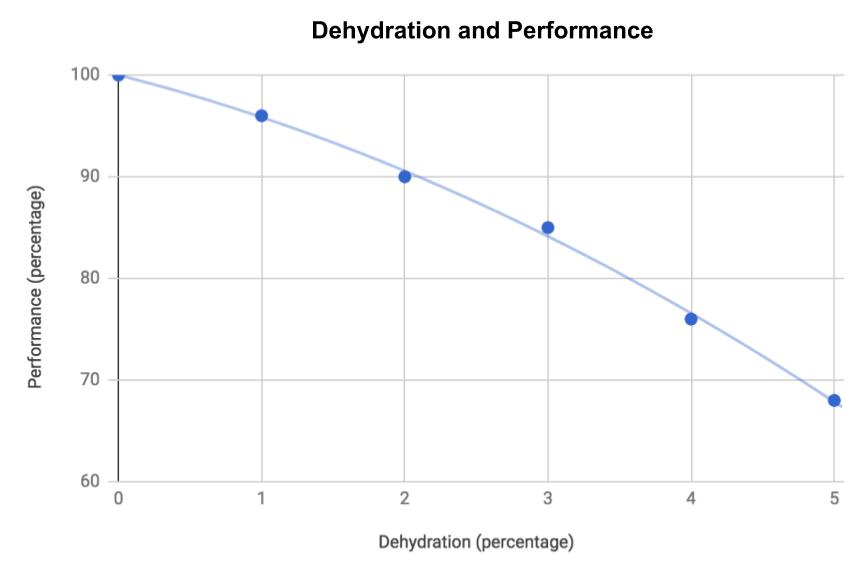
During exercise, thirst is not a reliable short-term indicator of the body’s water needs, as it typically is not enough to replace the water lost. Even with constant replenishing of water throughout a workout, it may not be possible to drink enough water to compensate for the losses. Dehydration occurs when water loss is so significant that total blood volume decreases, which leads to a reduction in oxygen and nutrients transported to the muscle cells. A decreased blood volume also reduces blood flow to the skin and the production of sweat, which can increase body temperature. As a result, the risk of heat-related illnesses such as heat exhaustion or heat stroke, increases. The external temperature during exercise can also play a role in the risk of heat-related illnesses. As the external temperature increases, it becomes more difficult for the body to dissipate heat. As humidity also increases, the body is unable to cool itself through evaporation.
Hyponatremia and Sports Drinks

Sweating during exercise helps our bodies to stay cool. Sweat consists of mostly water, but it also causes losses of sodium, potassium, calcium and magnesium. During most types of exercise, the amount of sodium lost is very small, and drinking water after a workout will replenish the sodium in the body. However, during long endurance exercises, such as a marathon or triathlon, sodium losses are larger and must be replenished. If water is replenished without sodium, the sodium already in the body will become diluted. These low levels of sodium in the blood will cause a condition known as hyponatremia. When sodium levels in the blood are decreased, water moves into cells through osmosis, which causes swelling. Accumulation of fluid in the lungs and the brain can cause serious, life-threatening conditions such as seizure, coma, and death (see Unit 9).
In order to avoid hyponatremia, athletes should increase their consumption of sodium in the days leading up to an event and consume sodium-containing sports drinks during their race or event. A well-concocted sports drink contains sugar, water, and sodium in the correct proportions so that hydration is optimized. The sugar is helpful in maintaining blood-glucose levels needed to fuel muscles, the water keeps an athlete hydrated, and the sodium enhances fluid absorption and replaces some of that lost in sweat. The American College of Sports Medicine states that the goal of drinking fluids during exercise is to prevent dehydration, which compromises performance and endurance.
Note: The nutrition profile of commercial sports drinks is 50 to 70 calories per 8 ounces, with about 110 milligrams of sodium. Following is a simple recipe that offers this profile, but at a much lower cost than expensive store-bought brands—without additives, colors, or preservatives.
Ingredients:
¼ cup (50 g) sugar
¼ teaspoon salt
¼ cup (60 ml) water
¼ cup (60 ml) orange juice (not concentrate) plus 2 tablespoons lemon juice
3 ½ cups (840 ml) cold water
Method:
- In the bottom of a pitcher, dissolve the sugar and salt in the hot water.
- Add the juice and the remaining water; chill.
- Quench that thirst!
Yield: 1 quart (1 L)
Nutrition Information: 200 total calories; 50 calories per 8 ounces (240 ml); 12 g carbohydrate; 110 mg sodium
Reprinted with permission from N. Clark, Nancy Clark’s Sports Nutrition Guidebook, 6th ed. (Champaign, IL: Human Kinetics, 2020), 454.
Who Needs Sports Drinks?
Scientific studies show that, under certain circumstances, consuming sports drinks (instead of plain water) during high-intensity exercise lasting longer than one hour significantly enhances endurance, and some evidence also indicates it enhances performance. There is no consistent evidence that drinking sports drinks instead of plain water enhances endurance or performance in individuals exercising less than one hour at a time and at low to moderate intensities. Children and adult athletes exercising for more than one hour at high-intensity (tennis, rowing, rugby, soccer, etc.) may benefit from consuming a sports drink rather than water. However, consuming sports drinks provides no benefit over water to endurance, performance, or exercise recovery for those exercising less than an hour. In fact, as with all other sugary drinks containing few to no nutrients, they are only another source of calories. Drinking sports drinks when you are doing no exercise at all is not recommended.
Self-Check:
Query \(\PageIndex{1}\)
Attributions:
- University of Hawai‘i at Mānoa Food Science and Human Nutrition Program. (2018). Performance Nutrition. Human Nutrition. pressbooks.oer.hawaii.edu/humannutrition/chapter/introduction-11/
References:
- 1Thomas, D. T., Erdman, K. A., & Burke, L. M. (2016). Position of the Academy of Nutrition and Dietetics, Dietitians of Canada, and the American College of Sports Medicine: nutrition and athletic performance. Journal of the Academy of Nutrition and Dietetics, 116(3), 501-528.
- 2Kerksick, C. M., Arent, S., Schoenfeld, B. J., Stout, J. R., Campbell, B., Wilborn, C. D., … & Willoughby, D. (2017). International society of sports nutrition position stand: nutrient timing. Journal of the International Society of Sports Nutrition, 14(1), 1-21.
- 3Schoenfeld, B. J., & Aragon, A. A. (2018). How much protein can the body use in a single meal for muscle-building? Implications for daily protein distribution. Journal of the International Society of Sports Nutrition, 15(1), 1-6.
- 4U.S. Department of Agriculture. (n.d.). FoodData Central. Retrieved September 9, 2020, from https://fdc.nal.usda.gov/
- 5Gelsomin, E. (2020, March 9). The scoop on protein powder. Harvard Health Blog. https://www.health.harvard.edu/blog/the-scoop-on-protein-powder-2020030918986
Image Credits:
- Training table photo by Shayda Torabi on Unsplash (license information)
- Table 10.3. “Athlete’s daily needs for carbohydrate” by Heather Leonard is licensed under CC BY-NC-SA 2.0
- Parfait photo by amirali mirhashemian on Unsplash (license information)
- Figure 10.6. “Dehydration’s Effect on Exercise Performance” by Allison Calabrese is licensed under CC BY 4.0
- Drinking water photo by Damir Spanic on Unsplash (license information)