

2.2.1: Types of Biological Macromolecules
- Page ID
- 90493

\( \newcommand{\vecs}[1]{\overset { \scriptstyle \rightharpoonup} {\mathbf{#1}} } \)
\( \newcommand{\vecd}[1]{\overset{-\!-\!\rightharpoonup}{\vphantom{a}\smash {#1}}} \)
\( \newcommand{\dsum}{\displaystyle\sum\limits} \)
\( \newcommand{\dint}{\displaystyle\int\limits} \)
\( \newcommand{\dlim}{\displaystyle\lim\limits} \)
\( \newcommand{\id}{\mathrm{id}}\) \( \newcommand{\Span}{\mathrm{span}}\)
( \newcommand{\kernel}{\mathrm{null}\,}\) \( \newcommand{\range}{\mathrm{range}\,}\)
\( \newcommand{\RealPart}{\mathrm{Re}}\) \( \newcommand{\ImaginaryPart}{\mathrm{Im}}\)
\( \newcommand{\Argument}{\mathrm{Arg}}\) \( \newcommand{\norm}[1]{\| #1 \|}\)
\( \newcommand{\inner}[2]{\langle #1, #2 \rangle}\)
\( \newcommand{\Span}{\mathrm{span}}\)
\( \newcommand{\id}{\mathrm{id}}\)
\( \newcommand{\Span}{\mathrm{span}}\)
\( \newcommand{\kernel}{\mathrm{null}\,}\)
\( \newcommand{\range}{\mathrm{range}\,}\)
\( \newcommand{\RealPart}{\mathrm{Re}}\)
\( \newcommand{\ImaginaryPart}{\mathrm{Im}}\)
\( \newcommand{\Argument}{\mathrm{Arg}}\)
\( \newcommand{\norm}[1]{\| #1 \|}\)
\( \newcommand{\inner}[2]{\langle #1, #2 \rangle}\)
\( \newcommand{\Span}{\mathrm{span}}\) \( \newcommand{\AA}{\unicode[.8,0]{x212B}}\)
\( \newcommand{\vectorA}[1]{\vec{#1}} % arrow\)
\( \newcommand{\vectorAt}[1]{\vec{\text{#1}}} % arrow\)
\( \newcommand{\vectorB}[1]{\overset { \scriptstyle \rightharpoonup} {\mathbf{#1}} } \)
\( \newcommand{\vectorC}[1]{\textbf{#1}} \)
\( \newcommand{\vectorD}[1]{\overrightarrow{#1}} \)
\( \newcommand{\vectorDt}[1]{\overrightarrow{\text{#1}}} \)
\( \newcommand{\vectE}[1]{\overset{-\!-\!\rightharpoonup}{\vphantom{a}\smash{\mathbf {#1}}}} \)
\( \newcommand{\vecs}[1]{\overset { \scriptstyle \rightharpoonup} {\mathbf{#1}} } \)
\(\newcommand{\longvect}{\overrightarrow}\)
\( \newcommand{\vecd}[1]{\overset{-\!-\!\rightharpoonup}{\vphantom{a}\smash {#1}}} \)
\(\newcommand{\ket}[1]{\left| #1 \right>}\)
\(\newcommand{\bra}[1]{\left< #1 \right|}\)
\(\newcommand{\braket}[2]{\left< #1 \vphantom{#2} \right| \left. #2 \vphantom{#1} \right>}\)
\(\newcommand{\braopket}[3]{\left< #1 \vphantom{#2}\vphantom{#3} \right| #2 \vphantom{#1}\vphantom{#3} \left| #3 \vphantom{#1}\vphantom{#2} \right>}\)
\(\newcommand{\qmvec}[1]{\mathbf{\vec{#1}}}\)
\(\newcommand{\op}[1]{\hat{\mathbf{#1}}}\)
\(\newcommand{\expect}[1]{\langle #1 \rangle}\)
\(\newcommand{\dfn}[1]{\emph{\textbf{#1}}}\)
Biological macromolecules, the large molecules necessary for life, include carbohydrates, lipids, nucleic acids, and proteins.
- Define the terms organic compound and macromolecule, and compare an organic compound with an inorganic compound.
- Distinguish between monomers and polymers.
- Identify the four major classes of biological macromolecules.
Introduction to the Types of Biological Macromolecules
All living matter, as well as the parts, products, and remains of living organisms, is composed of organic compounds. These organic compounds consist of large molecules, commonly referred to as biological macromolecules or, more simply, as biomolecules. The main thing that makes these molecules special is that they always contain carbon atoms (C) as well as hydrogen atoms (H) attached to the carbon. Think of the carbon atoms as the “backbone” of these molecules — like the spine in your body. Hydrogen atoms are attached to the carbon, like arms or legs. In addition, different organic compounds may be joined by other elements, such as oxygen (O), nitrogen (N), or phosphorus (P) to name just a few.
This means that you, other animals, plants, bacteria, and fungi are all remarkably similar at the molecular level, being constructed from variations of the same types of biomolecules.
In short:
-
Organic compounds: Carbon-based molecules that typically contain carbon-hydrogen bonds and form the backbone of living organisms, including carbohydrates, lipids, proteins, and nucleic acids.
-
Biological macromolecules (biomolecules) are large, complex molecules that serve as the building blocks of living things.
-
All organisms — from humans to bacteria — are fundamentally similar at the molecular level, despite their visible differences.
-
-
Inorganic compounds: Molecules that generally do not contain carbon-hydrogen bonds and include essential substances like water, salts, acids, and bases.
-
Carbon dioxide (CO₂): Even though it has carbon, it does not have hydrogen, so it is not organic.
-
Water (H₂O): It has hydrogen, but not carbon, so it is not organic.
-
Salt (sodium chloride, NaCl): It does not have carbon or hydrogen, so it not organic.
-
Monomers vs. Polymers
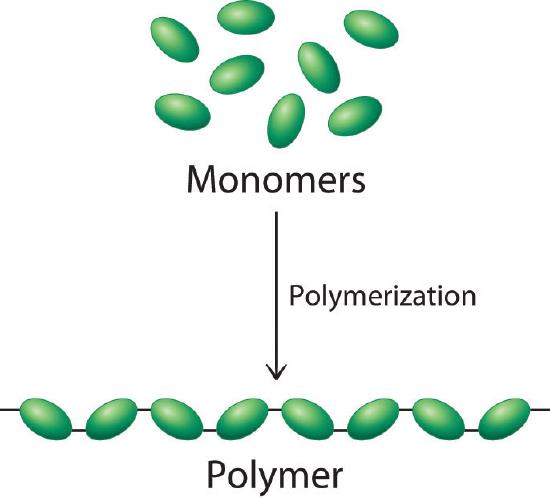 As you have seen, biomolecules are the VIPs of cell structure and function. Most of the big, important molecules in living things (called macromolecules) are actually polymers, which means they are made by snapping together lots of smaller, repeating units (building blocks) called monomers. Think of monomers as the Lego bricks of life: simple on their own, but incredibly powerful when combined in creative ways.
A great real-life example? Proteins. These essential polymer molecules are made by linking together long chains of amino acids, which are their monomers. You have only 20 types of amino acids to work with, yet your body can combine them in thousands of different ways to build everything from enzymes that speed up chemical reactions to structural proteins like keratin in your hair and nails. It is like making everything from a paperclip to a jet engine using just 20 kinds of building blocks.
You can also see this concept with carbohydrates. Table sugar (sucrose) is a disaccharide (a small polymer) made of two monomers: glucose and fructose. Link more sugar monomers together and you get polysaccharides like starch (found in potatoes and pasta) or glycogen (found in your muscle cells). The prefixes help you keep track: “mono-” means one, “di-” means two, and “poly-” means many.
In the image on the right, you can see the sucrose molecule (commonly known as table sugar): The two monosaccharides (glucose on the left and fructose on the right), both simple sugars/carbohydrates are joined to make the disaccharide sucrose.
In the image below, you can see polymers that are made up of the monomers glucose:
Amylose (upper left) forms a single chain and amylopectin (below it) is a branched chain. They are the two important polymers that make up starch. Starch is a polymer of glucose found in plants. You can see that glycogen, also a polymer of glucose — but in animals — is even more highly branched than amylopectin. Starch and glycogen are used for energy storage. Finally, cellulose, again a polymer of glucose, has every other glucose monomer upside down.

Interactive Polymerization Reaction Chamber:
The Four Major Classes of Biological Macromolecules
Cells may be tiny, but they are packed with some pretty amazing molecules that keep everything running smoothly. These molecules fall into four major categories:
-
Carbohydrates (COHs): A broad class of biomolecules that includes monosaccharides (the simplest sugars, e.g. glucose and fructose); disaccharides (two sugars linked together, e.g. sucrose = glucose + fructose); and polysaccharides (complex COHs made up of long chains of many sugar units, e.g. starch, glycogen, cellulose).
-
Lipids: A diverse group of hydrophobic biomolecules that includes fats (triglycerides, used for long-term energy storage), phospholipids (major components of cell membranes), and steroids (such as cholesterol and hormones). Unlike carbohydrates, lipids are not built from repeating monomer units but are typically made from fatty acids and glycerol.
-
Nucleic Acids: Two types of biomolecules that store and transmit genetic information. They include DNA (deoxyribonucleic acid), which holds the instructions for building proteins, and RNA (ribonucleic acid), which helps carry out those instructions. Nucleic acids are made up of nucleotide monomers, each consisting of a sugar, a phosphate group, and a nitrogenous base.
-
Proteins: A wide array of large, complex biomolecules made up of amino acid monomers linked in specific sequences. Proteins can be fibrous (providing structural support, e.g. collagen) or globular (involved in dynamic functions like enzymes, hormones, and antibodies). The unique shape of a protein determines its specific function within the body, from muscle contraction to cell signaling.
Each group plays a unique and essential role in human biology, whether it is providing energy, building structures, storing information, or helping chemical reactions happen at lightning speed. Without a steady supply of these biomolecules in your diet, cells simply could not do their jobs — and you could not function.
Together, these four types of macromolecules make up most of a cell’s dry mass (meaning everything except water). But since cells are mostly water by weight, all these important molecules are essentially floating in an aqueous (water-based) environment. Every reaction that happens in your body, whether you are breathing, blinking, or binge-watching your favorite show, is happening in water and depends on the teamwork of these four molecular VIPs.
Image below: Living organisms are made up of chemical building blocks: All organisms are composed of a variety of these biological macromolecules. Nutrients are the molecules that living organisms require for survival and growth but that animals and plants cannot synthesize all by themselves. Animals obtain nutrients by consuming food, while plants pull nutrients from soil.
Image below:

Figure \(\PageIndex{1}\): Biological Macromolecules (or Biomolecules). Living organisms are made up of chemical building blocks known as biomolecules. All organisms contain a variety of these essential molecules.