

2.10: Passive Movements across the Cell Membrane — Simple Diffusion
- Page ID
- 90503

\( \newcommand{\vecs}[1]{\overset { \scriptstyle \rightharpoonup} {\mathbf{#1}} } \)
\( \newcommand{\vecd}[1]{\overset{-\!-\!\rightharpoonup}{\vphantom{a}\smash {#1}}} \)
\( \newcommand{\dsum}{\displaystyle\sum\limits} \)
\( \newcommand{\dint}{\displaystyle\int\limits} \)
\( \newcommand{\dlim}{\displaystyle\lim\limits} \)
\( \newcommand{\id}{\mathrm{id}}\) \( \newcommand{\Span}{\mathrm{span}}\)
( \newcommand{\kernel}{\mathrm{null}\,}\) \( \newcommand{\range}{\mathrm{range}\,}\)
\( \newcommand{\RealPart}{\mathrm{Re}}\) \( \newcommand{\ImaginaryPart}{\mathrm{Im}}\)
\( \newcommand{\Argument}{\mathrm{Arg}}\) \( \newcommand{\norm}[1]{\| #1 \|}\)
\( \newcommand{\inner}[2]{\langle #1, #2 \rangle}\)
\( \newcommand{\Span}{\mathrm{span}}\)
\( \newcommand{\id}{\mathrm{id}}\)
\( \newcommand{\Span}{\mathrm{span}}\)
\( \newcommand{\kernel}{\mathrm{null}\,}\)
\( \newcommand{\range}{\mathrm{range}\,}\)
\( \newcommand{\RealPart}{\mathrm{Re}}\)
\( \newcommand{\ImaginaryPart}{\mathrm{Im}}\)
\( \newcommand{\Argument}{\mathrm{Arg}}\)
\( \newcommand{\norm}[1]{\| #1 \|}\)
\( \newcommand{\inner}[2]{\langle #1, #2 \rangle}\)
\( \newcommand{\Span}{\mathrm{span}}\) \( \newcommand{\AA}{\unicode[.8,0]{x212B}}\)
\( \newcommand{\vectorA}[1]{\vec{#1}} % arrow\)
\( \newcommand{\vectorAt}[1]{\vec{\text{#1}}} % arrow\)
\( \newcommand{\vectorB}[1]{\overset { \scriptstyle \rightharpoonup} {\mathbf{#1}} } \)
\( \newcommand{\vectorC}[1]{\textbf{#1}} \)
\( \newcommand{\vectorD}[1]{\overrightarrow{#1}} \)
\( \newcommand{\vectorDt}[1]{\overrightarrow{\text{#1}}} \)
\( \newcommand{\vectE}[1]{\overset{-\!-\!\rightharpoonup}{\vphantom{a}\smash{\mathbf {#1}}}} \)
\( \newcommand{\vecs}[1]{\overset { \scriptstyle \rightharpoonup} {\mathbf{#1}} } \)
\(\newcommand{\longvect}{\overrightarrow}\)
\( \newcommand{\vecd}[1]{\overset{-\!-\!\rightharpoonup}{\vphantom{a}\smash {#1}}} \)
\(\newcommand{\ket}[1]{\left| #1 \right>}\)
\(\newcommand{\bra}[1]{\left< #1 \right|}\)
\(\newcommand{\braket}[2]{\left< #1 \vphantom{#2} \right| \left. #2 \vphantom{#1} \right>}\)
\(\newcommand{\braopket}[3]{\left< #1 \vphantom{#2}\vphantom{#3} \right| #2 \vphantom{#1}\vphantom{#3} \left| #3 \vphantom{#1}\vphantom{#2} \right>}\)
\(\newcommand{\qmvec}[1]{\mathbf{\vec{#1}}}\)
\(\newcommand{\op}[1]{\hat{\mathbf{#1}}}\)
\(\newcommand{\expect}[1]{\langle #1 \rangle}\)
\(\newcommand{\dfn}[1]{\emph{\textbf{#1}}}\)
Diffusion is a process of passive transport in which molecules move from an area of higher concentration to one of lower concentration.
- Explain the principles of passive transport and describe how molecules move in relation to a concentration gradient, including what happens when dynamic equilibrium is reached.
- Identify the key factors that influence the movement of substances across the cell membrane.
- Explain the process of simple diffusion.
- Apply diffusion principles to real-life physiological scenarios, such as gas exchange in the lungs, dehydration, and filtration in the kidneys.
What is Diffusion?
Diffusion is the passive movement of molecules from an area of high concentration to an area of low concentration. In other words: diffusion happens down a concentration gradient. It continues until the substance is evenly spread out.
Once equilibrium is reached, molecules still move, but there is no net movement in any one direction. This is called a dynamic equilibrium.
Each type of particle will diffuse at its own rate, depending on the steepness of its individual concentration gradient.
After a substance has finished diffusing and is evenly spread throughout a space, its concentration gradient disappears. But that does not mean the molecules stop moving! In fact, molecules are always in motion because of their inherent kinetic energy — they constantly jiggle, bump, and slide past one another. Even without a concentration gradient, they keep moving randomly in all directions.
What changes is that there is no longer a net movement of molecules from one area to another. This balance is called dynamic equilibrium: molecules continue to move, but because their concentrations are equal everywhere, the number of molecules moving in one direction is matched by the number moving the opposite way. So the overall distribution stays the same, even though individual molecules are still active.
A classic example of diffusion is a drop of food coloring spreading through a glass of water. The coloring moves from where it is highly concentrated to where it is not, until it is evenly distributed (see image below).

Figure \(\PageIndex{1}\): Diffusion in a water glass — One very easy diffusion demonstration is to pour a few drops of food coloring into a glass of water and watch as the color spreads through the glass.
When someone is cooking food in a kitchen, the smell begins to waft through the house, and eventually everyone can tell what’s for dinner! This is due to the diffusion of odor molecules through the air, from an area of high concentration (the kitchen) to areas of low concentration (your upstairs bedroom).
Diffusion is a passive process of transport. A single substance tends to move from an area of high concentration to an area of low concentration until the concentration is equal across a space. You are familiar with diffusion of substances through the air. For example, think about someone opening a bottle of ammonia in a room filled with people. The ammonia gas is at its highest concentration in the bottle; its lowest concentration is at the edges of the room. The ammonia vapor will diffuse, or spread away, from the bottle; gradually, more and more people will smell the ammonia as it spreads. Materials move within the cell ‘s cytosol by diffusion, and certain materials move through the plasma membrane by diffusion. Diffusion expends no energy. On the contrary, concentration gradients are a form of potential energy, dissipated as the gradient is eliminated.
Diffusion across Cell Membranes
At this point, you know that diffusion means molecules move from where they are more concentrated to where they are less concentrated.
In the cells of our body, this process allows small molecules, like oxygen, carbon dioxide, ions, and some nutrients, to pass through the cell membrane without using energy. It is therefore a passive process, meaning it does not require energy — the particles move naturally, just by bouncing around due to their inherent kinetic energy. It is one of the main ways cells exchange materials with their environment to maintain balance and stay healthy.
️What Affects the Rate of Diffusion?
Within a system, there will be different rates of diffusion of the different substances in the medium:
-
Concentration Gradient
The bigger the difference in concentration, the faster diffusion happens. As the gradient evens out, diffusion slows down. -
Mass of Molecules
Heavier molecules move more slowly and therefore diffuse more slowly. Lighter molecules zip around faster and diffuse quicker. -
Temperature
Heat = energy! Higher temperatures give molecules more energy, so they move (and diffuse) faster. Colder temps slow things down. -
Solvent Density
A thick or crowded medium slows diffusion. Imagine trying to run through honey vs. water. For example, in dehydration, cells lose water and their cytoplasm becomes more dense, slowing diffusion inside the cell. That is one reason why dehydration can make you feel foggy or even faint—your neurons struggle to function when internal diffusion slows down. -
Solubility
Molecules that are nonpolar or lipid-soluble, like oxygen (O2) or carbon dioxide (CO2), move easily through the cell membrane and diffuse quickly. Polar or charged molecules have a harder time crossing. -
Membrane Surface Area & Thickness
A larger surface area = more diffusion! A thicker membrane = slower diffusion. -
Distance Traveled
The farther molecules have to go, the slower they move. This is one big reason cells are so small. If a cell gets too big, it takes too long for nutrients to get to the center—and the cell could die.
| Factor | How It Affects Diffusion |
|---|---|
| Concentration Gradient | Bigger differences cause faster diffusion; smaller differences slow it down as equilibrium is approached. |
| Molecule Size (Mass) | Larger molecules move more slowly; smaller ones diffuse faster. |
| Temperature | Higher temps = more energy = faster diffusion. Cold slows it down. |
| Solvent Density | A thick medium (like syrup) slows diffusion. Water is easier to move through. |
| Solubility | Lipid-soluble (nonpolar) molecules diffuse more easily across membranes. |
| Membrane Surface Area | More area = more places to cross = faster diffusion. |
| Membrane Thickness | Thicker membranes slow down diffusion. |
| Distance to Travel | The farther the distance, the slower the diffusion — this limits how big cells can grow. |

A healthy respiratory membrane is thin and moist, allowing gases to diffuse efficiently. Oxygen (O₂) moves from the alveoli into the bloodstream, while carbon dioxide (CO₂) moves from the blood into the alveoli to be exhaled.
However, in certain medical conditions, this vital diffusion process is disrupted:
-
In emphysema, the alveolar walls are damaged and break down. This reduces the total surface area available for gas exchange and makes the membrane less efficient. As a result, less oxygen gets into the blood, and carbon dioxide removal is impaired.
-
In pneumonia, the alveoli fill with fluid and inflammatory cells. This creates a physical barrier that thickens the respiratory membrane and blocks gas exchange. Oxygen cannot diffuse into the blood effectively, and carbon dioxide becomes trapped.
Both conditions make it difficult for oxygen to reach body tissues and for waste gases to be cleared. This can lead to shortness of breath, rapid breathing, fatigue, and dangerously low blood oxygen levels. These examples emphasize how critical diffusion across the respiratory membrane is to survival. We will get back to this when we cover the respiratory system.
Yet another example of how important diffusion is to homeostasis occurs during dehydration. When cells lose water, their cytoplasm becomes denser and more crowded, making it harder for molecules like ions, nutrients, and waste to move around. This slows diffusion and disrupts vital cell functions. The dehydration effect is especially dangerous in neurons, which depend on rapid molecular movement for communication and survival. When diffusion slows, brain function suffers, leading to symptoms like dizziness, confusion, and even coma in severe cases.
What About Filtration?
Filtration is like a turbocharged version of diffusion. Instead of just relying on concentration gradients, it also uses pressure to push materials through a membrane. This happens in your kidneys, where high blood pressure forces water and solutes out of the blood and into the tubules that make urine.
This makes the diffusion more efficient, but the downside is that too much pressure can push large proteins through the filter and into the urine. Proteins are normally not supposed to pass. That is why protein in the urine can be a warning sign of high blood pressure damaging your kidneys.
Simple Diffusion:
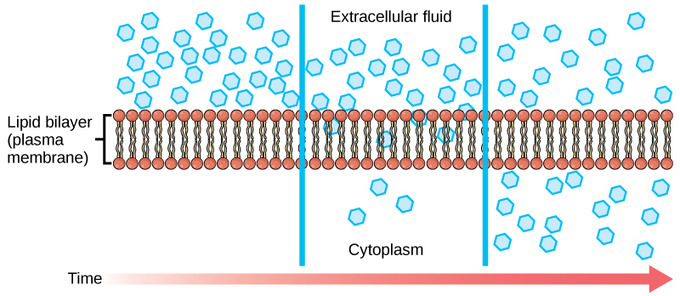
This is the most basic type of diffusion. It happens when small, lipid-soluble molecules move directly through the cell membrane from an area of higher concentration to an area of lower concentration. Because this process does not require any energy, it is called a form of passive transport.
As you have learned in this module, the plasma membrane is made of a lipid bilayer. That means only molecules that can mix with lipids can pass through easily. To do that, a molecule must be small and nonpolar (uncharged) — like oxygen and carbon dioxide. These molecules simply drift through the membrane until the concentration is equal on both sides, a state called equilibrium.
On the other hand, molecules that are not lipid-soluble — like polar, charged, or hydrophilic molecules — cannot pass through the membrane this way. They need help in the form of protein channels or carriers to cross the barrier.
