

5: Coloring
- Page ID
- 131187

\( \newcommand{\vecs}[1]{\overset { \scriptstyle \rightharpoonup} {\mathbf{#1}} } \)
\( \newcommand{\vecd}[1]{\overset{-\!-\!\rightharpoonup}{\vphantom{a}\smash {#1}}} \)
\( \newcommand{\dsum}{\displaystyle\sum\limits} \)
\( \newcommand{\dint}{\displaystyle\int\limits} \)
\( \newcommand{\dlim}{\displaystyle\lim\limits} \)
\( \newcommand{\id}{\mathrm{id}}\) \( \newcommand{\Span}{\mathrm{span}}\)
( \newcommand{\kernel}{\mathrm{null}\,}\) \( \newcommand{\range}{\mathrm{range}\,}\)
\( \newcommand{\RealPart}{\mathrm{Re}}\) \( \newcommand{\ImaginaryPart}{\mathrm{Im}}\)
\( \newcommand{\Argument}{\mathrm{Arg}}\) \( \newcommand{\norm}[1]{\| #1 \|}\)
\( \newcommand{\inner}[2]{\langle #1, #2 \rangle}\)
\( \newcommand{\Span}{\mathrm{span}}\)
\( \newcommand{\id}{\mathrm{id}}\)
\( \newcommand{\Span}{\mathrm{span}}\)
\( \newcommand{\kernel}{\mathrm{null}\,}\)
\( \newcommand{\range}{\mathrm{range}\,}\)
\( \newcommand{\RealPart}{\mathrm{Re}}\)
\( \newcommand{\ImaginaryPart}{\mathrm{Im}}\)
\( \newcommand{\Argument}{\mathrm{Arg}}\)
\( \newcommand{\norm}[1]{\| #1 \|}\)
\( \newcommand{\inner}[2]{\langle #1, #2 \rangle}\)
\( \newcommand{\Span}{\mathrm{span}}\) \( \newcommand{\AA}{\unicode[.8,0]{x212B}}\)
\( \newcommand{\vectorA}[1]{\vec{#1}} % arrow\)
\( \newcommand{\vectorAt}[1]{\vec{\text{#1}}} % arrow\)
\( \newcommand{\vectorB}[1]{\overset { \scriptstyle \rightharpoonup} {\mathbf{#1}} } \)
\( \newcommand{\vectorC}[1]{\textbf{#1}} \)
\( \newcommand{\vectorD}[1]{\overrightarrow{#1}} \)
\( \newcommand{\vectorDt}[1]{\overrightarrow{\text{#1}}} \)
\( \newcommand{\vectE}[1]{\overset{-\!-\!\rightharpoonup}{\vphantom{a}\smash{\mathbf {#1}}}} \)
\( \newcommand{\vecs}[1]{\overset { \scriptstyle \rightharpoonup} {\mathbf{#1}} } \)
\(\newcommand{\longvect}{\overrightarrow}\)
\( \newcommand{\vecd}[1]{\overset{-\!-\!\rightharpoonup}{\vphantom{a}\smash {#1}}} \)
\(\newcommand{\avec}{\mathbf a}\) \(\newcommand{\bvec}{\mathbf b}\) \(\newcommand{\cvec}{\mathbf c}\) \(\newcommand{\dvec}{\mathbf d}\) \(\newcommand{\dtil}{\widetilde{\mathbf d}}\) \(\newcommand{\evec}{\mathbf e}\) \(\newcommand{\fvec}{\mathbf f}\) \(\newcommand{\nvec}{\mathbf n}\) \(\newcommand{\pvec}{\mathbf p}\) \(\newcommand{\qvec}{\mathbf q}\) \(\newcommand{\svec}{\mathbf s}\) \(\newcommand{\tvec}{\mathbf t}\) \(\newcommand{\uvec}{\mathbf u}\) \(\newcommand{\vvec}{\mathbf v}\) \(\newcommand{\wvec}{\mathbf w}\) \(\newcommand{\xvec}{\mathbf x}\) \(\newcommand{\yvec}{\mathbf y}\) \(\newcommand{\zvec}{\mathbf z}\) \(\newcommand{\rvec}{\mathbf r}\) \(\newcommand{\mvec}{\mathbf m}\) \(\newcommand{\zerovec}{\mathbf 0}\) \(\newcommand{\onevec}{\mathbf 1}\) \(\newcommand{\real}{\mathbb R}\) \(\newcommand{\twovec}[2]{\left[\begin{array}{r}#1 \\ #2 \end{array}\right]}\) \(\newcommand{\ctwovec}[2]{\left[\begin{array}{c}#1 \\ #2 \end{array}\right]}\) \(\newcommand{\threevec}[3]{\left[\begin{array}{r}#1 \\ #2 \\ #3 \end{array}\right]}\) \(\newcommand{\cthreevec}[3]{\left[\begin{array}{c}#1 \\ #2 \\ #3 \end{array}\right]}\) \(\newcommand{\fourvec}[4]{\left[\begin{array}{r}#1 \\ #2 \\ #3 \\ #4 \end{array}\right]}\) \(\newcommand{\cfourvec}[4]{\left[\begin{array}{c}#1 \\ #2 \\ #3 \\ #4 \end{array}\right]}\) \(\newcommand{\fivevec}[5]{\left[\begin{array}{r}#1 \\ #2 \\ #3 \\ #4 \\ #5 \\ \end{array}\right]}\) \(\newcommand{\cfivevec}[5]{\left[\begin{array}{c}#1 \\ #2 \\ #3 \\ #4 \\ #5 \\ \end{array}\right]}\) \(\newcommand{\mattwo}[4]{\left[\begin{array}{rr}#1 \amp #2 \\ #3 \amp #4 \\ \end{array}\right]}\) \(\newcommand{\laspan}[1]{\text{Span}\{#1\}}\) \(\newcommand{\bcal}{\cal B}\) \(\newcommand{\ccal}{\cal C}\) \(\newcommand{\scal}{\cal S}\) \(\newcommand{\wcal}{\cal W}\) \(\newcommand{\ecal}{\cal E}\) \(\newcommand{\coords}[2]{\left\{#1\right\}_{#2}}\) \(\newcommand{\gray}[1]{\color{gray}{#1}}\) \(\newcommand{\lgray}[1]{\color{lightgray}{#1}}\) \(\newcommand{\rank}{\operatorname{rank}}\) \(\newcommand{\row}{\text{Row}}\) \(\newcommand{\col}{\text{Col}}\) \(\renewcommand{\row}{\text{Row}}\) \(\newcommand{\nul}{\text{Nul}}\) \(\newcommand{\var}{\text{Var}}\) \(\newcommand{\corr}{\text{corr}}\) \(\newcommand{\len}[1]{\left|#1\right|}\) \(\newcommand{\bbar}{\overline{\bvec}}\) \(\newcommand{\bhat}{\widehat{\bvec}}\) \(\newcommand{\bperp}{\bvec^\perp}\) \(\newcommand{\xhat}{\widehat{\xvec}}\) \(\newcommand{\vhat}{\widehat{\vvec}}\) \(\newcommand{\uhat}{\widehat{\uvec}}\) \(\newcommand{\what}{\widehat{\wvec}}\) \(\newcommand{\Sighat}{\widehat{\Sigma}}\) \(\newcommand{\lt}{<}\) \(\newcommand{\gt}{>}\) \(\newcommand{\amp}{&}\) \(\definecolor{fillinmathshade}{gray}{0.9}\)Background
Have you ever been so absorbed in a task that you lost track of time and everything else seemed to fade away? In those moments, the body and mind are fully engaged in the present, often accompanied by a sense of deep satisfaction and peace (Psychology Today, n.d.). This experience is known as flow state. More casually, this phenomenon is described as being 'in the zone,' as when a person is immersed in an activity that requires complete concentration. Flow state is desirable not only because it enhances productivity, but also because it helps reduce stress and anxiety (Flett et al., 2017). For many, moments of flow can also feel deeply spiritual, providing a sense of connection to something greater than oneself. In Christian practice, this aligns with experiences of being present with God through prayer. Professionals, artists, and athletes are just a few groups who intentionally cultivate flow to optimize their roles, crafts, or performances.
So how does flow state work, and how can you achieve it? The answer lies in neuroscience. When a person experiences the deep mind–body connection of flow, the brain releases dopamine, a neurotransmitter associated with pleasure, motivation, and relaxation (Ranes, 2025). This positive chemical response has led researchers to explore interventions that nurture flow for individuals facing high levels of daily stress, like health care workers or those in other helping professions.
One popular intervention that promotes flow state is coloring (Jakobsson Støre & Jakobsson, 2022). Although it may seem simple, coloring is a well-researched activity with proven health benefits. These include a reduction in anxiety and depression in addition to an increase in mindfulness, enjoyment, and creativity (Flett et al., 2017; Flicker et al., 2025; Holt et al., 2019). For health care workers such as nurses, recent research shows a significant decrease in stress symptoms after completing a structured coloring intervention (Daly et al., 2024; Kaplow et al., 2025). Coloring is also an appealing coping strategy because it is affordable, readily available, and easy to practice.
Activity
Today you will be coloring. But not just any coloring of your favorite Disney princess or comic superhero, but a specific type of coloring called mandala coloring.
What is a mandala? A mandala is a circular geometric design made of repeating shapes and patterns.
Why choose a mandala design for a coloring activity? Research suggests that coloring a mandala shape provides a clearly defined goal, which supports entry into flow state (Jakobsson Støre & Jakobsson, 2022).
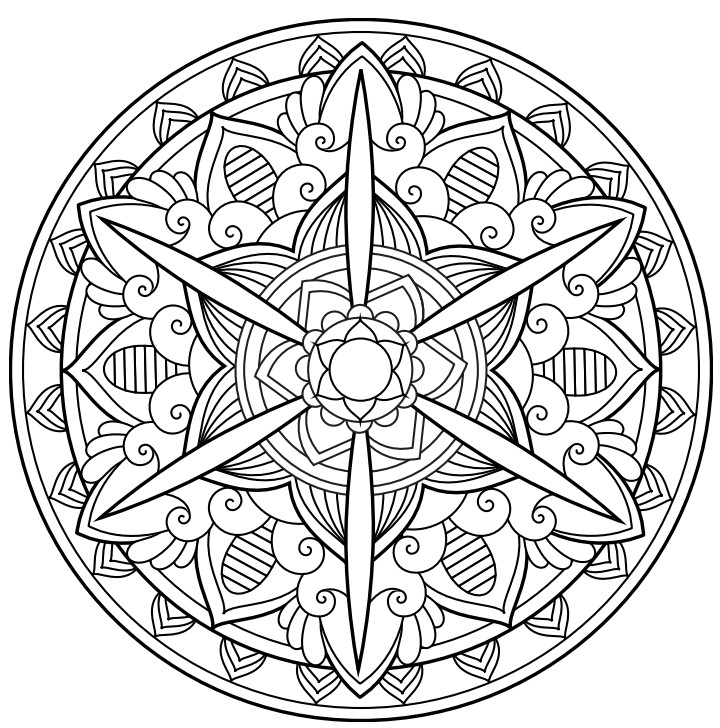
Figure \(\PageIndex{1}\): A mandala taken from the coloring book Magic Mandalas. (Illustration by Peaksel from Wikimedia Commons.)
Materials Suggested
Coloring is an outlet for creativity and emotional expression. As you choose your materials, pay attention to how you are feeling and select colors or patterns that express your current mood. If you wish to shift your mindset, select colors that inspire a positive intention for the day and invite a sense of calm.
- A printed mandala. You can purchase mandala coloring books at a local discount or dollar store, however, they are also able to be freely printed from online. Some websites with free printable versions include:
- 3-5 colored pencils, crayons, or markers. Remember that repetition of color is part of the beauty of mandala art.
- Quiet space.
- Music (optional)
Directions
- Set up materials in a quiet space. Choose an environment with minimal distractions to support deep concentration. This type of calm setting helps promote achievement of flow state.
- Select a time frame for your activity. Most research studies utilize a coloring intervention of 15-20 minutes. This amount of time may be necessary to achieve flow state and attain the physiologic benefits (like reduction of anxiety and stress) that come from coloring.
- Begin coloring. The strategy for coloring a mandala is highly individualized. Suggestions include coloring from center to outer ring, coloring wedge by wedge or one “slice” at a time, or filling similar shapes with the same color and then moving on to the next color. You can watch this quick tutorial of how to color a mandala
Video \(\PageIndex{1}\): How to color a mandala. ("Basic tutorial for beginners on how to color a Mandala (Art Lesson 128)" by Mandala Art by Maria Hajj from YouTube.)
- Notice your body tension throughout the activity. Pay attention to your posture and any tightness in your neck or shoulders. If you feel tension, consciously relax those areas and take a few deep breaths. You may find it helpful to set a timer every 4-5 minutes as a reminder to check in and release tension.
- Have fun. There is no “right” way to color a mandala. The process and activity of coloring is the reward.
Alternatives/Variations
These activities may also foster flow state:
- Drawing or sketching
- Painting
- Sculpting
- Puzzles
- Journaling or creative writing
- Dancing
- Yoga
Spend 15-20 minutes at least 3-4 times this week coloring a mandala. As you color, pay attention to your thoughts, feelings, and any tension in your body. Choose colors that reflect your current mood or help set a positive intention for the day. You may also play soft music to enhance focus and relaxation. After each session, take a moment to reflect on how the activity influenced you physically, mentally, and spiritually.
Reflection Questions:
1. Describe any changes you noticed in the following areas when coloring this week:
Emotional, Environmental, Intellectual, Occupational, Physical, Social, and/or Spiritual
2. What benefits did you feel when coloring?
3. What, if any, barriers did you experience when coloring?
4. Do you have any additional thoughts and/or future plans for coloring?
5. What are your current stressors and do you have a wellness goal for this week?
References
Daly, A., Perry, J., & Creazzo, J. (2024). Impact of group coloring therapy on stress reduction among nurses. Nursing, 54(3), 50-53. https://doi.org/10.1097/01.nurse.0001006252.89450.de
Flett, J. A. M., Lie, C., Riordan, B. C., Thompson, L. M., Conner, T. S., & Hayne, H. (2017). Sharpen your pencils: Preliminary evidence that adult coloring reduces depressive symptoms and anxiety. Creativity Research Journal, 29(4), 409-416. https://doi.org/10.1080/10400419.2017.1376505
Flicker, S. M., Sancier-Barbosa, F., Tang, A. N., Ho, A., Zhong, S., Alafranji, R. R., & Clemons-Castanos, C. R. (2025). Mechanisms of anxiety reduction during adult coloring: Mindfulness, flow, enjoyment, and distraction. Mindfulness, 16(6), 1693–1704. https://doi.org/10.1007/s12671-025-02586-9
Holt, N. J., Furbert, L., & Sweetingham, E. (2019). Cognitive and affective benefits of coloring: Two randomized controlled crossover studies. Art Therapy, 36(4), 200-208. https://doi.org/10.1080/07421656.2019.1645498
Jakobsson Støre, S., & Jakobsson, N. (2022). The effect of mandala coloring on state anxiety: A systematic review and meta-analysis. Art Therapy, 39(4), 173-181. https://doi.org/10.1080/07421656.2021.2003144
Kaplow, R., Willis, P., Higgins, M., & Mota, S. (2025). Effects of coloring on nurse stress in an academic medical center. Journal of Radiology Nursing, 44(3), 306-313. https://doi.org/10.1016/j.jradnu.2025.02.004
Psychology Today (n.d.). Flow. https://www.psychologytoday.com/us/basics/flow
Ranes, B. (2025, January 8). The neuroscience of flow state: Fine-tuning your brain to achieve effortless performance. Medium. https://medium.com/firing-and-wiring/the-neuroscience-of-flow-state-28a5d7bffac9