

2.1: Suffixes for Symptoms
- Page ID
- 150518

\( \newcommand{\vecs}[1]{\overset { \scriptstyle \rightharpoonup} {\mathbf{#1}} } \)
\( \newcommand{\vecd}[1]{\overset{-\!-\!\rightharpoonup}{\vphantom{a}\smash {#1}}} \)
\( \newcommand{\dsum}{\displaystyle\sum\limits} \)
\( \newcommand{\dint}{\displaystyle\int\limits} \)
\( \newcommand{\dlim}{\displaystyle\lim\limits} \)
\( \newcommand{\id}{\mathrm{id}}\) \( \newcommand{\Span}{\mathrm{span}}\)
( \newcommand{\kernel}{\mathrm{null}\,}\) \( \newcommand{\range}{\mathrm{range}\,}\)
\( \newcommand{\RealPart}{\mathrm{Re}}\) \( \newcommand{\ImaginaryPart}{\mathrm{Im}}\)
\( \newcommand{\Argument}{\mathrm{Arg}}\) \( \newcommand{\norm}[1]{\| #1 \|}\)
\( \newcommand{\inner}[2]{\langle #1, #2 \rangle}\)
\( \newcommand{\Span}{\mathrm{span}}\)
\( \newcommand{\id}{\mathrm{id}}\)
\( \newcommand{\Span}{\mathrm{span}}\)
\( \newcommand{\kernel}{\mathrm{null}\,}\)
\( \newcommand{\range}{\mathrm{range}\,}\)
\( \newcommand{\RealPart}{\mathrm{Re}}\)
\( \newcommand{\ImaginaryPart}{\mathrm{Im}}\)
\( \newcommand{\Argument}{\mathrm{Arg}}\)
\( \newcommand{\norm}[1]{\| #1 \|}\)
\( \newcommand{\inner}[2]{\langle #1, #2 \rangle}\)
\( \newcommand{\Span}{\mathrm{span}}\) \( \newcommand{\AA}{\unicode[.8,0]{x212B}}\)
\( \newcommand{\vectorA}[1]{\vec{#1}} % arrow\)
\( \newcommand{\vectorAt}[1]{\vec{\text{#1}}} % arrow\)
\( \newcommand{\vectorB}[1]{\overset { \scriptstyle \rightharpoonup} {\mathbf{#1}} } \)
\( \newcommand{\vectorC}[1]{\textbf{#1}} \)
\( \newcommand{\vectorD}[1]{\overrightarrow{#1}} \)
\( \newcommand{\vectorDt}[1]{\overrightarrow{\text{#1}}} \)
\( \newcommand{\vectE}[1]{\overset{-\!-\!\rightharpoonup}{\vphantom{a}\smash{\mathbf {#1}}}} \)
\( \newcommand{\vecs}[1]{\overset { \scriptstyle \rightharpoonup} {\mathbf{#1}} } \)
\(\newcommand{\longvect}{\overrightarrow}\)
\( \newcommand{\vecd}[1]{\overset{-\!-\!\rightharpoonup}{\vphantom{a}\smash {#1}}} \)
\(\newcommand{\avec}{\mathbf a}\) \(\newcommand{\bvec}{\mathbf b}\) \(\newcommand{\cvec}{\mathbf c}\) \(\newcommand{\dvec}{\mathbf d}\) \(\newcommand{\dtil}{\widetilde{\mathbf d}}\) \(\newcommand{\evec}{\mathbf e}\) \(\newcommand{\fvec}{\mathbf f}\) \(\newcommand{\nvec}{\mathbf n}\) \(\newcommand{\pvec}{\mathbf p}\) \(\newcommand{\qvec}{\mathbf q}\) \(\newcommand{\svec}{\mathbf s}\) \(\newcommand{\tvec}{\mathbf t}\) \(\newcommand{\uvec}{\mathbf u}\) \(\newcommand{\vvec}{\mathbf v}\) \(\newcommand{\wvec}{\mathbf w}\) \(\newcommand{\xvec}{\mathbf x}\) \(\newcommand{\yvec}{\mathbf y}\) \(\newcommand{\zvec}{\mathbf z}\) \(\newcommand{\rvec}{\mathbf r}\) \(\newcommand{\mvec}{\mathbf m}\) \(\newcommand{\zerovec}{\mathbf 0}\) \(\newcommand{\onevec}{\mathbf 1}\) \(\newcommand{\real}{\mathbb R}\) \(\newcommand{\twovec}[2]{\left[\begin{array}{r}#1 \\ #2 \end{array}\right]}\) \(\newcommand{\ctwovec}[2]{\left[\begin{array}{c}#1 \\ #2 \end{array}\right]}\) \(\newcommand{\threevec}[3]{\left[\begin{array}{r}#1 \\ #2 \\ #3 \end{array}\right]}\) \(\newcommand{\cthreevec}[3]{\left[\begin{array}{c}#1 \\ #2 \\ #3 \end{array}\right]}\) \(\newcommand{\fourvec}[4]{\left[\begin{array}{r}#1 \\ #2 \\ #3 \\ #4 \end{array}\right]}\) \(\newcommand{\cfourvec}[4]{\left[\begin{array}{c}#1 \\ #2 \\ #3 \\ #4 \end{array}\right]}\) \(\newcommand{\fivevec}[5]{\left[\begin{array}{r}#1 \\ #2 \\ #3 \\ #4 \\ #5 \\ \end{array}\right]}\) \(\newcommand{\cfivevec}[5]{\left[\begin{array}{c}#1 \\ #2 \\ #3 \\ #4 \\ #5 \\ \end{array}\right]}\) \(\newcommand{\mattwo}[4]{\left[\begin{array}{rr}#1 \amp #2 \\ #3 \amp #4 \\ \end{array}\right]}\) \(\newcommand{\laspan}[1]{\text{Span}\{#1\}}\) \(\newcommand{\bcal}{\cal B}\) \(\newcommand{\ccal}{\cal C}\) \(\newcommand{\scal}{\cal S}\) \(\newcommand{\wcal}{\cal W}\) \(\newcommand{\ecal}{\cal E}\) \(\newcommand{\coords}[2]{\left\{#1\right\}_{#2}}\) \(\newcommand{\gray}[1]{\color{gray}{#1}}\) \(\newcommand{\lgray}[1]{\color{lightgray}{#1}}\) \(\newcommand{\rank}{\operatorname{rank}}\) \(\newcommand{\row}{\text{Row}}\) \(\newcommand{\col}{\text{Col}}\) \(\renewcommand{\row}{\text{Row}}\) \(\newcommand{\nul}{\text{Nul}}\) \(\newcommand{\var}{\text{Var}}\) \(\newcommand{\corr}{\text{corr}}\) \(\newcommand{\len}[1]{\left|#1\right|}\) \(\newcommand{\bbar}{\overline{\bvec}}\) \(\newcommand{\bhat}{\widehat{\bvec}}\) \(\newcommand{\bperp}{\bvec^\perp}\) \(\newcommand{\xhat}{\widehat{\xvec}}\) \(\newcommand{\vhat}{\widehat{\vvec}}\) \(\newcommand{\uhat}{\widehat{\uvec}}\) \(\newcommand{\what}{\widehat{\wvec}}\) \(\newcommand{\Sighat}{\widehat{\Sigma}}\) \(\newcommand{\lt}{<}\) \(\newcommand{\gt}{>}\) \(\newcommand{\amp}{&}\) \(\definecolor{fillinmathshade}{gray}{0.9}\)Suffixes are often used when describing signs and symptoms that individuals are experiencing. There is much variation in how they are used, and examples will be provided to illustrate how suffixes are applied to medical terms to explain signs and symptoms. As stated in the introduction to this chapter, some of the suffixes were introduced in Chapter 1 but will be explained in further detail here.
| SUFFIX | MEANING | EXAMPLE OF USE IN MEDICAL TERMS |
|---|---|---|
| -algia | condition of pain, pain | neuralgia |
| -cele | hernia, protrusion, swelling | hydrocele |
Key Concept
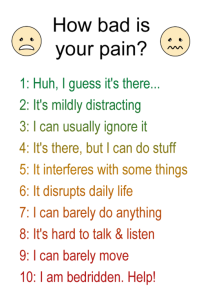
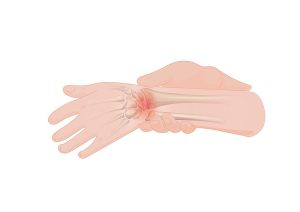
Pain is a common symptom in healthcare settings. There are various ways to assess pain, and the chart in Figure 2.1 is an example of one way. There are a number of places in and on the body where a person can experience pain, and pain can also vary greatly in severity (Figure 2.2). Table 2.2 below provides some examples of the use of the suffix -algia, which means “pain” or “condition of pain.” It lists the more common usages; there are of course more, and on specialty units in a hospital, there are likely others that will be commonly heard as well.
Table 2.2. Examples of -algia
| MEDICAL TERM | MEANING |
|---|---|
| arthralgia | condition of pain in the joint (Figure 2.2) |
| brachialgia | condition of pain in the arm |
| cephalgia | condition of pain in the head (headache) |
| cervicalgia | condition of pain in the neck |
| dentalgia | condition of pain in the tooth |
| fibromyalgia | condition of pain in the fibrous tissue and muscle |
| hepatalgia | condition of pain in the liver |
| mammalgia | condition of pain in the breast |
| myalgia | condition of pain in the muscle |
| neuralgia | condition of pain in the nerve |
| otalgia | condition of pain in the ear |
| rhinalgia | condition of pain in the nose |
| spondylalgia | condition of pain in the spine |
| thoracalgia | condition of pain in the chest or thorax |
| SUFFIX | MEANING | EXAMPLE OF USE IN MEDICAL TERMS |
|---|---|---|
| -dipsia | thirst | polydipsia |
| -emesis | vomiting | hematemesis |


Key Concept
The medical term polydipsia, which means “much thirst,” comes from the prefix poly- (“much” or “many”) and the suffix -dipsia (“thirst”). A number of medical conditions can cause polydipsia (Figure 2.3), including diabetes mellitus.
Nausea and vomiting (Figure 2.4) are common symptoms for patients in a hospital and can result from many causes. As such, it would not be uncommon to see medical terms with the suffix -emesis (“vomiting”) and have it combined with other terms, as with -algia in Table 2.2 above; for example, the term hematemesis means there is blood in the vomit.
| SUFFIX | MEANING | EXAMPLE OF USE IN MEDICAL TERMS |
|---|---|---|
| -emia | blood condition | ischemia |
| -ia | condition | pneumonia |
| -itis | inflammation | appendicitis |
Key Concept
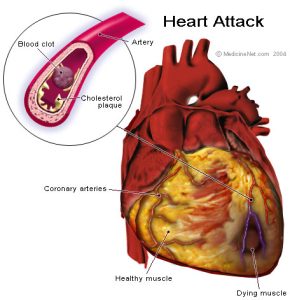
Figure 2.5 shows a heart during a myocardial infarction, also known as a heart attack. When this occurs, blood is held back from part of the heart. The medical term for this is ischemia, meaning “blood condition of holding back,” which has the suffix -emia (“blood condition”) and the combining form isch/o (“to hold back”). When ischemia occurs and is not corrected right away, it results in necrosis. In this case, it would be the death of cardiac muscle.
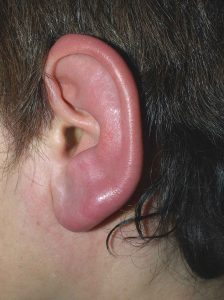
Inflammation is also a common symptom because many parts of the human body can become inflamed. Figure 2.6 shows an ear that has become inflamed; the medical term for this is otitis (“inflammation of the ear”). Table 2.5 below provides some examples of medical terms with -itis (“inflammation”), but there are many more that you may hear in a medical setting.
Table 2.5. Examples of -itis
| MEDICAL TERM | MEANING |
|---|---|
| adenoiditis | inflammation of the adenoids |
| appendicitis | inflammation of the appendix |
| bronchitis | inflammation of the bronchi |
| bursitis | inflammation of the bursae |
| cholecystitis | inflammation of the gallbladder |
| cystitis | inflammation of the urinary bladder |
| dermatitis | inflammation of the skin |
| encephalitis | inflammation of the brain |
| enteritis | inflammation of the intestines |
| esophagitis | inflammation of the esophagus |
| gastroenteritis | inflammation of the stomach and intestines |
| hepatitis | inflammation of the liver |
| nephritis | inflammation of the kidney |
| neuritis | inflammation of the nerve |
| otitis | inflammation of the ear (Figure 2.6) |
| thrombophlebitis | inflammation with clots in the vein |
| SUFFIX | MEANING | EXAMPLE OF USE IN MEDICAL TERMS |
|---|---|---|
| -lapse | to fall, slide | prolapse |
| -megaly | enlargement | cardiomegaly |
Key Concept
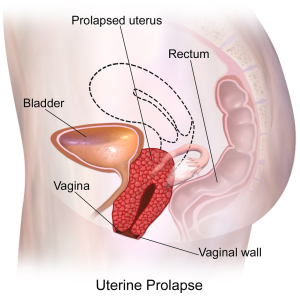
Fig 2.7 is an image of a uterine prolapse. Prolapses can occur in other parts of the body as well, and the literal meaning of prolapse is “to slide or fall forward,” from the suffix -lapse (“to fall or slide”) and the prefix pro- (“before” or “forward”). When a prolapse occurs, it can be corrected surgically and with physiotherapy treatment. Uterine prolapses are more common with increased age and a history of pregnancy.
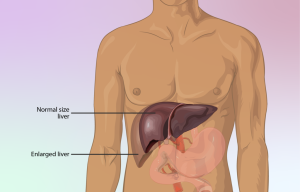
Various organs in the body can become enlarged owing to different pathologies and conditions. Cardiomegaly is enlargement of the heart, and Figure 2.8 shows enlargement of the liver, which is referred to as hepatomegaly. Both types of enlargements often result from chronic conditions such as congestive heart failure (CHF) or hepatitis.
| SUFFIX | MEANING | EXAMPLE OF USE IN MEDICAL TERMS |
|---|---|---|
| -oma | tumour, mass | hematoma |
| -osis | condition, abnormal condition | psychosis |
Key Concept
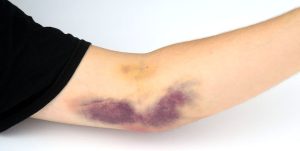
Hematomas, shown in Figure 2.9, are very common in the general population and among patients in hospitals or clinics. Hematomas are often referred to as bruises, and the term literally mean “mass of blood,” from the suffix -oma (“mass” or “tumour”) and the combining form hemat/o (“blood”).
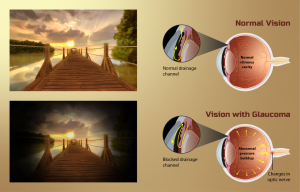
Another type of -oma is glaucoma, which is medical condition that causes increased pressure within the eye and results in narrowed vision, as seen in Figure 2.10. Glaucoma literally means “mass that is grey,” from the suffix -oma and the combining form glauc/o (“grey” or “opaque”) (Global RPH, 2021). This refers to the grey mass in the field of vision that patients experience and that can be seen in the figure above.
| SUFFIX | MEANING | EXAMPLE OF USE IN MEDICAL TERMS |
|---|---|---|
| -penia | deficiency | pancytopenia |
| -phagia | eating | dysphagia |
| -phasia | speech | aphasia |
Key Concepts
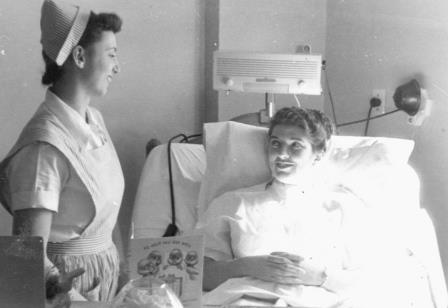
Speaking and eating are, for most of us, a part of everyday life. Difficulty or the inability to eat or speak can be extremely confusing and frustrating for those who are affected. The medical terms that describe these conditions are dysphagia (“difficulty eating”) and dysphasia (“difficulty speaking).” Even more detrimental conditions would be aphagia and aphasia; with the prefix a- (“no”), the terms mean “no eating” and “no speaking.”
| SUFFIX | MEANING | EXAMPLE OF USE IN MEDICAL TERMS |
|---|---|---|
| -pathy | disease condition | cardiomyopathy |
| -pepsia | digestion | dyspepsia |
| -phobia | aversion, abnormal fear | arachnophobia |
| -plegia | paralysis | paraplegia |
Key Concept
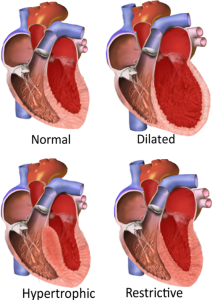
The suffix -pathy (“disease condition”) is very common in medical settings. Figure 2.12 shows various forms of cardiomyopathy. This condition can result from an acute condition, such as a heart attack, or a more chronic condition, such as congestive heart failure. Acute conditions come on quickly, whereas chronic ones can last a lifetime.
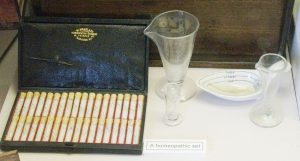
Another example of the use of the suffix -pathy would be the term homeopathy. Figure 2.13 shows a homeopathy set that was once used to treat ailments. This term has the combining form home/o, which means “similar,” “same,” or “alike.” Homeopathy originated in the 18th century from the idea that “like cures like,” meaning that a small concentration of a toxin could be used to treat the symptoms that it would cause when taken in larger doses (Wanjek, 2013); for example, using the active ingredient in poison ivy to treat a rash (Wanjek, 2013). This thinking resulted in the development of the first vaccines, which use small doses of viruses to treat or prevent illness (Wanjek, 2013).
Table 2.10 below provides some examples of medical terms with -pathy, but there are many more used in medical settings.
Table 2.10. Examples of -pathy
| MEDICAL TERM | MEANING |
|---|---|
| adenopathy | disease condition of the glands |
| adrenopathy | disease condition of the adrenal gland |
| arthropathy | disease condition of the joint |
| cardiopathy | disease condition of the heart |
| cardiomyopathy | disease condition of the heart and muscle |
| encephalopathy | disease condition of the brain |
| hepatopathy | disease condition of the liver |
| lymphadenopathy | disease condition of the lymph nodes |
| myopathy | disease condition of the muscle |
| neuropathy | disease condition of the nerve |
| psychopathy | disease condition of the mind |
| retinopathy | disease condition of the retina |
| SUFFIX | MEANING | EXAMPLE OF USE IN MEDICAL TERMS |
|---|---|---|
| -rrhea | flow, discharge | menorrhea |
| -rrhage | excessive discharge of blood | hemorrhage |
| -rrhagia | excessive discharge of blood | menorrhagia |
Key Concept
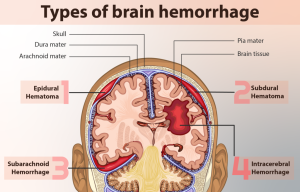
Although very similar, the three suffixes in Table 2.11 are used in different ways. It is important to note the manner in which the suffixes are used and when one is used over the other. For example, look at the terms dysmenorrhea, amenorrhea, menorrhagia, menorrhea, and hemorrhage. The first four have to do with menstrual flow, the first term meaning “painful,” then “lack of,” “excessive,” and, finally, “normal menstrual flow.” The last term means “excessive discharge of blood,” which could be from anywhere in the body. Figure 2.14 shows some examples of hemorrhages in the brain, and many of the prefixes you see in the terms used will be discussed further in Chapter 3.
| SUFFIX | MEANING | EXAMPLE OF USE IN MEDICAL TERMS |
|---|---|---|
| -sclerosis | hardening | arteriosclerosis |
| -uria | condition of urine | glycosuria |
Key Concept
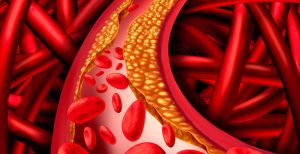
Arteri/o, meaning “artery,” can be seen in the term arteriosclerosis, which literally means “hardening of an artery.” Ather/o means “plaque” and is part of the term atherosclerosis, a condition that results from an accumulation of plaque within an artery and causes hardening of the artery. As such, it is a type of arteriosclerosis that is specifically caused by plaque build-up (Figure 2.15).
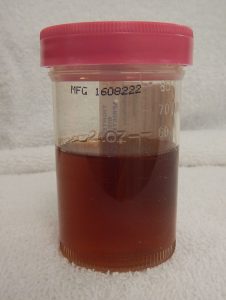
You were introduced to the term hematuria (Figure 2.16) in Chapter 1, and it means “a condition of urine(-uria) with blood (hemat-)” (Ansorge, 2022). A urinalysis examines various factors in urine, including blood, sugar, protein, and white blood cells. The results of a urinalysis are a good indicator of how a person’s kidneys are functioning. Kidneys play a key role in the urinary system.
Exercises
Attribution
Unless otherwise indicated, material on this page has been adapted from the following resource:
Carter, K., & Rutherford, M. (2020). Building a medical terminology foundation. eCampus Ontario. https://ecampusontario.pressbooks.pub/medicalterminology/ licensed under CC BY 4.0
References
Ansorge, R. (2022). Blood in urine (hematuria). WebMD. https://www.webmd.com/digestive-disorders/blood-in-urine-causes
Global RPH. (2021). Color medical terms – Prefixes and terms for color. https://globalrph.com/med-terms-prefixes-and-combining-forms-color-medical-terms/#:~:text=red%20blood%20cell)-,glauc%2Fo,gleam%20of%20the%20affected%20eye)
Wanjek, C. (May 13, 2013). What is homeopathy? Live Science. https://www.livescience.com/31977-homeopathy.html
Image Credits (images are listed in order of appearance)
Pain scale with words by MissLunaRose12, CC BY-SA 4.0
Wrist pain by Injurymap, CC BY-SA 4.0
Drink up to stay healthy. Health is Wealth by Victorbraimoh, CC BY-SA 4.0
Symptoms-vomiting by Centers for Disease Control and Prevention, Public domain
Heart attack anatomy by ravindra gandhi, CC BY-SA 2.0
Erysipel2a by Klaus D. Peter, CC BY 3.0 DE
Uterine Prolapse by BruceBlaus, CC BY-SA 4.0
Depiction of an enlarged liver by myUpchar, CC BY-SA 4.0
Plateletpheresis hematoma 2016 by MajorB, CC0 1.0
Depiction of vision for a Glaucoma patient by myUpchar, CC BY-SA 4.0
Nurse aide with patient at La Junta Hospital by Mennonite Church USA Archives, Public domain
Major categories of cardiomyopathy by Npatchett, CC BY-SA 4.0
HomeopathicSetBedfordMuseum by Simon Speed, Public domain
An illustration of the different types of brain hemorrhage by myUpchar, CC BY-SA 4.0
Dislipidemias3 by TLECOATL ZYANYA, CC BY-SA 4.0
HematuriaGross by James Heilman, MD, CC BY-SA 4.0
The condition of pain in the nerves
Swelling in the scrotum caused by an accumulation of fluid
Much thirst
Vomiting blood
Blood held back or to hold back blood
Pertaining to the lungs; a serious lung infection caused by a virus or bacteria
Inflammation of the appendix
An abnormal condition of death
To fall forward
Enlargement of the heart
A mass of blood
An abnormal condition of the mind
Deficiency in all blood cells (red blood cells, white blood cells, and platelets)
Difficulty eating
No speech
Disease condition of the heart muscle
Painful digestion
Aversion to or fear of spiders
Paralysis of the lower half of the body
Discharge or flow of menses; normal menstrual flow
Excessive discharge of blood, often from a trauma
Excessive discharge of blood during menstruation
The hardening of an artery
Condition of sugar in urine
Condition of blood in urine