

2.2: Suffixes for Treatment Procedures
- Page ID
- 150519

\( \newcommand{\vecs}[1]{\overset { \scriptstyle \rightharpoonup} {\mathbf{#1}} } \)
\( \newcommand{\vecd}[1]{\overset{-\!-\!\rightharpoonup}{\vphantom{a}\smash {#1}}} \)
\( \newcommand{\dsum}{\displaystyle\sum\limits} \)
\( \newcommand{\dint}{\displaystyle\int\limits} \)
\( \newcommand{\dlim}{\displaystyle\lim\limits} \)
\( \newcommand{\id}{\mathrm{id}}\) \( \newcommand{\Span}{\mathrm{span}}\)
( \newcommand{\kernel}{\mathrm{null}\,}\) \( \newcommand{\range}{\mathrm{range}\,}\)
\( \newcommand{\RealPart}{\mathrm{Re}}\) \( \newcommand{\ImaginaryPart}{\mathrm{Im}}\)
\( \newcommand{\Argument}{\mathrm{Arg}}\) \( \newcommand{\norm}[1]{\| #1 \|}\)
\( \newcommand{\inner}[2]{\langle #1, #2 \rangle}\)
\( \newcommand{\Span}{\mathrm{span}}\)
\( \newcommand{\id}{\mathrm{id}}\)
\( \newcommand{\Span}{\mathrm{span}}\)
\( \newcommand{\kernel}{\mathrm{null}\,}\)
\( \newcommand{\range}{\mathrm{range}\,}\)
\( \newcommand{\RealPart}{\mathrm{Re}}\)
\( \newcommand{\ImaginaryPart}{\mathrm{Im}}\)
\( \newcommand{\Argument}{\mathrm{Arg}}\)
\( \newcommand{\norm}[1]{\| #1 \|}\)
\( \newcommand{\inner}[2]{\langle #1, #2 \rangle}\)
\( \newcommand{\Span}{\mathrm{span}}\) \( \newcommand{\AA}{\unicode[.8,0]{x212B}}\)
\( \newcommand{\vectorA}[1]{\vec{#1}} % arrow\)
\( \newcommand{\vectorAt}[1]{\vec{\text{#1}}} % arrow\)
\( \newcommand{\vectorB}[1]{\overset { \scriptstyle \rightharpoonup} {\mathbf{#1}} } \)
\( \newcommand{\vectorC}[1]{\textbf{#1}} \)
\( \newcommand{\vectorD}[1]{\overrightarrow{#1}} \)
\( \newcommand{\vectorDt}[1]{\overrightarrow{\text{#1}}} \)
\( \newcommand{\vectE}[1]{\overset{-\!-\!\rightharpoonup}{\vphantom{a}\smash{\mathbf {#1}}}} \)
\( \newcommand{\vecs}[1]{\overset { \scriptstyle \rightharpoonup} {\mathbf{#1}} } \)
\(\newcommand{\longvect}{\overrightarrow}\)
\( \newcommand{\vecd}[1]{\overset{-\!-\!\rightharpoonup}{\vphantom{a}\smash {#1}}} \)
\(\newcommand{\avec}{\mathbf a}\) \(\newcommand{\bvec}{\mathbf b}\) \(\newcommand{\cvec}{\mathbf c}\) \(\newcommand{\dvec}{\mathbf d}\) \(\newcommand{\dtil}{\widetilde{\mathbf d}}\) \(\newcommand{\evec}{\mathbf e}\) \(\newcommand{\fvec}{\mathbf f}\) \(\newcommand{\nvec}{\mathbf n}\) \(\newcommand{\pvec}{\mathbf p}\) \(\newcommand{\qvec}{\mathbf q}\) \(\newcommand{\svec}{\mathbf s}\) \(\newcommand{\tvec}{\mathbf t}\) \(\newcommand{\uvec}{\mathbf u}\) \(\newcommand{\vvec}{\mathbf v}\) \(\newcommand{\wvec}{\mathbf w}\) \(\newcommand{\xvec}{\mathbf x}\) \(\newcommand{\yvec}{\mathbf y}\) \(\newcommand{\zvec}{\mathbf z}\) \(\newcommand{\rvec}{\mathbf r}\) \(\newcommand{\mvec}{\mathbf m}\) \(\newcommand{\zerovec}{\mathbf 0}\) \(\newcommand{\onevec}{\mathbf 1}\) \(\newcommand{\real}{\mathbb R}\) \(\newcommand{\twovec}[2]{\left[\begin{array}{r}#1 \\ #2 \end{array}\right]}\) \(\newcommand{\ctwovec}[2]{\left[\begin{array}{c}#1 \\ #2 \end{array}\right]}\) \(\newcommand{\threevec}[3]{\left[\begin{array}{r}#1 \\ #2 \\ #3 \end{array}\right]}\) \(\newcommand{\cthreevec}[3]{\left[\begin{array}{c}#1 \\ #2 \\ #3 \end{array}\right]}\) \(\newcommand{\fourvec}[4]{\left[\begin{array}{r}#1 \\ #2 \\ #3 \\ #4 \end{array}\right]}\) \(\newcommand{\cfourvec}[4]{\left[\begin{array}{c}#1 \\ #2 \\ #3 \\ #4 \end{array}\right]}\) \(\newcommand{\fivevec}[5]{\left[\begin{array}{r}#1 \\ #2 \\ #3 \\ #4 \\ #5 \\ \end{array}\right]}\) \(\newcommand{\cfivevec}[5]{\left[\begin{array}{c}#1 \\ #2 \\ #3 \\ #4 \\ #5 \\ \end{array}\right]}\) \(\newcommand{\mattwo}[4]{\left[\begin{array}{rr}#1 \amp #2 \\ #3 \amp #4 \\ \end{array}\right]}\) \(\newcommand{\laspan}[1]{\text{Span}\{#1\}}\) \(\newcommand{\bcal}{\cal B}\) \(\newcommand{\ccal}{\cal C}\) \(\newcommand{\scal}{\cal S}\) \(\newcommand{\wcal}{\cal W}\) \(\newcommand{\ecal}{\cal E}\) \(\newcommand{\coords}[2]{\left\{#1\right\}_{#2}}\) \(\newcommand{\gray}[1]{\color{gray}{#1}}\) \(\newcommand{\lgray}[1]{\color{lightgray}{#1}}\) \(\newcommand{\rank}{\operatorname{rank}}\) \(\newcommand{\row}{\text{Row}}\) \(\newcommand{\col}{\text{Col}}\) \(\renewcommand{\row}{\text{Row}}\) \(\newcommand{\nul}{\text{Nul}}\) \(\newcommand{\var}{\text{Var}}\) \(\newcommand{\corr}{\text{corr}}\) \(\newcommand{\len}[1]{\left|#1\right|}\) \(\newcommand{\bbar}{\overline{\bvec}}\) \(\newcommand{\bhat}{\widehat{\bvec}}\) \(\newcommand{\bperp}{\bvec^\perp}\) \(\newcommand{\xhat}{\widehat{\xvec}}\) \(\newcommand{\vhat}{\widehat{\vvec}}\) \(\newcommand{\uhat}{\widehat{\uvec}}\) \(\newcommand{\what}{\widehat{\wvec}}\) \(\newcommand{\Sighat}{\widehat{\Sigma}}\) \(\newcommand{\lt}{<}\) \(\newcommand{\gt}{>}\) \(\newcommand{\amp}{&}\) \(\definecolor{fillinmathshade}{gray}{0.9}\)Suffixes are often used when describing procedures that patients might receive during their course of treatment. Once again, there is high level of variation between how suffixes are used, and this will be elaborated upon below. Examples will be provided that illustrate the manner in which these suffixes are used in various terms related to procedures. As stated in the introduction to this chapter, some of these will be suffixes that were introduced in the previous chapter, but in this chapter their use will be explained in further detail.
| SUFFIX | MEANING | EXAMPLE OF USE IN MEDICAL TERMS |
|---|---|---|
| -centesis | surgical puncture to remove fluid | abdominal paracentesis |
Key Concept
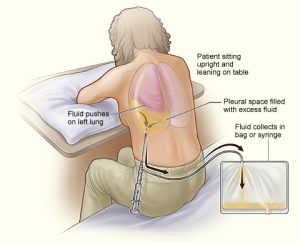
Amniocentesis was introduced in Chapter 1, but it is just one form of a “surgical puncture to remove fluid,” or -centesis. Another common procedure is thoracentesis, as shown in Figure 2.17, which involves removing fluid from the pleural space around the lungs. Fluid accumulating in this area is called pleural effusion and can make it difficult for patients to breath because the fluid compresses their lungs (Cleveland Clinic, 2022).
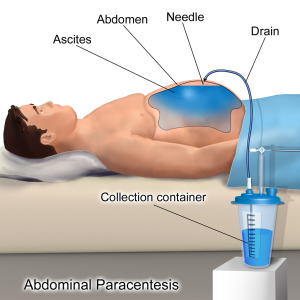
Figure 2.18 shows another common procedure called paracentesis, a surgical puncture to remove fluid from the peritoneal cavity. Fluid accumulation in this area is called ascites, and as more fluid develops, the patient will become increasingly uncomfortable (John Hopkins, 2022a). Often this condition can be chronic and is associated with liver failure.
| SUFFIX | MEANING | EXAMPLE OF USE IN MEDICAL TERMS |
|---|---|---|
| -ectomy | removal, resection, excision | hysterectomy |
Key Concept
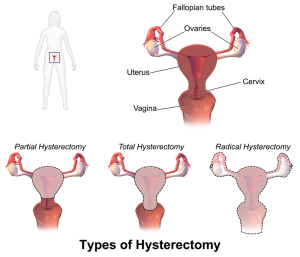
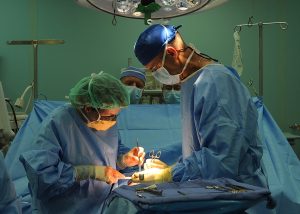
The suffix -ectomy is used in medical terms that refer to the removal of an organ, tissue, tumour, or gland. Figure 2.19 is an image of the different types of hysterectomies that a patient might need to have, depending on their diagnosis. The term hysterectomy includes the combining form hyster/o, meaning “uterus,” and the suffix -ectomy, meaning “removal.” Figure 2.20 is an image of a surgeon in an operating room performing an appendectomy, the removal of the appendix.
Table 2.15 provides an extensive list of surgical procedures that patients might have to undergo. Note that the term excision means “to cut out” or “to remove.” It includes the suffix -cision, meaning “to cut,” and the prefix ex-, meaning “out.”
Table 2.15. Excisions
| MEDICAL TERM | MEANING |
| adenectomy | excision of a gland |
| adenoidectomy | excision of the adenoids |
| appendectomy | excision of the appendix |
| cholecystectomy | excision of the gallbladder |
| colectomy | excision of the colon |
| gastrectomy | excision of the stomach |
| hysterectomy | excision of the uterus |
| laminectomy | excision of a piece of backbone |
| lobectomy | excision of a single lobe of the lung |
| mastectomy | excision of the breast |
| myomectomy | excision of a muscle tumour |
| oophorectomy | excision of the ovaries |
| pneumonectomy | excision of lung tissue |
| prostatectomy | excision of the prostate gland |
| salpingectomy | excision of the fallopian tubes |
| splenectomy | excision of the spleen |
| tonsillectomy | excision of the tonsils |
| total pneumonectomy | excision of a whole lung |
| SUFFIX | MEANING | EXAMPLE OF USE IN MEDICAL TERMS |
|---|---|---|
| -gram | record | arthrogram |
| -graph | instrument used to record | electrocardiograph |
| -graphy | process of recording | electrocardiography |
Key Concept
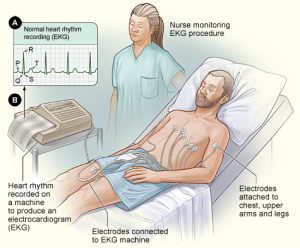
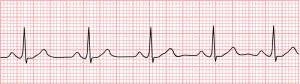
The three suffixes in Table 2.16 are similar; however, they are very different in the way they are used in reference to tests or procedures. When discussing the record that is made as a result of a test, for example, an electrocardiogram as shown in Figure 2.21, then suffix would be -gram (“record”). However, when discussing the process of actually completing the record, as illustrated in Figure 2.22, then the suffix -graphy (“process of recording”) would be used. The instrument itself, in this case, would be the electrocardiograph. It is important to differentiate between the three suffixes and how they are used in medical terminology.
Table 2.17. Examples of -gram
| MEDICAL TERM | MEANING |
|---|---|
| arthrogram | record of the joint |
| audiogram | record of hearing |
| cystogram | record of the urinary bladder |
| echocardiogram | record of heart with sound |
| electrocardiogram | record of the electrical activity of the heart |
| electroencephalogram | record of the electrical activity of the brain |
| electromyogram | record of the electrical activity in muscles |
| esophagogram | record of the esophagus |
| hysterosalpingogram | record of the uterus and fallopian tubes |
| mammogram | record of the breast |
| myelogram | record of the spinal cord |
| pyelogram | record of the renal pelvis |
| urogram | record of the kidney and urinary tract |
| SUFFIX | MEANING | EXAMPLE OF USE IN MEDICAL TERMS |
|---|---|---|
| -lysis | separation, breakdown, destruction | hemodialysis |
| -meter | instrument used to measure | audiometer |
| -metry | process of measuring | audiometry |
Key Concept
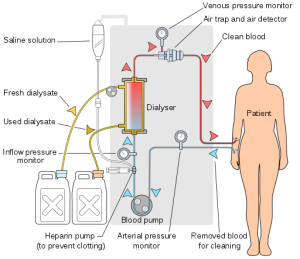
When a patient’s kidneys begin to fail, they have a few options, including peritoneal dialysis, hemodialysis, or a kidney transplant. Peritoneal dialysis was explained in Chapter 1 and is a procedure in which a tube is inserted through the abdominal wall. A solution is then instilled to help filter the blood. This type of dialysis can be completed in a patient’s home on a daily basis. The other type of dialysis is called hemodialysis and is shown in Fig 2.23 (Kidney Foundation of Canada, 2022). It involves using a dialysis machine to filter a patient’s blood and then return the blood to the patient’s body with the wastes removed. Dialysis is often used until a suitable kidney is found for transplant (Kidney Foundation of Canada, 2022).
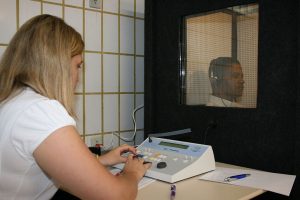
Audiometry is an assessment of a person’s hearing. This term has the suffix -metry (“process of measuring”) and the combining form audi/o (“hearing”). Figure 2.24 shows one manner in which audiometry can be completed.
| SUFFIX | MEANING | EXAMPLE OF USE IN MEDICAL TERMS |
|---|---|---|
| -opsy | process of viewing | biopsy |
| -plasty | surgical repair, surgical correction | angioplasty |
| -scope | instrument used to visually exam | colonoscope |
| -scopy | process of visual examination | gastroscopy |
Key Concept
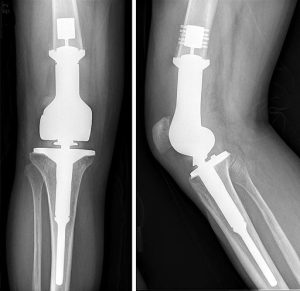
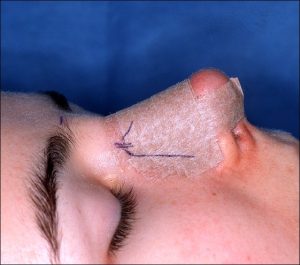
Surgical corrections can be completed for mobility reasons, such as an arthroplasty (Figure 2.25), or for cosmetic reasons, such as a rhinoplasty (Figure 2.26). A rhinoplasty can also be done for medical reasons, depending on the patient’s history and pathologies.
Key Concept
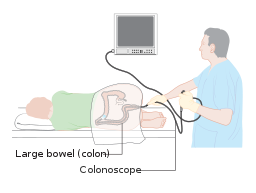
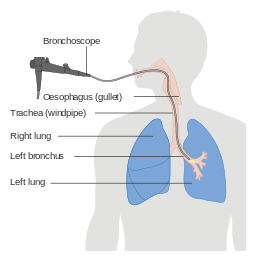
There are many different types of -scopy procedures, and a few are listed in Table 2.20 below. It is important to differentiate between how the suffix -scopy (“process of visual examination”) and -scope (“instrument used to visually examine”) are used. The images in Figure 2.27 and Figure 2.28 show a colonoscopy and a bronchoscopy, the processes of visualizing the colon and bronchi. These would be performed using a colonoscope, as shown in the first image, and a bronchoscope, as shown in the second image—the instruments used to complete the procedures.
Table 2.20. Examples of -scopy
| MEDICAL TERM | MEANING |
|---|---|
| anoscopy | process of visual examination of the anus |
| arthroscopy | process of visual examination of the joint |
| bronchoscopy | process of visual examination of the bronchi |
| colonoscopy | process of visual examination of the colon |
| colposcopy | process of visual examination of the vagina and cervix |
| cystoscopy | process of visual examination of the urinary bladder |
| endoscopy | process of visual exam of a body cavity or organ with a narrow, tube-like instrument (endoscope) |
| esophagogastroduodenoscopy | process of visual examination of the esophagus, stomach, and first part of the small intestine |
| esophagoscopy | process of visual examination of the esophagus |
| gastroscopy | process of visual examination of the stomach |
| hysteroscopy | process of visual examination of the uterus |
| laparoscopy | process of visual examination of the abdominal cavity |
| laryngoscopy | process of visual examination of the larynx |
| proctoscopy | process of visual examination of the rectum and anus |
| sigmoidoscopy | process of visual examination of the sigmoid colon |
| thoracoscopy | process of visual examination of the surface of the lungs (thoracic cavity) |
| SUFFIX | MEANING | EXAMPLE OF USE IN MEDICAL TERMS |
|---|---|---|
| -stomy | opening | colostomy |
| -therapy | treatment | cryotherapy |
Key Concept
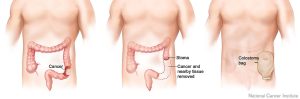
Figure 2.29 shows one type of -stomy (“opening”), a colostomy that was created for a patient with colon cancer. This procedure can also be done for patients with bowel obstructions. An opening into the colon is created, and a stoma is formed on the abdomen to allow bowel movements to exit the body into a colostomy bag. The opening can be permanent, or if the patient’s condition permits, may be only semi-permanent.
Key Concept
Below are three examples of very different ways of the using the suffix -therapy (“treatment)”:
- chemotherapy: Treatment with drugs (chem/o)
- cryotherapy: Treatment with cold (cry/o)
- radiotherapy: Treatment with X-rays (radi/o)
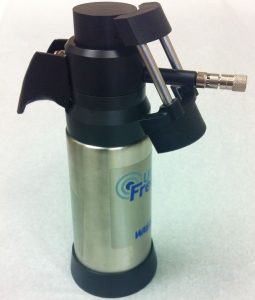
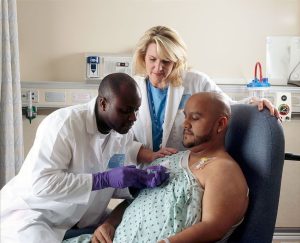
Fig 2.30 shows a cryogun, a common device used in cryotherapy. The cold contents are sprayed on a wart or skin tag, and through a series of treatments, the wart or skin tag is slowly removed. Figure 2.31 has a patient about to receive a chemotherapy treatment, which is used to treat various forms of cancer.
| SUFFIX | MEANING | EXAMPLE OF USE IN MEDICAL TERMS |
|---|---|---|
| -tripsy | surgical crushing | Extracorporeal shock wave lithotripsy |
| -tomy | incision, cutting into | phlebotomy |
Key Concept
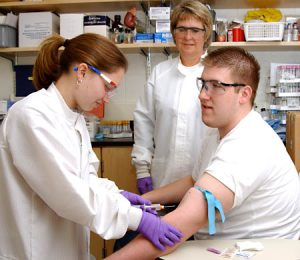
Phlebotomy, withdrawing a blood sample for analysis (Figure 2.32), is a common procedure that many, if not most, people experience during their lifetime. Another example of the use of the suffix -tomy (“incision” or “cutting into”) would be a craniotomy, a procedure often done to release pressure during brain surgery.
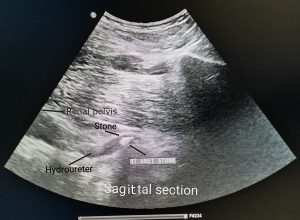
Extracorporeal shock wave lithotripsy (ESWL) is used to assist patients who have stones in their kidneys, ureters, pancreatic, or bile ducts (John Hopkins, 2022b). This procedure is not invasive and breaks down the stones using shock waves with the assistance of X-rays or ultrasound (Fig 2.33). Once broken down, the stones can pass through the urinary system and out of the patient’s body (John Hopkins, 2022b).
Exercises
Attribution
Unless otherwise indicated, material on this page has been adapted from the following resource:
Carter, K., & Rutherford, M. (2020). Building a medical terminology foundation. eCampus Ontario. https://ecampusontario.pressbooks.pub/medicalterminology/ licensed under CC BY 4.0
References
Cleveland Clinic. (2022). Pleural effusion causes, signs and treatment. https://my.clevelandclinic.org/health/diseases/17373-pleural-effusion-causes-signs–treatment#:~:text=Pleural%20effusion%2C%20sometimes%20referred%20to,to%20lubricate%20and%20facilitate%20breathing.
John Hopkins. (2022a). Ascites. https://www.hopkinsmedicine.org/health/conditions-and-diseases/ascites#:~:text=Ascites%20is%20a%20condition%20in,chest%20and%20surround%20your%20lungs.
John Hopkins. (2022b). Extracorporeal shock wave lithotripsy (ESWL). https://www.hopkinsmedicine.org/health/conditions-and-diseases/kidney-stones/extracorporeal-shock-wave-lithotripsy-eswl
Kidney Foundation of Canada. (2022). Dialysis. https://kidney.ca/Kidney-Health/Living-With-Kidney-Failure/Dialysis
Image Credits (images are listed in order of appearance)
Thoracentesis by National Heart, Lung, and Blood Institute, Public domain
Blausen 0004 AbdominalParacentesis by BruceBlaus, CC BY 3.0
Hysterectomy by BruceBlaus, CC BY-SA 4.0
US Navy 110427-N-NY820-294 Capt. Beth Jaklic, left, and Cmdr. Eric Gessler perform an open appendectomy on Electrician’s Mate 3rd Class Mikhail Gri by U.S. Navy photo by Mass Communication Specialist 2nd Class Eric C. Tretter, Public domain
Normal Sinus Rhythm Unlabeled by Andrewmyerson, CC BY-SA 3.0
Ekg NIH by National Heart, Lung, and Blood Institute, Public domain
Hemodialysis-en by YassineMrabet, CC BY 3.0
HearingExam by Flávia Costa, CC BY 3.0
Knee arthroplasty due to a chondrosarcoma by Jmarchn, CC BY 3.0
RhinoplastySplint2 by FacialSurgery, CC BY 3.0
Diagram showing a colonoscopy CRUK 060 by Cancer Research UK, CC BY-SA 4.0
Diagram showing a bronchoscopy CRUK 053 by Cancer Research UK, CC BY-SA 4.0
Colostomie by National Cancer Institute, Public domain
Cryogun by Warfieldian, CC BY 3.0
Patient receives chemotherapy by National Cancer Institute, Public domain
Phlebotomy-practice-university-of-delaware by University of Delaware, Department of Medical Technology, CC BY 3.0
Right kidney hydroureter with stone within by Cerevisae, CC BY-SA 4.0
Removal of fluid from the peritoneal cavity
A surgical puncture to remove fluid from the amniotic sac
Removal of the uterus
Removal of the appendix
A record (scan) of a joint
An instrument used to record the electrical activity of the heart
The process of recording the electricity of the heart
Separating or breaking down blood completely
An instrument used to measure hearing (sound)
The process of measuring hearing (sound)
To view life
The surgical repair of a blood vessel
An instrument used to visually exam the colon
The process of visually examining the stomach
An opening into the colon
Treatment with cold
A procedure that breaks up stones using a series of shock waves generated by a machine called a lithotripter
An incision into a vein