

2.3: Additional Suffixes
- Page ID
- 150520

\( \newcommand{\vecs}[1]{\overset { \scriptstyle \rightharpoonup} {\mathbf{#1}} } \)
\( \newcommand{\vecd}[1]{\overset{-\!-\!\rightharpoonup}{\vphantom{a}\smash {#1}}} \)
\( \newcommand{\dsum}{\displaystyle\sum\limits} \)
\( \newcommand{\dint}{\displaystyle\int\limits} \)
\( \newcommand{\dlim}{\displaystyle\lim\limits} \)
\( \newcommand{\id}{\mathrm{id}}\) \( \newcommand{\Span}{\mathrm{span}}\)
( \newcommand{\kernel}{\mathrm{null}\,}\) \( \newcommand{\range}{\mathrm{range}\,}\)
\( \newcommand{\RealPart}{\mathrm{Re}}\) \( \newcommand{\ImaginaryPart}{\mathrm{Im}}\)
\( \newcommand{\Argument}{\mathrm{Arg}}\) \( \newcommand{\norm}[1]{\| #1 \|}\)
\( \newcommand{\inner}[2]{\langle #1, #2 \rangle}\)
\( \newcommand{\Span}{\mathrm{span}}\)
\( \newcommand{\id}{\mathrm{id}}\)
\( \newcommand{\Span}{\mathrm{span}}\)
\( \newcommand{\kernel}{\mathrm{null}\,}\)
\( \newcommand{\range}{\mathrm{range}\,}\)
\( \newcommand{\RealPart}{\mathrm{Re}}\)
\( \newcommand{\ImaginaryPart}{\mathrm{Im}}\)
\( \newcommand{\Argument}{\mathrm{Arg}}\)
\( \newcommand{\norm}[1]{\| #1 \|}\)
\( \newcommand{\inner}[2]{\langle #1, #2 \rangle}\)
\( \newcommand{\Span}{\mathrm{span}}\) \( \newcommand{\AA}{\unicode[.8,0]{x212B}}\)
\( \newcommand{\vectorA}[1]{\vec{#1}} % arrow\)
\( \newcommand{\vectorAt}[1]{\vec{\text{#1}}} % arrow\)
\( \newcommand{\vectorB}[1]{\overset { \scriptstyle \rightharpoonup} {\mathbf{#1}} } \)
\( \newcommand{\vectorC}[1]{\textbf{#1}} \)
\( \newcommand{\vectorD}[1]{\overrightarrow{#1}} \)
\( \newcommand{\vectorDt}[1]{\overrightarrow{\text{#1}}} \)
\( \newcommand{\vectE}[1]{\overset{-\!-\!\rightharpoonup}{\vphantom{a}\smash{\mathbf {#1}}}} \)
\( \newcommand{\vecs}[1]{\overset { \scriptstyle \rightharpoonup} {\mathbf{#1}} } \)
\(\newcommand{\longvect}{\overrightarrow}\)
\( \newcommand{\vecd}[1]{\overset{-\!-\!\rightharpoonup}{\vphantom{a}\smash {#1}}} \)
\(\newcommand{\avec}{\mathbf a}\) \(\newcommand{\bvec}{\mathbf b}\) \(\newcommand{\cvec}{\mathbf c}\) \(\newcommand{\dvec}{\mathbf d}\) \(\newcommand{\dtil}{\widetilde{\mathbf d}}\) \(\newcommand{\evec}{\mathbf e}\) \(\newcommand{\fvec}{\mathbf f}\) \(\newcommand{\nvec}{\mathbf n}\) \(\newcommand{\pvec}{\mathbf p}\) \(\newcommand{\qvec}{\mathbf q}\) \(\newcommand{\svec}{\mathbf s}\) \(\newcommand{\tvec}{\mathbf t}\) \(\newcommand{\uvec}{\mathbf u}\) \(\newcommand{\vvec}{\mathbf v}\) \(\newcommand{\wvec}{\mathbf w}\) \(\newcommand{\xvec}{\mathbf x}\) \(\newcommand{\yvec}{\mathbf y}\) \(\newcommand{\zvec}{\mathbf z}\) \(\newcommand{\rvec}{\mathbf r}\) \(\newcommand{\mvec}{\mathbf m}\) \(\newcommand{\zerovec}{\mathbf 0}\) \(\newcommand{\onevec}{\mathbf 1}\) \(\newcommand{\real}{\mathbb R}\) \(\newcommand{\twovec}[2]{\left[\begin{array}{r}#1 \\ #2 \end{array}\right]}\) \(\newcommand{\ctwovec}[2]{\left[\begin{array}{c}#1 \\ #2 \end{array}\right]}\) \(\newcommand{\threevec}[3]{\left[\begin{array}{r}#1 \\ #2 \\ #3 \end{array}\right]}\) \(\newcommand{\cthreevec}[3]{\left[\begin{array}{c}#1 \\ #2 \\ #3 \end{array}\right]}\) \(\newcommand{\fourvec}[4]{\left[\begin{array}{r}#1 \\ #2 \\ #3 \\ #4 \end{array}\right]}\) \(\newcommand{\cfourvec}[4]{\left[\begin{array}{c}#1 \\ #2 \\ #3 \\ #4 \end{array}\right]}\) \(\newcommand{\fivevec}[5]{\left[\begin{array}{r}#1 \\ #2 \\ #3 \\ #4 \\ #5 \\ \end{array}\right]}\) \(\newcommand{\cfivevec}[5]{\left[\begin{array}{c}#1 \\ #2 \\ #3 \\ #4 \\ #5 \\ \end{array}\right]}\) \(\newcommand{\mattwo}[4]{\left[\begin{array}{rr}#1 \amp #2 \\ #3 \amp #4 \\ \end{array}\right]}\) \(\newcommand{\laspan}[1]{\text{Span}\{#1\}}\) \(\newcommand{\bcal}{\cal B}\) \(\newcommand{\ccal}{\cal C}\) \(\newcommand{\scal}{\cal S}\) \(\newcommand{\wcal}{\cal W}\) \(\newcommand{\ecal}{\cal E}\) \(\newcommand{\coords}[2]{\left\{#1\right\}_{#2}}\) \(\newcommand{\gray}[1]{\color{gray}{#1}}\) \(\newcommand{\lgray}[1]{\color{lightgray}{#1}}\) \(\newcommand{\rank}{\operatorname{rank}}\) \(\newcommand{\row}{\text{Row}}\) \(\newcommand{\col}{\text{Col}}\) \(\renewcommand{\row}{\text{Row}}\) \(\newcommand{\nul}{\text{Nul}}\) \(\newcommand{\var}{\text{Var}}\) \(\newcommand{\corr}{\text{corr}}\) \(\newcommand{\len}[1]{\left|#1\right|}\) \(\newcommand{\bbar}{\overline{\bvec}}\) \(\newcommand{\bhat}{\widehat{\bvec}}\) \(\newcommand{\bperp}{\bvec^\perp}\) \(\newcommand{\xhat}{\widehat{\xvec}}\) \(\newcommand{\vhat}{\widehat{\vvec}}\) \(\newcommand{\uhat}{\widehat{\uvec}}\) \(\newcommand{\what}{\widehat{\wvec}}\) \(\newcommand{\Sighat}{\widehat{\Sigma}}\) \(\newcommand{\lt}{<}\) \(\newcommand{\gt}{>}\) \(\newcommand{\amp}{&}\) \(\definecolor{fillinmathshade}{gray}{0.9}\)Suffixes are used in several other medical terms that do not fit the previous categories discussed. This page will review several suffixes and provide examples of terms. Note that there are a few suffixes that are very close in spelling but have slightly different meanings. It is important to be aware of these differences.
| Suffix | MEANING | EXAMPLE OF USE IN A MEDICAL TERM |
| -crine | secretion | endocrine |
| -cyte | cell | thrombocyte |
| -globin | protein | hemoglobin |
Key Concept
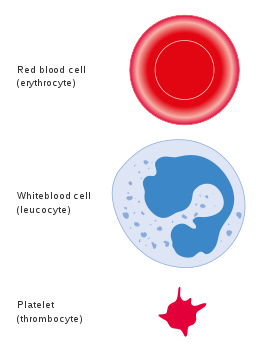
As discussed in Chapter 1, there are different types of cells in the human body. Figure 2.34 provides a review of the three most common cell types: erythrocyte, leukocyte, and thrombocyte. Note that all the cell names end with the suffix -cyte, meaning “cell,” and begin with a combining form that indicates the type of cell.
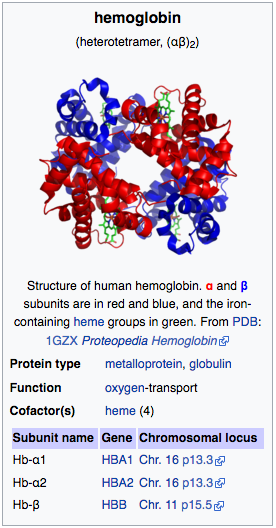
The term hemoglobin means “protein (-globin) in the blood (hem/o).” Hemoglobin is the part of the red blood cell that carries oxygen throughout the body and transports carbon dioxide back to the lungs (Mayo Clinic, 2022). Figure 2.35 is an image of the complex hemoglobin cell structure. If you have low hemoglobin, you would be diagnosed with anemia. Various types of anemia were discussed in Chapter 1.
| Suffix | MEANING | EXAMPLE OF USE IN A MEDICAL TERM |
| -gen | substance or agent that produces or causes | antigen |
| -genic | producing, originating, causing | carcinogenic |

Key Concept
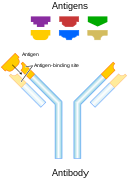
The term antigen literally means “to produce against.” Some examples of antigens are bacteria, viruses, and fungi. When an antigen enters the body, the immune system responds by producing antibodies to fight the antigen.
There are various ways to detect antigens in the body. An example is the rapid test for COVID-19 (Figure 2.37), which is used to detect the presence of certain proteins on the COVID-19 virus found in a sample of bodily fluid.
| Suffix | MEANING | EXAMPLE OF USE IN A MEDICAL TERM |
| -plasia | formation (condition) | hyperplasia |
| -plasm | formation (tissue) | neoplasm |
Key Concept
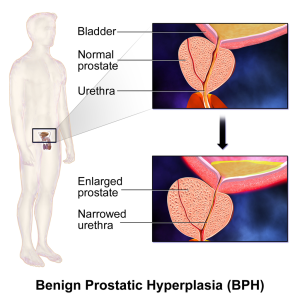
Figure 2.38 provides a comparison of a normal prostate and an enlarged prostate. When the prostate becomes enlarged and is non-cancerous, the individual is diagnosed with benign prostatic hyperplasia (BPH). Hyperplasia means “formation (-plasia) that is excessive (hyper-).”
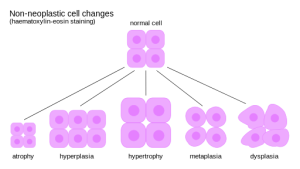
Figure 2.41 below shows examples of several cell types, including hyperplasia. A physician may first treat BPH with medication, but if that does not work, they might perform a surgical procedure called a transurethral resection of the prostate (TURP) (WebMD, 2020).
| Suffix | MEANING | EXAMPLE OF USE IN A MEDICAL TERM |
| -iatrist | specialist | psychiatrist |
| -iatry | specialty, treatment | psychiatry |
| -logist | specialist who studies or treats | psychologist |
| -logy | study of | psychology |


Key Concept
It is important to note that all the suffixes in Table 2.26 (-iatrist, -iatry, -logist, -logy) are very similar but have slightly different meanings. The context determines which suffix is used in a medical term. For example, nephrology means “the study of the kidneys,” whereas a nephrologist is a specialist who treats kidney disease. In fig. 2.39 and 2.40 there are different specialists at work in clinical and laboratory settings.
Table 2.27. Examples of -logy
| MEDICAL TERM | MEANING |
|---|---|
| cardiology | study of the heart |
| dermatology | study of the skin |
| endocrinology | study of the endocrine system and hormones |
| gastroenterology | study of the stomach and intestines |
| gynecology | study of women |
| hematology | study of blood |
| immunology | study of immunity |
| neurology | study of nerves |
| oncology | study of tumours |
| ophthalmology | study of the eye |
| pathology | study of disease |
| pharmacology | study of medication |
| proctology | study of the anus and rectum |
| psychology | study of the mind |
| pulmonology | study of the lungs |
| radiology | study of X-rays |
| rheumatology | study of disease of the joints |
| urology | study of the urinary tract |
| Suffix | MEANING | EXAMPLE OF USE IN A MEDICAL TERM |
| -thesis | to put, to place | prosthesis |
| -trophy | nourishment, development | atrophy |
| -al, -eal, -ar, -ary, -ic, -ior, -tic | pertaining to | renal, esophageal, vascular, pulmonary, pelvic, anterior, antibiotic |
Key Concept
There are a number of changes that cells can undergo, and Figure 2.41 illustrates several of these using the suffixes -trophy (“nourishment” or “development”) and -plasia (“formation”).
- atrophy: No development; for example, when a cast is removed and the affected limb has decreased in size
- dysplasia: Formation that is abnormal; for example, children who have abnormal hip formation such as hip dysplasia (Medical News Today, 2022)
- hyperplasia: Formation that is excessive; for example BPH, seen in Figure 2.38 (WebMD, 2020)
- hypertrophy: Development that is excessive; for example, the large muscles of a bodybuilder (Healthline, 2019).
- metaplasia: Cell formation that has changed; for example, lungs exposed to cigarette smoke may have cells that have changed shape (Giroux & Rustgi, 2017)
Exercises
Attribution
Unless otherwise indicated, material on this page has been adapted from the following resource:
Carter, K., & Rutherford, M. (2020). Building a medical terminology foundation. eCampus Ontario. https://ecampusontario.pressbooks.pub/medicalterminology/ licensed under CC BY 4.0
References
Giroux, V., & Rustgi, A. K. (2017). Metaplasia: tissue injury adaptation and a precursor to the dysplasia–cancer sequence. Nature Reviews Cancer, 17(10), 594–604. https://doi.org/10.1038/nrc.2017.68
Healthline. (February 26, 2019). Muscular hypertrophy and your workout. https://www.healthline.com/health/muscular-hypertrophy#exercise-frequency
Mayo Clinic. (2022). Hemoglobin test. https://www.mayoclinic.org/tests-procedures/hemoglobin-test/about/pac-20385075#:~:text=Hemoglobin%20is%20a%20protein%20in,blood%20cell%20count%20(anemia)
Medical News Today. (April 12, 2022). Everything you need to know about dysplasia. https://www.medicalnewstoday.com/articles/311902#types
National Cancer Institute. (2022). Neoplasm. https://www.cancer.gov/publications/dictionaries/cancer-terms/def/neoplasm
WebMD. (October 30, 2020). Do I need surgery for BPH? https://www.webmd.com/men/prostate-enlargement-bph/enlarged-prostate-time-prostate-surgery#:~:text=Transurethral%20resection%20of%20the%20prostate,to%20remove%20the%20excess%20tissue
Image Credits (images are listed in order of appearance)
Diagram of three different types of blood cell CRUK 049 by Cancer Research UK, CC BY-SA 4.0
English-language Wikipedia infobox for hemoglobin by Flor WMCH, CC BY-SA 4.0
Antibody by Fvasconcellos, Public domain
Bôite test rapide Covid-19 Rapid Response TNX EN by Miguel Tremblay, CC0 1.0
Benign Prostatic Hyperplasia (BPH) by BruceBlaus, CC BY-SA 4.0
Professional Medical Doctor by Mona Hassan Abo-Abda, CC BY-SA 4.0
Microscope (inverted) by National Cancer Institute, Public domain
Non-neoplastic changes by DennisHansen, CC BY 3.0
To secrete within; for example, endocrine glands secrete hormones
A cell that clots (platelet)
A protein in the blood that carries oxygen
A cell that is red; red blood cell
A cell that is white; white blood cell
The condition of no blood
To produce against bacteria or viruses that enter the body
Producing or causing cancer
Enlargement of an organ or tissue caused by an increase in the number of cells
New formation or growth
A specialist in the treatment of the mind
Treatment of the mind
A specialist in the study of the mind
The study of the mind
To place in front; an artificial limb
No nourishment or development
Pertaining to the kidneys
Pertaining to the esophagus
Pertaining to the blood vessels
Pertaining to the lungs
Pertaining to the pelvis
Pertaining to the front
Pertaining to against life