

3.2: Prefixes for Diagnostic Procedures and Symptoms
- Page ID
- 150525

\( \newcommand{\vecs}[1]{\overset { \scriptstyle \rightharpoonup} {\mathbf{#1}} } \)
\( \newcommand{\vecd}[1]{\overset{-\!-\!\rightharpoonup}{\vphantom{a}\smash {#1}}} \)
\( \newcommand{\dsum}{\displaystyle\sum\limits} \)
\( \newcommand{\dint}{\displaystyle\int\limits} \)
\( \newcommand{\dlim}{\displaystyle\lim\limits} \)
\( \newcommand{\id}{\mathrm{id}}\) \( \newcommand{\Span}{\mathrm{span}}\)
( \newcommand{\kernel}{\mathrm{null}\,}\) \( \newcommand{\range}{\mathrm{range}\,}\)
\( \newcommand{\RealPart}{\mathrm{Re}}\) \( \newcommand{\ImaginaryPart}{\mathrm{Im}}\)
\( \newcommand{\Argument}{\mathrm{Arg}}\) \( \newcommand{\norm}[1]{\| #1 \|}\)
\( \newcommand{\inner}[2]{\langle #1, #2 \rangle}\)
\( \newcommand{\Span}{\mathrm{span}}\)
\( \newcommand{\id}{\mathrm{id}}\)
\( \newcommand{\Span}{\mathrm{span}}\)
\( \newcommand{\kernel}{\mathrm{null}\,}\)
\( \newcommand{\range}{\mathrm{range}\,}\)
\( \newcommand{\RealPart}{\mathrm{Re}}\)
\( \newcommand{\ImaginaryPart}{\mathrm{Im}}\)
\( \newcommand{\Argument}{\mathrm{Arg}}\)
\( \newcommand{\norm}[1]{\| #1 \|}\)
\( \newcommand{\inner}[2]{\langle #1, #2 \rangle}\)
\( \newcommand{\Span}{\mathrm{span}}\) \( \newcommand{\AA}{\unicode[.8,0]{x212B}}\)
\( \newcommand{\vectorA}[1]{\vec{#1}} % arrow\)
\( \newcommand{\vectorAt}[1]{\vec{\text{#1}}} % arrow\)
\( \newcommand{\vectorB}[1]{\overset { \scriptstyle \rightharpoonup} {\mathbf{#1}} } \)
\( \newcommand{\vectorC}[1]{\textbf{#1}} \)
\( \newcommand{\vectorD}[1]{\overrightarrow{#1}} \)
\( \newcommand{\vectorDt}[1]{\overrightarrow{\text{#1}}} \)
\( \newcommand{\vectE}[1]{\overset{-\!-\!\rightharpoonup}{\vphantom{a}\smash{\mathbf {#1}}}} \)
\( \newcommand{\vecs}[1]{\overset { \scriptstyle \rightharpoonup} {\mathbf{#1}} } \)
\(\newcommand{\longvect}{\overrightarrow}\)
\( \newcommand{\vecd}[1]{\overset{-\!-\!\rightharpoonup}{\vphantom{a}\smash {#1}}} \)
\(\newcommand{\avec}{\mathbf a}\) \(\newcommand{\bvec}{\mathbf b}\) \(\newcommand{\cvec}{\mathbf c}\) \(\newcommand{\dvec}{\mathbf d}\) \(\newcommand{\dtil}{\widetilde{\mathbf d}}\) \(\newcommand{\evec}{\mathbf e}\) \(\newcommand{\fvec}{\mathbf f}\) \(\newcommand{\nvec}{\mathbf n}\) \(\newcommand{\pvec}{\mathbf p}\) \(\newcommand{\qvec}{\mathbf q}\) \(\newcommand{\svec}{\mathbf s}\) \(\newcommand{\tvec}{\mathbf t}\) \(\newcommand{\uvec}{\mathbf u}\) \(\newcommand{\vvec}{\mathbf v}\) \(\newcommand{\wvec}{\mathbf w}\) \(\newcommand{\xvec}{\mathbf x}\) \(\newcommand{\yvec}{\mathbf y}\) \(\newcommand{\zvec}{\mathbf z}\) \(\newcommand{\rvec}{\mathbf r}\) \(\newcommand{\mvec}{\mathbf m}\) \(\newcommand{\zerovec}{\mathbf 0}\) \(\newcommand{\onevec}{\mathbf 1}\) \(\newcommand{\real}{\mathbb R}\) \(\newcommand{\twovec}[2]{\left[\begin{array}{r}#1 \\ #2 \end{array}\right]}\) \(\newcommand{\ctwovec}[2]{\left[\begin{array}{c}#1 \\ #2 \end{array}\right]}\) \(\newcommand{\threevec}[3]{\left[\begin{array}{r}#1 \\ #2 \\ #3 \end{array}\right]}\) \(\newcommand{\cthreevec}[3]{\left[\begin{array}{c}#1 \\ #2 \\ #3 \end{array}\right]}\) \(\newcommand{\fourvec}[4]{\left[\begin{array}{r}#1 \\ #2 \\ #3 \\ #4 \end{array}\right]}\) \(\newcommand{\cfourvec}[4]{\left[\begin{array}{c}#1 \\ #2 \\ #3 \\ #4 \end{array}\right]}\) \(\newcommand{\fivevec}[5]{\left[\begin{array}{r}#1 \\ #2 \\ #3 \\ #4 \\ #5 \\ \end{array}\right]}\) \(\newcommand{\cfivevec}[5]{\left[\begin{array}{c}#1 \\ #2 \\ #3 \\ #4 \\ #5 \\ \end{array}\right]}\) \(\newcommand{\mattwo}[4]{\left[\begin{array}{rr}#1 \amp #2 \\ #3 \amp #4 \\ \end{array}\right]}\) \(\newcommand{\laspan}[1]{\text{Span}\{#1\}}\) \(\newcommand{\bcal}{\cal B}\) \(\newcommand{\ccal}{\cal C}\) \(\newcommand{\scal}{\cal S}\) \(\newcommand{\wcal}{\cal W}\) \(\newcommand{\ecal}{\cal E}\) \(\newcommand{\coords}[2]{\left\{#1\right\}_{#2}}\) \(\newcommand{\gray}[1]{\color{gray}{#1}}\) \(\newcommand{\lgray}[1]{\color{lightgray}{#1}}\) \(\newcommand{\rank}{\operatorname{rank}}\) \(\newcommand{\row}{\text{Row}}\) \(\newcommand{\col}{\text{Col}}\) \(\renewcommand{\row}{\text{Row}}\) \(\newcommand{\nul}{\text{Nul}}\) \(\newcommand{\var}{\text{Var}}\) \(\newcommand{\corr}{\text{corr}}\) \(\newcommand{\len}[1]{\left|#1\right|}\) \(\newcommand{\bbar}{\overline{\bvec}}\) \(\newcommand{\bhat}{\widehat{\bvec}}\) \(\newcommand{\bperp}{\bvec^\perp}\) \(\newcommand{\xhat}{\widehat{\xvec}}\) \(\newcommand{\vhat}{\widehat{\vvec}}\) \(\newcommand{\uhat}{\widehat{\uvec}}\) \(\newcommand{\what}{\widehat{\wvec}}\) \(\newcommand{\Sighat}{\widehat{\Sigma}}\) \(\newcommand{\lt}{<}\) \(\newcommand{\gt}{>}\) \(\newcommand{\amp}{&}\) \(\definecolor{fillinmathshade}{gray}{0.9}\)Prefixes are often used for terms related to diagnostic tests and to symptoms that patients might be experiencing. Examples will be provided that illustrate the manner in which prefixes are used for such terms. Some of these prefixes were introduced in the first chapter, but their use will be explained in further detail here.
| PREFIX | MEANING | EXAMPLE OF USE IN MEDICAL TERMS |
|---|---|---|
| a-, an- | no, not, without | amenorrhea |
| ana- | up, apart | analysis |
Key Concept
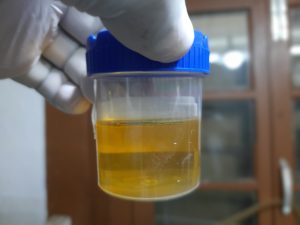
The term analysis literally means “to separate” (-lysis) “apart” (ana-).” Figure 3.16 is an image of a urine specimen ready for analysis, a procedure called urinalysis. The urine is closely analyzed for specific contents such as sugar, protein, bacteria, and blood (Mayo Clinic, 2022b). The information from the analysis is then used to monitor a person’s overall health and assist with diagnosing certain diseases or infections such as diabetes, kidney disease, and urinary tract infections (UTIs).
In health care, pretty much any type of specimen can be analyzed to assist with the diagnosis of a medical condition, disease, or infection. For example, a semen specimen can be analyzed to look at the size, motility, and amount of sperm (Cleveland Clinic, 2022). Other bodily fluids can be analyzed as well, including sputum, wound drainage, and stool.
| PREFIX | MEANING | EXAMPLE OF USE IN MEDICAL TERMS |
|---|---|---|
| ante- | before, forward | antepartum |
| brady- | slow | bradycardia |
As discussed previously, the term antepartum, meaning “before” (ante-) “birth” (-partum), is the period of time before a women delivers their baby. In some hospitals, there is an antepartum unit in which mothers stay if they are having complications with their pregnancy. The time after a women gives birth is called postpartum, meaning “after” (post-) “birth” (-partum). Once again, some hospitals will have a postpartum unit where patients will stay for as little as a day or much longer depending on how their birthing experience went.
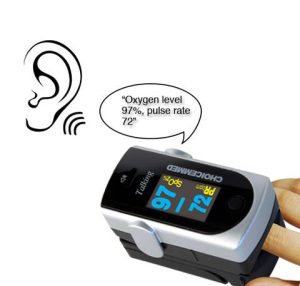
Bradycardia, meaning “condition” (-ia) of a “slow” (brady-) “heart” (cardi/o), refers to a heart beating more slowly than normal (Mayo Clinic, 2022a). This can occur for several reasons, including damage to the heart tissue, medications, birth defect, and thyroid disorders. Figure 3.17 is an image of a pulse oximeter, a device that measures heart rate and oxygen level.
Bradypnea meaning “breathing” (-pnea) “slowly” (brady-). This is a condition in which a person breathes at a slower than normal rate (Smith, 2020). Sleep apnea, which was discussed in a previous chapter, is a condition in which a person may stop breathing (apnea) in addition to breathing more slowly than normal (bradypnea) and therefore not get enough oxygen. Bradypnea can also occur with a drug overdose or in carbon monoxide poisoning.
| Prefix | MEANING | EXAMPLE OF USE IN MEDICAL TERMS |
|---|---|---|
| dys- | painful, difficult, abnormal | dyspnea |
Key Concept
The prefix dys-, which means “painful, difficult or abnormal,” is used in a number of medical terms, usually relating to a symptom that a patient might be experiencing. Table 3.14 below lists some of the more common terms that use this prefix. There are, of course, more, and on specialty units in a hospital, there are likely others that will be commonly heard as well.
Dysuria, meaning “a urine condition” (-uria) that is “painful” (dys-), is often one of the symptoms of a urinary tract infection (UTI). As mentioned above, a patient will likely have a urinalysis to help diagnose a UTI (Mayo Clinic, 2022c).
| MEDICAL TERM | MEANING |
|---|---|
| dysentery | condition of painful intestines |
| dyspepsia | digestion that is painful |
| dysphagia | difficulty swallowing |
| dysphasia | difficulty with speech |
| dysplasia | abnormal formation |
| dyspnea | difficulty breathing |
| dysmenorrhea | painful menstrual flow |
| dysuria | painful urination |
| PREFIX | MEANING | EXAMPLE OF USE IN MEDICAL TERMS |
|---|---|---|
| hyper- | excessive, too much, above | hypertension |
| hypo- | deficient, too little, below | hypotension |
Key Concept
The prefixes hyper- and hypo- are used in many medical terms, and it is critical to use the correct prefix because they mean the exact opposite of one another. The list below demonstrates this concept:
- hyperglycemia (blood sugar that is high)
- hypoglycemia (blood sugar that is low)
- hypertension (pressure that is high or high blood pressure)
- hypotension (pressure that is low or low blood pressure)
- hyperthyroidism (condition of high thyroid)
- hypothyroidism (condition of low thyroid)
- hyperkalemia (blood condition with high potassium)
- hypokalemia (blood condition with low potassium)
| PREFIX | MEANING | EXAMPLE OF USE IN MEDICAL TERMS |
|---|---|---|
| mal- | bad | malignant |
| meta- | change, beyond | metastasis |
| neo- | new | neoplasm |
Key Concept
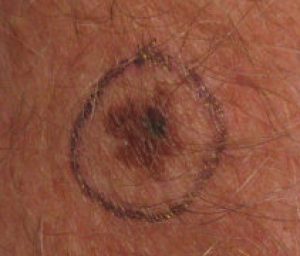
Figure 3.18 is an image of a neoplasm. This term has the prefix neo- (“new”) and the suffix -plasm (“formation”). A neoplasm occurs when cells reproduce more than they should. It can be benign (non-cancerous) or malignant (cancerous), and if the cancer spreads to another place, such as other tissues or organs, it is called metastasis, meaning “place” (-stasis) that has “changed” (meta-) (National Cancer Institute, 2022).
| PREFIX | MEANING | EXAMPLE OF USE IN MEDICAL TERMS |
|---|---|---|
| pre- | before | precancerous |
| post- | after | postmortem |
| tachy- | fast | tachycardia |
Key Concept
The prefix pre-, meaning “before,” is used in a number of medical terms; for example:
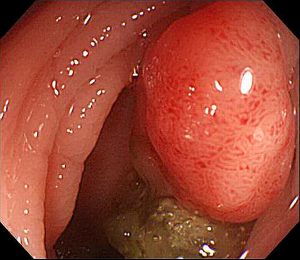
- precancerous (“pertaining to before cancer”; for example, a precancerous colonic polyp, shown in Figure 3.19)
- prenatal (“pertaining to before birth”; for example, prenatal care)
The prefix tachy- (“fast”) is the opposite of the prefix brady- (“slow”). Tachycardia means a “condition” (-ia) of a “fast” (tachy-) “heart” (cardi/o) and can occur during exercise or can be a serious medical conditions such as an arrhythmia.
Tachypnea, meaning “breathing” (-pnea) that is “fast” (tachy-), is the opposite of bradypnea, which was discussed earlier on this page. Tachypnea can occur when a person is exercising vigorously or with certain medical conditions such as asthma, chronic obstructive pulmonary disease (COPD), and pneumonia (Berry & Fletcher, 2022).
Exercises
Attribution
Unless otherwise indicated, material on this page has been adapted from the following resource:
Carter, K., & Rutherford, M. (2020). Building a medical terminology foundation. eCampusOntario. https://ecampusontario.pressbooks.pub/medicalterminology/ licensed under CC BY 4.0
References
Berry, J., & Fletcher, J. (2022). What to know about tachypnea. MedicalNewsToday. https://www.medicalnewstoday.com/articles/324548#oxygen-shortage
Cleveland Clinic. (2022). Semen analysis. https://my.clevelandclinic.org/health/diagnostics/21520-semen-analysis#:~:text=A%20semen%20analysis%20is%20a%20lab%20test%20that%20evaluates%20sperm,that%20more%20testing%20is%20necessa
Mayo Clinic. (2022a). Bradycardia. https://www.mayoclinic.org/diseases-conditions/bradycardia/symptoms-causes/syc-20355474#:~:text=Bradycardia%20(brad%2De%2DKAHR,than%2060%20times%20a%20minute
Mayo Clinic. (2022b). Urinalysis. https://www.mayoclinic.org/tests-procedures/urinalysis/about/pac-20384907#:~:text=A%20urinalysis%20is%20a%20test,concentration%20and%20content%20of%20urine
Mayo Clinic. (2022c). Urinary tract infection. https://www.mayoclinic.org/diseases-conditions/urinary-tract-infection/symptoms-causes/syc-20353447
National Cancer Institute. (2022). Neoplasm. https://www.cancer.gov/publications/dictionaries/cancer-terms/def/neoplasm
Smith, M. (2020). Types of breathing problems, explained. WebMD. https://www.webmd.com/lung/breathing-problems#:~:text=you%20feel%20better.-,Bradypnea,poisoning%2C%20or%20a%20drug%20overdose
Image Credits (images are listed in order of appearance)
Urine sample for Culture and Sensitivity by Ajay Kumar Chaurasiya, CC BY-SA 4.0
Pulse Oximeterr by Beijing Choice Electronic Tech, CC BY-SA 4.0
Malignant Melanoma in situ Left Forearm by Dermanonymous, CC BY-SA 4.0
Colon-Polyp by Kuyohong, CC BY-SA 4.0
No menstruation or no menstrual flow
To separate; for example, in a urinalysis
Before birth
condition of a slow heart rate
Pain or difficulty breathing
Pressure that is high; high blood pressure
Pressure that is low; low blood pressure
Growing in an uncontrolled or invasive way; typically refers to cancer that has spread to nearby organs or tissues
To change place
New formation or growth
Pertaining to before cancer; many colon polyps are this type
Death after or after death
condition of a fast heart rate
Pertaining to an irregular heart rhythm
A chronic respiratory condition characterized by narrowing and swelling of the airways
A chronic inflammatory condition of the lungs; often abbreviated as COPD
Pertaining to the lungs; a serious lung infection caused by a virus or bacteria