

3.4: Additional Prefixes
- Page ID
- 150527

\( \newcommand{\vecs}[1]{\overset { \scriptstyle \rightharpoonup} {\mathbf{#1}} } \)
\( \newcommand{\vecd}[1]{\overset{-\!-\!\rightharpoonup}{\vphantom{a}\smash {#1}}} \)
\( \newcommand{\dsum}{\displaystyle\sum\limits} \)
\( \newcommand{\dint}{\displaystyle\int\limits} \)
\( \newcommand{\dlim}{\displaystyle\lim\limits} \)
\( \newcommand{\id}{\mathrm{id}}\) \( \newcommand{\Span}{\mathrm{span}}\)
( \newcommand{\kernel}{\mathrm{null}\,}\) \( \newcommand{\range}{\mathrm{range}\,}\)
\( \newcommand{\RealPart}{\mathrm{Re}}\) \( \newcommand{\ImaginaryPart}{\mathrm{Im}}\)
\( \newcommand{\Argument}{\mathrm{Arg}}\) \( \newcommand{\norm}[1]{\| #1 \|}\)
\( \newcommand{\inner}[2]{\langle #1, #2 \rangle}\)
\( \newcommand{\Span}{\mathrm{span}}\)
\( \newcommand{\id}{\mathrm{id}}\)
\( \newcommand{\Span}{\mathrm{span}}\)
\( \newcommand{\kernel}{\mathrm{null}\,}\)
\( \newcommand{\range}{\mathrm{range}\,}\)
\( \newcommand{\RealPart}{\mathrm{Re}}\)
\( \newcommand{\ImaginaryPart}{\mathrm{Im}}\)
\( \newcommand{\Argument}{\mathrm{Arg}}\)
\( \newcommand{\norm}[1]{\| #1 \|}\)
\( \newcommand{\inner}[2]{\langle #1, #2 \rangle}\)
\( \newcommand{\Span}{\mathrm{span}}\) \( \newcommand{\AA}{\unicode[.8,0]{x212B}}\)
\( \newcommand{\vectorA}[1]{\vec{#1}} % arrow\)
\( \newcommand{\vectorAt}[1]{\vec{\text{#1}}} % arrow\)
\( \newcommand{\vectorB}[1]{\overset { \scriptstyle \rightharpoonup} {\mathbf{#1}} } \)
\( \newcommand{\vectorC}[1]{\textbf{#1}} \)
\( \newcommand{\vectorD}[1]{\overrightarrow{#1}} \)
\( \newcommand{\vectorDt}[1]{\overrightarrow{\text{#1}}} \)
\( \newcommand{\vectE}[1]{\overset{-\!-\!\rightharpoonup}{\vphantom{a}\smash{\mathbf {#1}}}} \)
\( \newcommand{\vecs}[1]{\overset { \scriptstyle \rightharpoonup} {\mathbf{#1}} } \)
\(\newcommand{\longvect}{\overrightarrow}\)
\( \newcommand{\vecd}[1]{\overset{-\!-\!\rightharpoonup}{\vphantom{a}\smash {#1}}} \)
\(\newcommand{\avec}{\mathbf a}\) \(\newcommand{\bvec}{\mathbf b}\) \(\newcommand{\cvec}{\mathbf c}\) \(\newcommand{\dvec}{\mathbf d}\) \(\newcommand{\dtil}{\widetilde{\mathbf d}}\) \(\newcommand{\evec}{\mathbf e}\) \(\newcommand{\fvec}{\mathbf f}\) \(\newcommand{\nvec}{\mathbf n}\) \(\newcommand{\pvec}{\mathbf p}\) \(\newcommand{\qvec}{\mathbf q}\) \(\newcommand{\svec}{\mathbf s}\) \(\newcommand{\tvec}{\mathbf t}\) \(\newcommand{\uvec}{\mathbf u}\) \(\newcommand{\vvec}{\mathbf v}\) \(\newcommand{\wvec}{\mathbf w}\) \(\newcommand{\xvec}{\mathbf x}\) \(\newcommand{\yvec}{\mathbf y}\) \(\newcommand{\zvec}{\mathbf z}\) \(\newcommand{\rvec}{\mathbf r}\) \(\newcommand{\mvec}{\mathbf m}\) \(\newcommand{\zerovec}{\mathbf 0}\) \(\newcommand{\onevec}{\mathbf 1}\) \(\newcommand{\real}{\mathbb R}\) \(\newcommand{\twovec}[2]{\left[\begin{array}{r}#1 \\ #2 \end{array}\right]}\) \(\newcommand{\ctwovec}[2]{\left[\begin{array}{c}#1 \\ #2 \end{array}\right]}\) \(\newcommand{\threevec}[3]{\left[\begin{array}{r}#1 \\ #2 \\ #3 \end{array}\right]}\) \(\newcommand{\cthreevec}[3]{\left[\begin{array}{c}#1 \\ #2 \\ #3 \end{array}\right]}\) \(\newcommand{\fourvec}[4]{\left[\begin{array}{r}#1 \\ #2 \\ #3 \\ #4 \end{array}\right]}\) \(\newcommand{\cfourvec}[4]{\left[\begin{array}{c}#1 \\ #2 \\ #3 \\ #4 \end{array}\right]}\) \(\newcommand{\fivevec}[5]{\left[\begin{array}{r}#1 \\ #2 \\ #3 \\ #4 \\ #5 \\ \end{array}\right]}\) \(\newcommand{\cfivevec}[5]{\left[\begin{array}{c}#1 \\ #2 \\ #3 \\ #4 \\ #5 \\ \end{array}\right]}\) \(\newcommand{\mattwo}[4]{\left[\begin{array}{rr}#1 \amp #2 \\ #3 \amp #4 \\ \end{array}\right]}\) \(\newcommand{\laspan}[1]{\text{Span}\{#1\}}\) \(\newcommand{\bcal}{\cal B}\) \(\newcommand{\ccal}{\cal C}\) \(\newcommand{\scal}{\cal S}\) \(\newcommand{\wcal}{\cal W}\) \(\newcommand{\ecal}{\cal E}\) \(\newcommand{\coords}[2]{\left\{#1\right\}_{#2}}\) \(\newcommand{\gray}[1]{\color{gray}{#1}}\) \(\newcommand{\lgray}[1]{\color{lightgray}{#1}}\) \(\newcommand{\rank}{\operatorname{rank}}\) \(\newcommand{\row}{\text{Row}}\) \(\newcommand{\col}{\text{Col}}\) \(\renewcommand{\row}{\text{Row}}\) \(\newcommand{\nul}{\text{Nul}}\) \(\newcommand{\var}{\text{Var}}\) \(\newcommand{\corr}{\text{corr}}\) \(\newcommand{\len}[1]{\left|#1\right|}\) \(\newcommand{\bbar}{\overline{\bvec}}\) \(\newcommand{\bhat}{\widehat{\bvec}}\) \(\newcommand{\bperp}{\bvec^\perp}\) \(\newcommand{\xhat}{\widehat{\xvec}}\) \(\newcommand{\vhat}{\widehat{\vvec}}\) \(\newcommand{\uhat}{\widehat{\uvec}}\) \(\newcommand{\what}{\widehat{\wvec}}\) \(\newcommand{\Sighat}{\widehat{\Sigma}}\) \(\newcommand{\lt}{<}\) \(\newcommand{\gt}{>}\) \(\newcommand{\amp}{&}\) \(\definecolor{fillinmathshade}{gray}{0.9}\)This page focuses on prefixes not covered in the previous sections. Some of these prefixes were introduced earlier in the book; however, their use can be complex, and it is important to understand these concepts fully. Examples and review exercises will be provided to help you learn and remember these important concepts.
| PREFIX | MEANING | EXAMPLE OF USE IN A MEDICAL TERM |
| anti- | against | antibiotic |

Key Concept
As discussed in Chapter 2, antigens, which means “producing against,” are foreign substances such as bacteria, viruses, or fungi that enter the body. When a foreign substance enters the body, the body reacts by producing antibodies, a term that means “working against the bodies of the foreign substance.” If the foreign substance is a bacteria, your doctor would likely prescribe an antibiotic, a term that means “pertaining to” (-tics) “against” (anti-) “life” (bi/o). Figure 3.23 is a plaque commemorating the use of the first antibiotic, penicillin (NHS, 2019).
| PREFIX | MEANING | EXAMPLE OF USE IN A MEDICAL TERM |
| dia- | complete, through | diagnosis |
Key Concepts
The prefix dia- (“complete”) is frequently used in medical terms; for example, in the term diagnosis, which most people are familiar with. Diagnosis means “pertaining to knowledge” (gnos/o -is) that is “complete” (dia-), or “complete knowledge.” Once a physician has all the necessary information to provide a patient with a proper diagnosis, they will often tell the patient their prognosis. This term literally means “knowledge before,” and in this situation, prognosis refers to how the physician feels a patient’s outcome will be with or without treatment.
There are several other medical terms that use the prefix dia-. The list below provides some examples, but you may hear others, especially in hospital specialty units:
- diaphragm: The muscle separating the abdominal and thoracic cavities
- dialysis: Separation that is complete; as discussed previously, there are two types—peritoneal dialysis and hemodialysis
- diameter: Measure completely
- diarrhea: Flow completely
| PREFIX | MEANING | EXAMPLE OF USE IN A MEDICAL TERM |
| de- | from, down, away from | dehydration |
| eu- | good, normal | euphoria |
Key Concept
The term dehydration means “condition” (-ation) of “down” (de-) “water “(hydr/o). On average, a person requires four to six cups of water a day to avoid dehydration, but this may vary depending on a person’s activity level, the climate, and whether or not they have other health conditions that require them to drink more or less water based on a physician’s advice (Harvard Medical School, 2020).
| PREFIX | MEANING | EXAMPLE OF USE IN A MEDICAL TERM |
| hemi- | half | hemiplegia |
Key Concepts
The prefix hemi- (“half”) is used in a number of terms, especially those related to surgical procedures; for example:
- hemigastrectomy: Removal of half the stomach
- hemicolectomy: Removal of half the colon
- hemiarthroplasty: Surgical repair of half a joint
The prefix hemi- is also used in terms related to symptoms that a patient might be experiencing; for example, hemiplegia, meaning “paralysis” (-plegia) of “half” (hemi-), might refer to paralysis of the right or left side of the body as a result of a cerebrovascular accident (CVA), or stroke. If a patient is experiencing paralysis of the lower half of their body, the term used is paraplegia. When a person has paralysis of all four extremities, this is called quadriplegia.
| PREFIX | MEANING | EXAMPLE OF USE IN A MEDICAL TERM |
| sym- | together, with, joined | symbiotic |
| syn- | together, with, joined | syndrome |
Key Concept
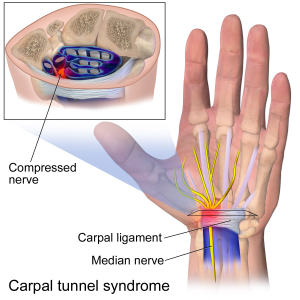
Figure 3.24 is an illustration of a common syndrome that may affect healthcare workers, carpal tunnel syndrome, from the suffix -al (“pertaining to”) and carp/o (“wrist”). This condition is a type of repetitive strain injury (RSI) and can be caused by such activities as typing, overexertion, and various clinical tasks that require the use of fine motor skills (ReliasMedia, 2012).
| PREFIX | MEANING | EXAMPLE OF USE IN A MEDICAL TERM |
| ultra- | beyond | ultrasonogram |
Key Concept
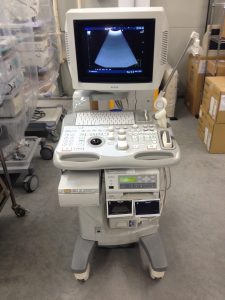
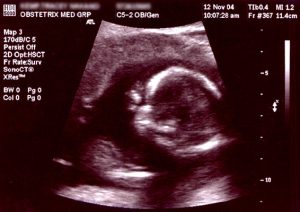
Ultrasonography, which means “process of recording” (-graphy) “beyond” (ultra-) “sound” (son/o), is commonly used to help diagnose the cause of pain or to assess for abnormalities or infections (RadiologyInfo.org, 2020). Figure 3.25 is an image of ultrasound equipment that would be used by an ultrasound technician or radiologist. Figure 3.26 is an obstetrical ultrasound that is used to assess the health of a fetus.
Exercises
Attribution
Unless otherwise indicated, material on this page has been adapted from the following resource:
Carter, K., & Rutherford, M. (2020). Building a medical terminology foundation. eCampusOntario. https://ecampusontario.pressbooks.pub/medicalterminology/ licensed under CC BY 4.0
References
Harvard Medical School. (2020). How much water should you drink? https://www.health.harvard.edu/staying-healthy/how-much-water-should-you-drink
NHS. (2019). Uses: Antibiotics. https://www.nhs.uk/conditions/antibiotics/uses/#:~:text=Antibiotics%20are%20used%20to%20treat,without%20antibiotics%20%E2%80%93%20such%20as%20acne
RadiologyInfo.org. (2020). General ultrasound. https://www.radiologyinfo.org/en/info/genus#:~:text=Ultrasound%20imaging%20uses%20sound%20waves,%2C%20hips%2C%20and%20spine.%20
ReliasMedia. (2012). Nurses at risk for carpal tunnel. https://www.reliasmedia.com/articles/78400-nurses-at-risk-for-carpal-tunnel
Image Credits (images are listed in order of appearance)
Penicillin treatment (45905411884) by Owen Massey McKnight, CC BY-SA 2.0
Carpal Tunnel Syndrome by BruceBlaus, CC BY 3.0
ALOKA SSD-3500SV by Kitmondo Marketplace, CC BY 2.0
Obstetric ultrasonograph by Jeremykemp, Public domain
Pertaining to against life
A state of complete knowledge (this term is an exception to the rules; the suffix -sis means "state of")
The condition of down (too little) water
A state of goodness
Paralysis of half the body, usually caused by a cerebrovascular accident (stroke)
Paralysis of the lower half of the body
Paralysis of all four extremities
Pertaining to together in life
A group of signs and symptoms that combine to form a syndrome
A record beyond sound