

4.8: Common Medical Terms
- Page ID
- 150538

\( \newcommand{\vecs}[1]{\overset { \scriptstyle \rightharpoonup} {\mathbf{#1}} } \)
\( \newcommand{\vecd}[1]{\overset{-\!-\!\rightharpoonup}{\vphantom{a}\smash {#1}}} \)
\( \newcommand{\dsum}{\displaystyle\sum\limits} \)
\( \newcommand{\dint}{\displaystyle\int\limits} \)
\( \newcommand{\dlim}{\displaystyle\lim\limits} \)
\( \newcommand{\id}{\mathrm{id}}\) \( \newcommand{\Span}{\mathrm{span}}\)
( \newcommand{\kernel}{\mathrm{null}\,}\) \( \newcommand{\range}{\mathrm{range}\,}\)
\( \newcommand{\RealPart}{\mathrm{Re}}\) \( \newcommand{\ImaginaryPart}{\mathrm{Im}}\)
\( \newcommand{\Argument}{\mathrm{Arg}}\) \( \newcommand{\norm}[1]{\| #1 \|}\)
\( \newcommand{\inner}[2]{\langle #1, #2 \rangle}\)
\( \newcommand{\Span}{\mathrm{span}}\)
\( \newcommand{\id}{\mathrm{id}}\)
\( \newcommand{\Span}{\mathrm{span}}\)
\( \newcommand{\kernel}{\mathrm{null}\,}\)
\( \newcommand{\range}{\mathrm{range}\,}\)
\( \newcommand{\RealPart}{\mathrm{Re}}\)
\( \newcommand{\ImaginaryPart}{\mathrm{Im}}\)
\( \newcommand{\Argument}{\mathrm{Arg}}\)
\( \newcommand{\norm}[1]{\| #1 \|}\)
\( \newcommand{\inner}[2]{\langle #1, #2 \rangle}\)
\( \newcommand{\Span}{\mathrm{span}}\) \( \newcommand{\AA}{\unicode[.8,0]{x212B}}\)
\( \newcommand{\vectorA}[1]{\vec{#1}} % arrow\)
\( \newcommand{\vectorAt}[1]{\vec{\text{#1}}} % arrow\)
\( \newcommand{\vectorB}[1]{\overset { \scriptstyle \rightharpoonup} {\mathbf{#1}} } \)
\( \newcommand{\vectorC}[1]{\textbf{#1}} \)
\( \newcommand{\vectorD}[1]{\overrightarrow{#1}} \)
\( \newcommand{\vectorDt}[1]{\overrightarrow{\text{#1}}} \)
\( \newcommand{\vectE}[1]{\overset{-\!-\!\rightharpoonup}{\vphantom{a}\smash{\mathbf {#1}}}} \)
\( \newcommand{\vecs}[1]{\overset { \scriptstyle \rightharpoonup} {\mathbf{#1}} } \)
\(\newcommand{\longvect}{\overrightarrow}\)
\( \newcommand{\vecd}[1]{\overset{-\!-\!\rightharpoonup}{\vphantom{a}\smash {#1}}} \)
\(\newcommand{\avec}{\mathbf a}\) \(\newcommand{\bvec}{\mathbf b}\) \(\newcommand{\cvec}{\mathbf c}\) \(\newcommand{\dvec}{\mathbf d}\) \(\newcommand{\dtil}{\widetilde{\mathbf d}}\) \(\newcommand{\evec}{\mathbf e}\) \(\newcommand{\fvec}{\mathbf f}\) \(\newcommand{\nvec}{\mathbf n}\) \(\newcommand{\pvec}{\mathbf p}\) \(\newcommand{\qvec}{\mathbf q}\) \(\newcommand{\svec}{\mathbf s}\) \(\newcommand{\tvec}{\mathbf t}\) \(\newcommand{\uvec}{\mathbf u}\) \(\newcommand{\vvec}{\mathbf v}\) \(\newcommand{\wvec}{\mathbf w}\) \(\newcommand{\xvec}{\mathbf x}\) \(\newcommand{\yvec}{\mathbf y}\) \(\newcommand{\zvec}{\mathbf z}\) \(\newcommand{\rvec}{\mathbf r}\) \(\newcommand{\mvec}{\mathbf m}\) \(\newcommand{\zerovec}{\mathbf 0}\) \(\newcommand{\onevec}{\mathbf 1}\) \(\newcommand{\real}{\mathbb R}\) \(\newcommand{\twovec}[2]{\left[\begin{array}{r}#1 \\ #2 \end{array}\right]}\) \(\newcommand{\ctwovec}[2]{\left[\begin{array}{c}#1 \\ #2 \end{array}\right]}\) \(\newcommand{\threevec}[3]{\left[\begin{array}{r}#1 \\ #2 \\ #3 \end{array}\right]}\) \(\newcommand{\cthreevec}[3]{\left[\begin{array}{c}#1 \\ #2 \\ #3 \end{array}\right]}\) \(\newcommand{\fourvec}[4]{\left[\begin{array}{r}#1 \\ #2 \\ #3 \\ #4 \end{array}\right]}\) \(\newcommand{\cfourvec}[4]{\left[\begin{array}{c}#1 \\ #2 \\ #3 \\ #4 \end{array}\right]}\) \(\newcommand{\fivevec}[5]{\left[\begin{array}{r}#1 \\ #2 \\ #3 \\ #4 \\ #5 \\ \end{array}\right]}\) \(\newcommand{\cfivevec}[5]{\left[\begin{array}{c}#1 \\ #2 \\ #3 \\ #4 \\ #5 \\ \end{array}\right]}\) \(\newcommand{\mattwo}[4]{\left[\begin{array}{rr}#1 \amp #2 \\ #3 \amp #4 \\ \end{array}\right]}\) \(\newcommand{\laspan}[1]{\text{Span}\{#1\}}\) \(\newcommand{\bcal}{\cal B}\) \(\newcommand{\ccal}{\cal C}\) \(\newcommand{\scal}{\cal S}\) \(\newcommand{\wcal}{\cal W}\) \(\newcommand{\ecal}{\cal E}\) \(\newcommand{\coords}[2]{\left\{#1\right\}_{#2}}\) \(\newcommand{\gray}[1]{\color{gray}{#1}}\) \(\newcommand{\lgray}[1]{\color{lightgray}{#1}}\) \(\newcommand{\rank}{\operatorname{rank}}\) \(\newcommand{\row}{\text{Row}}\) \(\newcommand{\col}{\text{Col}}\) \(\renewcommand{\row}{\text{Row}}\) \(\newcommand{\nul}{\text{Nul}}\) \(\newcommand{\var}{\text{Var}}\) \(\newcommand{\corr}{\text{corr}}\) \(\newcommand{\len}[1]{\left|#1\right|}\) \(\newcommand{\bbar}{\overline{\bvec}}\) \(\newcommand{\bhat}{\widehat{\bvec}}\) \(\newcommand{\bperp}{\bvec^\perp}\) \(\newcommand{\xhat}{\widehat{\xvec}}\) \(\newcommand{\vhat}{\widehat{\vvec}}\) \(\newcommand{\uhat}{\widehat{\uvec}}\) \(\newcommand{\what}{\widehat{\wvec}}\) \(\newcommand{\Sighat}{\widehat{\Sigma}}\) \(\newcommand{\lt}{<}\) \(\newcommand{\gt}{>}\) \(\newcommand{\amp}{&}\) \(\definecolor{fillinmathshade}{gray}{0.9}\)This final section covers abbreviations for common medical terms. Essentially, it is a collection of abbreviations that are commonplace but do not fit into the other categories in this chapter. Once again, the more complex abbreviations will be explained to help you fully understanding the content, and review exercises are provided at the end of the section.
| ABBREVIATIONS | MEANING |
| Ab | antibody |
| abd | abdomen |
| BM | bowel movement, bone marrow |
| C1, C2, … | cervical vertebra 1, cervical vertebra 2, … |
| CCU | coronary care unit |
| CNS | central nervous system |
Key Concepts
As can be seen in the table above, the abbreviation BM (bowel movement or bone marrow) can have two very different meanings. As such, it is always important to look at the context in which the abbreviation is used. This will help you determine which meaning is intended.
A coronary care unit (CCU) is a hospital unit that specializes in assessing heart rhythms and providing complex care to patients experiencing cardiac pathologies. Not all hospitals have a CCU, but there are a number of them in the Edmonton area, including at the Grey Nuns Community Hospital (Alberta Health Services, 2022).
Example of orders:
- Pt to be discharged from the CCU this pm
Explanation of orders:
- Patient to be discharged from the coronary care unit this evening.
| ABBREVIATIONS | MEANING |
| DNA | deoxyribonucleic acid |
| DOB | date of birth |
| Dr. | doctor |
| Dx | diagnosis |
| EENT | eye, ear, nose, and throat |
| ENT | ears, nose, and throat |
| ER | emergency room |
| Fx | fracture |
Key Concept
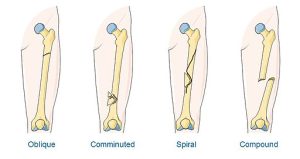
Fractures (Fx) can occur in any bone in the body and, as can be seen in Figure 4.19, there are different types of fractures depending on the mechanism of injury. Fractures are often, at least initially, treated in the emergency room (ER), then the patient is sent to a surgical unit if they require surgery to repair the injury.
Example of orders:
- Dx: GERD and COPD
- Pt admitted to the ER with L leg Fx
Explanation of orders:
- Diagnosis: gastroesophageal reflux disease and chronic obstructive pulmonary disease.
- Patient admitted to the emergency room with a left leg fracture.
| ABBREVIATIONS | MEANING |
| GI | gastrointestinal |
| GU | genitourinary |
| GYN | gynecology |
| HCA | healthcare aide |
| Ht | height |
| Hx | history |
| ICU | intensive care unit |
| JP | Jackson-Pratt drain |
| Kx | Kardex |
| L | left |
Key Concept
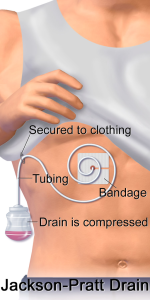
A Jackson-Pratt drain (JP) has a soft plastic bulb with a flexible tube attached to it. It also has a stopper that can be used to drain the fluid from the bulb (Memorial Sloan Kettering Cancer Center, 2022). The tubing is placed inside the patient to allow for drainage to leave the patient’s body and into the bulb, as can be seen in Figure 4.20. When the bulb is squeezed, a gentle suction is created that draws excess fluid from the body. The bulb should be compressed at all times, except when draining the bulb (Memorial Sloan Kettering Cancer Center, 2022).
Example of orders:
- Pt has Hx of PID, referral to GYN
Explanation of orders:
- Patient has a history of pelvic inflammatory disease, referral to gynecology.
| ABBREVIATIONS | MEANING |
| L1, L2, … | lumbar vertebra 1, lumbar vertebra 2, … |
| lat | lateral |
| LLQ | left lower quadrant |
| LPN | licensed practical nurse |
| LUQ | left upper quadrant |
| MBA | motorbike accident |
| MD | medical doctor |
| meds | medications |
| mets | metastasis |
| mmHg | millimetres of mercury |
Key Concept
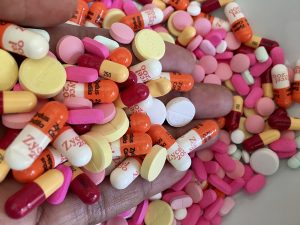
The abbreviation mmHg (millimetres of mercury) is the standard unit of measurement for pressure and is often used in reference to blood pressure. Blood pressure numbers at or slightly below 120/80 mmHg are considered to be within the normal range (American Heart Association, 2022). The first number (120) is the systolic blood pressure and shows how much pressure the blood is exerting against the artery walls when the heart beats. The second number (80) is the diastolic blood pressure and indicates how much pressure the blood is exerting against the artery walls while the heart is resting between beats (American Heart Association, 2022).
Example of orders:
- Pt has pain to LUQ and LLQ following MBA
Explanation of orders:
- Patient has pain to the left upper quadrant and left lower quadrant following a motorbike accident.
| ABBREVIATIONS | MEANING |
| MVA | motor vehicle accident |
| NICU | neonatal intensive care unit |
| OPD | outpatient department |
| OR | operating room |
| Ortho | orthopedics |
| PA | posteroanterior |
| PAC | pre-admission clinic |
| PCA | patient controlled analgesic |
| post-op | after surgery |
| pre-op | before surgery |
Key Concept
Patient-controlled analgesics (PCAs) are used on many different hospital units. PCAs, as the name indicates, allow the patient to control the administration of their analgesics. The patient presses a button, which then provides an analgesic through their IV to relieve their pain. The amount of analgesic that can be administered is limited and the amount used is monitored. PCAs are a great innovation for patient care because they enable patients to be self-reliant and also stay on top of their pain management.
Examples of orders:
- Pt to have PCA post-op
- Pt to arrive at PAC at 0700 tomorrow
Explanation of orders:
- Patient to have patient-controlled analgesic after surgery.
- Patient to arrive at patient admission clinic at 7 o’clock in the morning tomorrow.
| ABBREVIATIONS | MEANING |
| prep | preparation |
| Pt | patient |
| qt | quart |
| req | requisitions |
| RLQ | right lower quadrant |
| RN | registered nurse |
| ROM | range of motion |
| RR | recovery room |
| RT | respiratory therapist |
| R | right |
Key Concepts
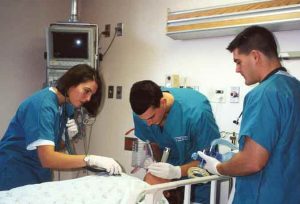
Respiratory therapists (RTs) are healthcare professionals who monitor, assess, and treat people who are having problems breathing. RTs are trained in many advanced airway interventions, including ventilation, airway management, cardiopulmonary resuscitation, and oxygen and aerosol therapy. They can assess ongoing patient needs and assist in various codes (medical emergencies) that may occur in the hospital. Figure 4.22 shows a group of RTs practising their intubation skills.
Registered nurses (RNs) and licensed practical nurses (LPNs) work in hospitals and other medical settings (Ernstmeyer & Christman, 2021). RNs complete a bachelor’s degree, whereas LPNs complete a two- to three-year program. Each profession has their own type of training and scope of practice.
Examples of orders:
- Pt to RR post-op to be assessed by RT
- Physio to assess ROM to R arm
Explanation of orders:
- Patient to recovery room after surgery to be assessed by a respiratory therapist.
- Physiotherapist to assess range of motion to the right arm.
| ABBREVIATIONS | MEANING |
| RUQ | right upper quadrant |
| S1, S2, … | sacral vertebra 1, sacral vertebra 2, … |
| T1, T2, … | thoracic vertebra 1, thoracic vertebra 2, … |
| Tx | treatment |
| UV | ultraviolet |
| W/C | wheelchair |
| wt | weight |
| yr | year |
Key Concept
VAX is a type of computerized medical system used in Alberta. It provides a means of recording medication administration and other aspects of patient care. There are a few hospitals that currently use it; however, the provincial-wide implementation of ConnectCare, another form of electronic medical record keeping, will end the use of VAX in the future.
Example of orders:
- Pt to mobilize with W/C
- Record pt wt in VAX
Explanation of orders:
- Patient to mobilize with wheelchair.
- Record patient’s weight in the computerized medical system.
Exercise
Attribution
Unless otherwise indicated, material on this page has been adapted from the following resource:
Carter, K., & Rutherford, M. (2020). Building a medical terminology foundation. eCampusOntario. https://ecampusontario.pressbooks.pub/medicalterminology/ licensed under CC BY 4.0
References
Alberta Health Services. (2022). Programs and services. https://www.albertahealthservices.ca/findhealth/search.aspx?type=service#icon_banner
American Heart Association (2022). Understanding blood pressure readings. https://www.heart.org/en/health-topics/high-blood-pressure/understanding-blood-pressure-readings
Ernstmeyer, K., & Christman, E. (Eds.). (2020). Nursing pharmacology. Chippewa Valley Technical College. https://wtcs.pressbooks.pub/pharmacology/ licensed under CC BY 4.0
Memorial Sloan Kettering Cancer Center. (2022). Caring for your Jackson-Pratt drain. https://www.mskcc.org/cancer-care/patient-education/caring-your-jackson-pratt-drain
Image Credits (images are listed in order of appearance)
Types of fracture by Smart Servier Medical Art, CC BY-SA 3.0
Jackson-Pratt Drain by BruceBlaus, CC BY-SA 4.0
People’s health and wellness with drugs (medicine) by SharonDawn, CC BY-SA 4.0
Spokane respiratory therapist students by Rose State Community College, CC BY 2.5