

3: Breathwork
- Page ID
- 99519

\( \newcommand{\vecs}[1]{\overset { \scriptstyle \rightharpoonup} {\mathbf{#1}} } \)
\( \newcommand{\vecd}[1]{\overset{-\!-\!\rightharpoonup}{\vphantom{a}\smash {#1}}} \)
\( \newcommand{\dsum}{\displaystyle\sum\limits} \)
\( \newcommand{\dint}{\displaystyle\int\limits} \)
\( \newcommand{\dlim}{\displaystyle\lim\limits} \)
\( \newcommand{\id}{\mathrm{id}}\) \( \newcommand{\Span}{\mathrm{span}}\)
( \newcommand{\kernel}{\mathrm{null}\,}\) \( \newcommand{\range}{\mathrm{range}\,}\)
\( \newcommand{\RealPart}{\mathrm{Re}}\) \( \newcommand{\ImaginaryPart}{\mathrm{Im}}\)
\( \newcommand{\Argument}{\mathrm{Arg}}\) \( \newcommand{\norm}[1]{\| #1 \|}\)
\( \newcommand{\inner}[2]{\langle #1, #2 \rangle}\)
\( \newcommand{\Span}{\mathrm{span}}\)
\( \newcommand{\id}{\mathrm{id}}\)
\( \newcommand{\Span}{\mathrm{span}}\)
\( \newcommand{\kernel}{\mathrm{null}\,}\)
\( \newcommand{\range}{\mathrm{range}\,}\)
\( \newcommand{\RealPart}{\mathrm{Re}}\)
\( \newcommand{\ImaginaryPart}{\mathrm{Im}}\)
\( \newcommand{\Argument}{\mathrm{Arg}}\)
\( \newcommand{\norm}[1]{\| #1 \|}\)
\( \newcommand{\inner}[2]{\langle #1, #2 \rangle}\)
\( \newcommand{\Span}{\mathrm{span}}\) \( \newcommand{\AA}{\unicode[.8,0]{x212B}}\)
\( \newcommand{\vectorA}[1]{\vec{#1}} % arrow\)
\( \newcommand{\vectorAt}[1]{\vec{\text{#1}}} % arrow\)
\( \newcommand{\vectorB}[1]{\overset { \scriptstyle \rightharpoonup} {\mathbf{#1}} } \)
\( \newcommand{\vectorC}[1]{\textbf{#1}} \)
\( \newcommand{\vectorD}[1]{\overrightarrow{#1}} \)
\( \newcommand{\vectorDt}[1]{\overrightarrow{\text{#1}}} \)
\( \newcommand{\vectE}[1]{\overset{-\!-\!\rightharpoonup}{\vphantom{a}\smash{\mathbf {#1}}}} \)
\( \newcommand{\vecs}[1]{\overset { \scriptstyle \rightharpoonup} {\mathbf{#1}} } \)
\(\newcommand{\longvect}{\overrightarrow}\)
\( \newcommand{\vecd}[1]{\overset{-\!-\!\rightharpoonup}{\vphantom{a}\smash {#1}}} \)
\(\newcommand{\ket}[1]{\left| #1 \right>}\)
\(\newcommand{\bra}[1]{\left< #1 \right|}\)
\(\newcommand{\braket}[2]{\left< #1 \vphantom{#2} \right| \left. #2 \vphantom{#1} \right>}\)
\(\newcommand{\braopket}[3]{\left< #1 \vphantom{#2}\vphantom{#3} \right| #2 \vphantom{#1}\vphantom{#3} \left| #3 \vphantom{#1}\vphantom{#2} \right>}\)
\(\newcommand{\qmvec}[1]{\mathbf{\vec{#1}}}\)
\(\newcommand{\op}[1]{\hat{\mathbf{#1}}}\)
\(\newcommand{\expect}[1]{\langle #1 \rangle}\)
\(\newcommand{\dfn}[1]{\emph{\textbf{#1}}}\)
Background
Three different scenarios: a women in labor, a friend laying hurt on a soccer field, and a student about to take a test. What do they all have in common? In each one of these situations, I locked eyes with someone else and decided that one of the best things that I could do was to shift the focus in the moment onto something that should happen without any thought: Breathing.
Take a deep breath is common saying used for when someone is upset, flustered, or struggling. Yet that simple phrase is backed by evidenced-based research. Breathing, something every human needs to do, has the power to directly affect stress and anxiety when specific practices are used (Bentley et al., 2023). Whether referred to as breathwork, breathing practices, therapeutic breathing, or a specific breathing pattern like box-breathing, the evidence supporting use of these practices is plentiful and varied. For example, daily 5-minute breathwork demonstrated improved mood, reduction in respiratory rate, and reduced anxiety (Balban et al., 2023). Evidence also supports the use of breathing techniques in almost all settings, including with students and healthcare providers. One study showed that performing 5 minutes of relaxing breathing improved medical resident performance in a high-fidelity simulation (Schlatter et al., 2022). A different review demonstrated that study participants who participated in controlled breathing patterns demonstrated increased heart rate variability, improved decision-making on tasks, and decreased perceived stress (De Couck et al., 2019).
Breathing practices have the additional advantage of being accessible to anyone and cost-free (Bentley et al., 2023). These practices can also be implemented in any setting with limited training, making it easy to scale their use (Fincham et al., 2023). As such, the application opportunities are nearly endless with benefits possible for college students, teachers, healthcare providers, and even patients. Everyone can benefit from focused breathing!
The benefits of breathwork can be explored even more deeply by thinking back to where the very first breath came from. Genesis 2:7 reads "Then the LORD God formed the man from the dust of the ground. He breathed the breath of life into the man’s nostrils, and the man became a living person." Think about it: the very breath of life that every human uses is a gift that came straight from the LORD. This is reiterated in Job 33:4, which proclaims: "For the Spirit of God has made me, and the breath of the Almighty gives me life." We are each so thoughtfully and wonderfully created. Is it no wonder that careful and deliberate use of the gift of breath can have wellness benefits?
Activity
This week is all about exploring a variety of controlled breathing patterns. For beginners, it is recommended to try these techniques in a quiet and comfortable setting, but they can be practiced anywhere. Once comfortable with these techniques, it can be beneficial to challenge oneself to implement them in more difficult settings or in times of more acute stress.
Materials Suggested
- Chair, if doing techniques sitting down.
- Open mind that is prepared to try something new
Directions
With each approach that you will try, there are several variations to consider and practice including:
- Count. This term refers to how long a breath or hold lasts. Try different counts to see what feels right!
- Nose vs. mouth. Inhaling (breathing in) or exhaling (breathing out) can be modified if you breathe through your nose or mouth. Try just your nose. Try just your mouth. Try breathing in through your nose and out through your mouth or the reverse. Breathing in through your nose and out through your mouth is a frequently referenced approach, but again, try variations and see what feels right.
- Position. When sitting, try sitting cross-legged. Or try laying down flat or with your feet on the ground.
- Hand position. Ideally, when breathing in, the lungs should expand and as a result, the abdomen should expand. When exhaling, the lungs should empty or deflate, and the abdomen should come in. To help with this, try placing a hand on the abdomen or one hand on the abdomen and one hand on the chest.
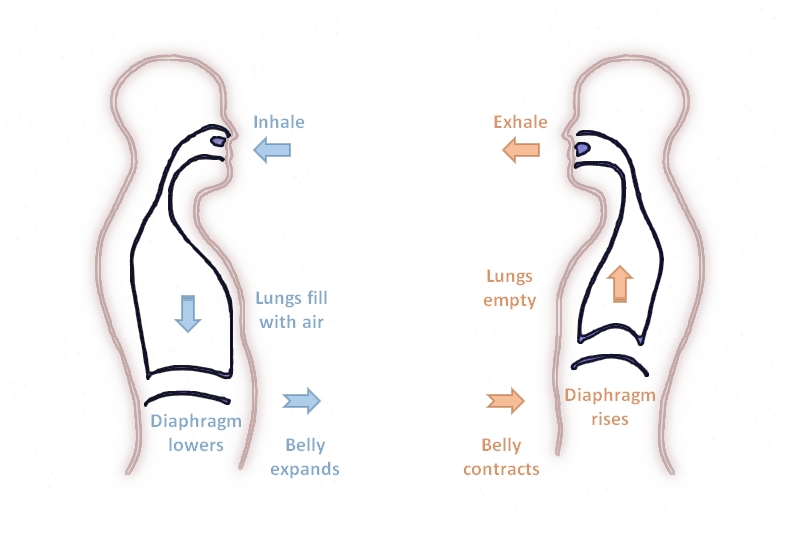
Figure \(\PageIndex{1}\): Diagram for deep breathing exercises. (Illustration by Remedial Class from Flickr.)
Now, take a few minutes to try each of the following exercises, considering different variations as discussed above.
Breathing Technique #1: Box breathing/Square breathing/Equal inhale exhale:
.png?revision=1&size=bestfit&width=421&height=421)
Figure \(\PageIndex{2}\): A person demonstrates breathing in, holding breath, breathing out, holding breath, counting four on each side around the side of a box. Also called square breathing: breathe in, hold, breathe out, hold. (Illustration by Sketchplanations.)
- Breathe in for a count (such as 2, 4, or 6) that feels comfortable.
- Hold breath for the same count as step 1 (2, 4, 6).
- Breathe out for the same count as step 1 (2, 4, 6).
- Hold breath for the same count as step 1.
- Repeat.
Breathing Technique #2: Extended exhale/Skewed pattern:
- Breathe in through the nose for a count (try 4).
- Breathe out through the mouth for double the count (try 8).
- Repeat.
Breathing Technique #3: 4-7-8 breathing
- Breathe in your nose for 4 seconds.
- Hold your breath for 7 seconds.
- Breathe out of your mouth for 8 seconds.
- Repeat 3 to 5 times.

Figure \(\PageIndex{2}\): Diagram for 4-7-8 Breathing Technique. (Illustration by Michelle VanderWoude, CC BY.)
Breathing Technique #4: Pursed lip breathing
- Breathe in for a count (try 2) through your nose with your mouth closed.
- Hold breath.
- Pucker/purse your lips, such as when trying to whistle, and blow out through your lips for a count longer than your inhale (try 4 or 6).
- Repeat.
Video \(\PageIndex{1}\): Demonstration of pursed lip breathing. ("Pursed Lip Breathing" by BreatheBetterwithElizabeth on YouTube.)
Breathing Technique #5: Alternate nostril breathing/Nadi Shodhana Pranayama:
- Using your right hand, close your right nostril with your thumb. Breathe in left nostril for a 4 count.
- Close left nostril with your right ring and pinkie fingers (both nostrils briefly closed as you switch).
- Open right nostril and breathe out for a 6 count.
- Breathe in right nostril for a 4 count.
- Close right nostril with your thumb (both nostrils briefly closed as you switch).
- Open left nostril and breathe out for a 6 count.
Video \(\PageIndex{2}\): Demonstration of alternate nostril breathing. ("Alternate Nostril Breathing - Yoga Technique" by intosport on YouTube.)
Alternatives/Variations
- 5-finger breathing
- Mindful breathing
- Lion's breath breathing
- Heart rate control
Incorporate breathwork for a minimum of 5 minutes at a time, three times a day. Aim to do a breathwork activity in the morning, afternoon, and evening. An easy way to make this happen is planning it as part of the morning routine (such as right after brushing your teeth), before lunch, and before bed. Try to stick to a schedule and be intentional about noticing your physical and mental state before and after each session.
In addition to the three scheduled sessions each day, look for other opportunities to incorporate breathwork. If there is a moment of increased stress, such as in traffic at a long red light or during a classroom exam, try a breathing activity and note how it feels to use in a time of need.
As you practice breathwork, experiment with different counts, postures, and techniques. Notice how these affect your relaxation state.
At least once this week, try teaching a breathing pattern to another person. Notice how it feels to teach the activity and perform it with another person.
Reflection questions:
1. Describe any changes you noticed in the following areas when using breathwork this week:
Emotional, Environmental, Intellectual, Occupational, Physical, Social, and/ or Spiritual
2. What benefits did you feel with breathwork exercises?
3. What, if any, barriers did you experience using breathwork?
4. Do you have any additional thoughts and/or future plans for breathwork?
5. What are your current stressors and do you have a wellness goal for this week?
References
Balban, M. Y., Neri, E., Kogon, M. M., Weed, L., Nouriani, B., Jo, B., Holl, G., Zeitzer, J. M., Spiegel, D., & Huberman, A. D. (2023). Brief structured respiration practices enhance mood and reduce physiological arousal. Cell Reports: Medicine, 4(1), Article 100895. https://doi.org/10.1016/j.xcrm.2022.100895
Bentley, T. G. K., D'Andrea-Penna, G., Rakic, M., Arce, N., LaFaille, M., Berman, R., Cooley, K., & Sprimont, P. (2023). Breathing practices for stress and anxiety reduction: Conceptual framework of implementation guidelines based on a systematic review of the published literature. Brain Sciences, 13(12), Article 1612. https://doi.org/10.3390/brainsci13121612
De Couck, M., Caers, R., Musch, L., Fliegauf, J., Giangreco, A., & Gidron, Y. (2019). How breathing can help you make better decisions: Two studies on the effects of breathing patterns on heart rate variability and decision-making in business cases. International Journal of Psychophysiology, 139, 1-9. https://doi.org/10.1016/j.ijpsycho.2019.02.011
Fincham, G. W., Strauss, C., Montero-Marin, J., & Cavanagh, K. (2023). Effect of breathwork on stress and mental health: A meta-analysis of randomised-controlled trials. Scientific Reports, 13, Article 432. https://doi.org/10.1038/s41598-022-27247-y
Schlatter, S. T., Thérond, C. C., Guillot, A., Louisy, S. P., Duclos, A., Lehot, J. J., Rimmelé, T., Debarnot, U. S., & Lilot, M. E. (2022). Effects of relaxing breathing paired with cardiac biofeedback on performance and relaxation during critical simulated situations: A prospective randomized controlled trial. BMC Medical Education, 22, Article 422. https://doi.org/10.1186/s12909-022-03420-9