

4.3: Procedures
- Page ID
- 150533

\( \newcommand{\vecs}[1]{\overset { \scriptstyle \rightharpoonup} {\mathbf{#1}} } \)
\( \newcommand{\vecd}[1]{\overset{-\!-\!\rightharpoonup}{\vphantom{a}\smash {#1}}} \)
\( \newcommand{\dsum}{\displaystyle\sum\limits} \)
\( \newcommand{\dint}{\displaystyle\int\limits} \)
\( \newcommand{\dlim}{\displaystyle\lim\limits} \)
\( \newcommand{\id}{\mathrm{id}}\) \( \newcommand{\Span}{\mathrm{span}}\)
( \newcommand{\kernel}{\mathrm{null}\,}\) \( \newcommand{\range}{\mathrm{range}\,}\)
\( \newcommand{\RealPart}{\mathrm{Re}}\) \( \newcommand{\ImaginaryPart}{\mathrm{Im}}\)
\( \newcommand{\Argument}{\mathrm{Arg}}\) \( \newcommand{\norm}[1]{\| #1 \|}\)
\( \newcommand{\inner}[2]{\langle #1, #2 \rangle}\)
\( \newcommand{\Span}{\mathrm{span}}\)
\( \newcommand{\id}{\mathrm{id}}\)
\( \newcommand{\Span}{\mathrm{span}}\)
\( \newcommand{\kernel}{\mathrm{null}\,}\)
\( \newcommand{\range}{\mathrm{range}\,}\)
\( \newcommand{\RealPart}{\mathrm{Re}}\)
\( \newcommand{\ImaginaryPart}{\mathrm{Im}}\)
\( \newcommand{\Argument}{\mathrm{Arg}}\)
\( \newcommand{\norm}[1]{\| #1 \|}\)
\( \newcommand{\inner}[2]{\langle #1, #2 \rangle}\)
\( \newcommand{\Span}{\mathrm{span}}\) \( \newcommand{\AA}{\unicode[.8,0]{x212B}}\)
\( \newcommand{\vectorA}[1]{\vec{#1}} % arrow\)
\( \newcommand{\vectorAt}[1]{\vec{\text{#1}}} % arrow\)
\( \newcommand{\vectorB}[1]{\overset { \scriptstyle \rightharpoonup} {\mathbf{#1}} } \)
\( \newcommand{\vectorC}[1]{\textbf{#1}} \)
\( \newcommand{\vectorD}[1]{\overrightarrow{#1}} \)
\( \newcommand{\vectorDt}[1]{\overrightarrow{\text{#1}}} \)
\( \newcommand{\vectE}[1]{\overset{-\!-\!\rightharpoonup}{\vphantom{a}\smash{\mathbf {#1}}}} \)
\( \newcommand{\vecs}[1]{\overset { \scriptstyle \rightharpoonup} {\mathbf{#1}} } \)
\(\newcommand{\longvect}{\overrightarrow}\)
\( \newcommand{\vecd}[1]{\overset{-\!-\!\rightharpoonup}{\vphantom{a}\smash {#1}}} \)
\(\newcommand{\ket}[1]{\left| #1 \right>}\)
\(\newcommand{\bra}[1]{\left< #1 \right|}\)
\(\newcommand{\braket}[2]{\left< #1 \vphantom{#2} \right| \left. #2 \vphantom{#1} \right>}\)
\(\newcommand{\braopket}[3]{\left< #1 \vphantom{#2}\vphantom{#3} \right| #2 \vphantom{#1}\vphantom{#3} \left| #3 \vphantom{#1}\vphantom{#2} \right>}\)
\(\newcommand{\qmvec}[1]{\mathbf{\vec{#1}}}\)
\(\newcommand{\op}[1]{\hat{\mathbf{#1}}}\)
\(\newcommand{\expect}[1]{\langle #1 \rangle}\)
\(\newcommand{\dfn}[1]{\emph{\textbf{#1}}}\)
Medical procedures and their abbreviations are often discussed and written in hospital and clinic settings. Later in the book, many of these procedures will be explained in detail, but for now, the most common abbreviations are listed below. Examples are provided along with a very basic explanation of the procedures to help you understand and remember them.
Table 4.11. Procedures
| ABBREVIATION | MEANING |
| AB | abortion |
| BP | blood pressure |
| BSE | breast self-exam |
| BSO | bilateral salpingo-oophorectomy |
| Bx | biopsy |
| cath | catheter |
| chemo | chemotherapy |
Key Concept
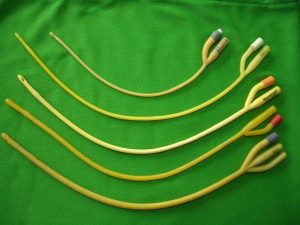
A few different forms of catheterization are used in hospitals, but one of the most common is urinary catheterization (Doyle & McCutcheon, 2020). The abbreviation for catheter is cath. Urinary catheterization is often used with patients in the hospital when they have difficulty voiding urine or are immobilized, often after surgery. Figure 4.8 shows a type of catheter that is placed through the patient’s urethra and into the bladder. It is then attached to a bag that collects the patient’s urine (Doyle & McCutcheon, 2020).
Examples of orders with procedures:
- Pt scheduled for Bx in am, take BP prior to Bx
- BSO this afternoon, Pt requires a cath in am
Explanation of orders with procedures:
- Patient scheduled for biopsy in the morning, take blood pressure prior to biopsy.
- Bilateral salpingo-oophorectomy this afternoon. Patient requires a catheter in the morning.
| ABBREVIATION | MEANING |
| CPR | cardiopulmonary resuscitation |
| cysto | cystoscopy |
| D&C | dilation and curettage |
| drsg | dressing |
| E | enema |
| ECT | electroconvulsive therapy |
| H&P | history and physical |
| HD | hemodialysis |
Key Concepts
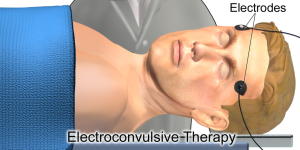
Electroconvulsive therapy (ECT) is a controversial and misunderstood treatment for mental illness. It is in fact very safe and effective for treating various mental illnesses, including severe depression, mania, and schizophrenia (Centre for Addiction and Mental Health, 2022). It is a useful therapy when patients have symptoms that have not responded well to medication, counselling, or any other psychosocial treatments.
Dilation and curettage (D&C) is a surgical procedure in which the cervix is dilated and a device called a curette is used to scrape the uterine lining (Stuart, 2022). It can be performed for a few reasons, such as diagnosing or treating uterine fibroids, hormonal imbalances, or cancer, and after a miscarriage.
Examples of orders with procedures:
- Pt requires H&P prior to D&C in am
- Drsg to R arm needs to be reapplied. E in pm prior to cysto in am
Explanation of orders with procedures:
- Patient requires history and physical prior to dilation and curettage in the morning.
- Dressing to the right arm needs to be reapplied. Enema in the afternoon prior to cystoscopy in the morning.
| ABBREVIATION | MEANING |
| HRT | hormone replacement therapy |
| I&D | incision and drainage |
| I&O | intake and output |
| lap | laparotomy |
| LP | lumbar puncture |
| SBFT | small bowel follow-through |
| T&A | tonsillectomy and adenoidectomy |
Key Concepts
Some women may take hormone replacement therapy (HRT) to ease menopausal symptoms (Canadian Cancer Society, 2022). This is because in women of a certain age, the ovaries produce lower amounts of hormones, especially when a woman reaches menopause. HRT helps to supplement the lack of hormones.
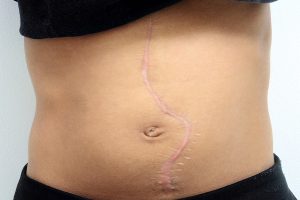
A lap (laparotomy) scar is show in Figure 4.10. The term laparotomy means “cutting into the abdomen,” a procedure that can be done for exploratory reasons or to remove an organ or some form of anomaly, such as a tumour.
Examples of orders with procedures:
- I&O q2h
- T&A in am. LP at 1200 today
Explanation of orders with procedures:
- Intake and output every two hours (intake includes all fluids, such as IV, oral, feeding tubes, etc., and output is urine, diarrhea, wound drains, etc.).
- Tonsillectomy and adenoidectomy in the morning. Lumbar puncture at noon today.
| ABBREVIATION | MEANING |
| TAB | therapeutic abortion |
| TAH-BSO | total abdominal hysterectomy–bilateral salpingo-oophorectomy |
| TPR | temperature, pulse, respirations |
| TURP | transurethral resection of the prostate gland |
| VS | vital signs |
| XRT | radiation therapy |
Key Concepts
TAH-BSO (total abdominal hysterectomy-bilateral salpingo-oophorectomy) is a complex medical term; however, if you look at the word parts, you can understand what procedure is being completed—”removal of” (-ectomy) something, and the combining forms (hyster/o, salping/o, and oophor/o) in the terms make it clear what is being removed. The surgery is removal of the uterus, both fallopian tubes, and both ovaries.
Vital signs (VS) are a combination of various medical assessments, including blood pressure, temperature, pulse, pulse oximetry, and breathing rate (Doyle & McCutcheon, 2020). Depending on the patient’s condition and hospital unit, vital signs can also include neurological vital signs, pain measurement, circulation, and other factors that may be relevant (Doyle & McCutcheon, 2020).
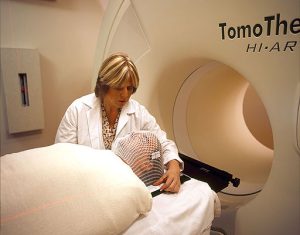
Radiation therapy (XRT), as shown in Figure 4.11, can be used to treat various forms of cancer as well as some other pathologies.
Examples of orders with procedures:
- Pt in for TURP today, VS q2h post-op
- Hx of TAH-BSO and XRT in past yr
Explanation of orders with procedures:
- Patient in for transurethral resection of the prostate gland today. Vital signs every two hours after surgery.
- History of total abdominal hysterectomy–bilateral salpingo-oophorectomy and radiation therapy in the past year.
Exercise
Attribution
Unless otherwise indicated, material on this page has been adapted from the following resource:
Carter, K., & Rutherford, M. (2020). Building a medical terminology foundation. eCampusOntario. https://ecampusontario.pressbooks.pub/medicalterminology/ licensed under CC BY 4.0
References
Canadian Cancer Society. (2022). All about hormone replacement therapy (HRT). https://cancer.ca/en/cancer-information/reduce-your-risk/understand-hormones/all-about-hormone-replacement-therapy-hrt
Centre for Addiction and Mental Health (CAMH). (2022). Electroconvulsive therapy (ECT). https://www.camh.ca/en/health-info/mental-illness-and-addiction-index/electroconvulsive-therapy
Doyle, G. R., & McCutcheon, J. A. (2020). Clinical procedures for safer patient care. BCcampus Open Education. https://opentextbc.ca/clinicalskills/ licensed under CC BY 4.0
Stuart, A. (2022). D and C (dilation and curettage). WebMD. https://www.webmd.com/women/guide/d-and-c-dilation-and-curettage
Image Credits (images are listed in order of appearance)
Urinary catheters 03 by Saltanat ebli, CC0 1.0
Electroconvulsive Therapy by BruceBlaus, CC BY-SA 4.0
Exploratory Laparotomy Scar (02) by Jéssica Raphaela, CC0 1.0
Patient prepared for radiation therapy by Rhoda Baer, National Cancer Institute, Public domain