

4.6: Obstetrics
- Page ID
- 150536

\( \newcommand{\vecs}[1]{\overset { \scriptstyle \rightharpoonup} {\mathbf{#1}} } \)
\( \newcommand{\vecd}[1]{\overset{-\!-\!\rightharpoonup}{\vphantom{a}\smash {#1}}} \)
\( \newcommand{\dsum}{\displaystyle\sum\limits} \)
\( \newcommand{\dint}{\displaystyle\int\limits} \)
\( \newcommand{\dlim}{\displaystyle\lim\limits} \)
\( \newcommand{\id}{\mathrm{id}}\) \( \newcommand{\Span}{\mathrm{span}}\)
( \newcommand{\kernel}{\mathrm{null}\,}\) \( \newcommand{\range}{\mathrm{range}\,}\)
\( \newcommand{\RealPart}{\mathrm{Re}}\) \( \newcommand{\ImaginaryPart}{\mathrm{Im}}\)
\( \newcommand{\Argument}{\mathrm{Arg}}\) \( \newcommand{\norm}[1]{\| #1 \|}\)
\( \newcommand{\inner}[2]{\langle #1, #2 \rangle}\)
\( \newcommand{\Span}{\mathrm{span}}\)
\( \newcommand{\id}{\mathrm{id}}\)
\( \newcommand{\Span}{\mathrm{span}}\)
\( \newcommand{\kernel}{\mathrm{null}\,}\)
\( \newcommand{\range}{\mathrm{range}\,}\)
\( \newcommand{\RealPart}{\mathrm{Re}}\)
\( \newcommand{\ImaginaryPart}{\mathrm{Im}}\)
\( \newcommand{\Argument}{\mathrm{Arg}}\)
\( \newcommand{\norm}[1]{\| #1 \|}\)
\( \newcommand{\inner}[2]{\langle #1, #2 \rangle}\)
\( \newcommand{\Span}{\mathrm{span}}\) \( \newcommand{\AA}{\unicode[.8,0]{x212B}}\)
\( \newcommand{\vectorA}[1]{\vec{#1}} % arrow\)
\( \newcommand{\vectorAt}[1]{\vec{\text{#1}}} % arrow\)
\( \newcommand{\vectorB}[1]{\overset { \scriptstyle \rightharpoonup} {\mathbf{#1}} } \)
\( \newcommand{\vectorC}[1]{\textbf{#1}} \)
\( \newcommand{\vectorD}[1]{\overrightarrow{#1}} \)
\( \newcommand{\vectorDt}[1]{\overrightarrow{\text{#1}}} \)
\( \newcommand{\vectE}[1]{\overset{-\!-\!\rightharpoonup}{\vphantom{a}\smash{\mathbf {#1}}}} \)
\( \newcommand{\vecs}[1]{\overset { \scriptstyle \rightharpoonup} {\mathbf{#1}} } \)
\(\newcommand{\longvect}{\overrightarrow}\)
\( \newcommand{\vecd}[1]{\overset{-\!-\!\rightharpoonup}{\vphantom{a}\smash {#1}}} \)
\(\newcommand{\ket}[1]{\left| #1 \right>}\)
\(\newcommand{\bra}[1]{\left< #1 \right|}\)
\(\newcommand{\braket}[2]{\left< #1 \vphantom{#2} \right| \left. #2 \vphantom{#1} \right>}\)
\(\newcommand{\braopket}[3]{\left< #1 \vphantom{#2}\vphantom{#3} \right| #2 \vphantom{#1}\vphantom{#3} \left| #3 \vphantom{#1}\vphantom{#2} \right>}\)
\(\newcommand{\qmvec}[1]{\mathbf{\vec{#1}}}\)
\(\newcommand{\op}[1]{\hat{\mathbf{#1}}}\)
\(\newcommand{\expect}[1]{\langle #1 \rangle}\)
\(\newcommand{\dfn}[1]{\emph{\textbf{#1}}}\)
Obstetrics is a medical specialty, and there are medical terms specifically related to this area. This section will focus on common abbreviations related to obstetrics. The most common abbreviations are listed, but there are more that are not covered here. As well as obstetrics-related abbreviations and definitions, some key concepts related to the abbreviations will be covered here.
| ABBREVIATIONS | MEANING |
| C-section | caesarean section |
| EDC | estimated date of confinement |
Key Concept
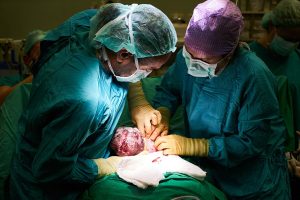
A C-section, or caesarean section, is a surgical procedure used in certain circumstances to deliver babies (Mayo Clinic, 2022). Sometimes a patient may have a planned C-section, but in certain circumstances, an emergency C-section is required. Typically a horizontal incision is made to the lower abdomen and uterus, then the baby is delivered through this incision (Mayo Clinic, 2022). Figure 4.15 shows a C-section being performed.
Example of orders related to obstetrics:
- Scheduled C-section at 1000
Explanation of orders related to obstetrics:
- Scheduled caesarean section at 10 o’clock in the morning.
| ABBREVIATIONS | MEANING |
| FHR | fetal heart rate |
| G | gravida (number of pregnancies may be given) |
| IUD | intrauterine device |
| LMP | last menstrual period |
| multigravida | pregnant more than once |
| multipara | given birth to more than one child |
Key Concept
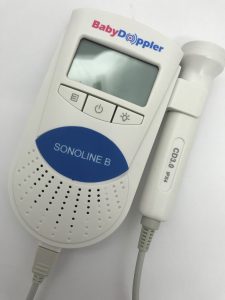
Figure 4.16 is an image of a fetal heart monitor, which provides the fetal heart rate (FHR) and rhythm for a fetus in utero (Johns Hopkins, 2022). The average fetal heart rate is 110–160 beats per minute, but the rate can vary depending on the situation. For example, if the umbilical cord is being compressed, the FHR may decrease, and if the situation worsens, it could result in the patient having a C-section (Johns Hopkins, 2022).
Example of orders related to obstetrics:
- Monitor FHR q2h
Explanation of orders related to obstetrics:
- Monitor fetal heart rate every two hours.
| ABBREVIATIONS | MEANING |
| NB | newborn |
| OB | obstetrics |
| Pap smear | test done on cervical cells for cancer |
| P | number of viable births |
| PID | pelvic inflammatory disease |
| PKU | phenylketonuria |
Key Concept
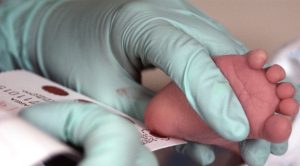
PKU (phenylketonuria) is an inherited disorder, and a PKU test is used to determine whether a baby has the enzyme required to help digest phenylalanine (Alberta Health Services, 2022). This enzyme plays a role in normal growth and development, and if it is missing from the body and the baby is not treated early on, the infant is at risk of developing seizures and brain damage and becoming intellectually delayed. This blood test is typically done 24 hours to a couple of days after birth (Alberta Health Services, 2022). Figure 4.17 shows a healthcare provider collecting a sample of blood from the heel of a newborn to complete the PKU test.
Example of orders related to obstetrics:
- Hx of PID
Explanation of orders related to obstetrics:
- History of pelvic inflammatory disease.
| ABBREVIATIONS | MEANING |
| PPD | postpartum depression |
| PPH | postpartum hemorrhage |
| primigravida | first pregnancy |
| primipara | first birth |
| PTL | preterm labour |
| umb | umbilical |
| VBAC | vaginal birth after C-section |
Key Concept
Most mothers will have the “baby blues” for the first few days after birth, but if the feelings of emptiness, sadness, or hopelessness do not go away after two weeks, then a new mother may have postpartum depression (PPD) (Office on Women’s Health, 2021). It is really important for new mothers to contact their healthcare provider if they think they have PPD.
Example of orders related to obstetrics:
- Patient arriving at 1300 for VBA
Explanation of orders related to obstetrics:
- Patient arriving at one o’clock in the afternoon for a vaginal birth after a C-section.
Exercise
Attribution
Unless otherwise indicated, material on this page has been adapted from the following resource:
Carter, K., & Rutherford, M. (2020). Building a medical terminology foundation. eCampusOntario. https://ecampusontario.pressbooks.pub/medicalterminology/ licensed under CC BY 4.0
References
Alberta Health Services. (2022). Phenylketonuria (PKU) test. https://myhealth.alberta.ca/Health/Pages/conditions.aspx?hwid=hw41965#:~:text=A%20phenylketonuria%20(PKU)%20screening%20test,whether%20your%20baby%20has%20PKU
Johns Hopkins. (2022). Fetal heart monitoring. https://www.hopkinsmedicine.org/health/treatment-tests-and-therapies/fetal-heart-monitoring
Mayo Clinic. (2022). C-section. https://www.mayoclinic.org/tests-procedures/c-section/about/pac-20393655
Office on Women’s Health, U.S. Department of Health & Human Services. (2021). Postpartum depression. https://www.womenshealth.gov/mental-health/mental-health-conditions/postpartum-depression
Image Credits (images are listed in order of appearance)
Infant’s head emerging during C-section by Engin Akyurt, Pixabay licence
Sonoline B by Baby Doppler by Cognito 100, CC BY-SA 4.0
Phenylketonuria testing by Staff Sgt. Eric T. Sheler, U.S. Air Force, Public domain