

4.4: Medications and Medication Orders
- Page ID
- 150534

\( \newcommand{\vecs}[1]{\overset { \scriptstyle \rightharpoonup} {\mathbf{#1}} } \)
\( \newcommand{\vecd}[1]{\overset{-\!-\!\rightharpoonup}{\vphantom{a}\smash {#1}}} \)
\( \newcommand{\dsum}{\displaystyle\sum\limits} \)
\( \newcommand{\dint}{\displaystyle\int\limits} \)
\( \newcommand{\dlim}{\displaystyle\lim\limits} \)
\( \newcommand{\id}{\mathrm{id}}\) \( \newcommand{\Span}{\mathrm{span}}\)
( \newcommand{\kernel}{\mathrm{null}\,}\) \( \newcommand{\range}{\mathrm{range}\,}\)
\( \newcommand{\RealPart}{\mathrm{Re}}\) \( \newcommand{\ImaginaryPart}{\mathrm{Im}}\)
\( \newcommand{\Argument}{\mathrm{Arg}}\) \( \newcommand{\norm}[1]{\| #1 \|}\)
\( \newcommand{\inner}[2]{\langle #1, #2 \rangle}\)
\( \newcommand{\Span}{\mathrm{span}}\)
\( \newcommand{\id}{\mathrm{id}}\)
\( \newcommand{\Span}{\mathrm{span}}\)
\( \newcommand{\kernel}{\mathrm{null}\,}\)
\( \newcommand{\range}{\mathrm{range}\,}\)
\( \newcommand{\RealPart}{\mathrm{Re}}\)
\( \newcommand{\ImaginaryPart}{\mathrm{Im}}\)
\( \newcommand{\Argument}{\mathrm{Arg}}\)
\( \newcommand{\norm}[1]{\| #1 \|}\)
\( \newcommand{\inner}[2]{\langle #1, #2 \rangle}\)
\( \newcommand{\Span}{\mathrm{span}}\) \( \newcommand{\AA}{\unicode[.8,0]{x212B}}\)
\( \newcommand{\vectorA}[1]{\vec{#1}} % arrow\)
\( \newcommand{\vectorAt}[1]{\vec{\text{#1}}} % arrow\)
\( \newcommand{\vectorB}[1]{\overset { \scriptstyle \rightharpoonup} {\mathbf{#1}} } \)
\( \newcommand{\vectorC}[1]{\textbf{#1}} \)
\( \newcommand{\vectorD}[1]{\overrightarrow{#1}} \)
\( \newcommand{\vectorDt}[1]{\overrightarrow{\text{#1}}} \)
\( \newcommand{\vectE}[1]{\overset{-\!-\!\rightharpoonup}{\vphantom{a}\smash{\mathbf {#1}}}} \)
\( \newcommand{\vecs}[1]{\overset { \scriptstyle \rightharpoonup} {\mathbf{#1}} } \)
\(\newcommand{\longvect}{\overrightarrow}\)
\( \newcommand{\vecd}[1]{\overset{-\!-\!\rightharpoonup}{\vphantom{a}\smash {#1}}} \)
\(\newcommand{\avec}{\mathbf a}\) \(\newcommand{\bvec}{\mathbf b}\) \(\newcommand{\cvec}{\mathbf c}\) \(\newcommand{\dvec}{\mathbf d}\) \(\newcommand{\dtil}{\widetilde{\mathbf d}}\) \(\newcommand{\evec}{\mathbf e}\) \(\newcommand{\fvec}{\mathbf f}\) \(\newcommand{\nvec}{\mathbf n}\) \(\newcommand{\pvec}{\mathbf p}\) \(\newcommand{\qvec}{\mathbf q}\) \(\newcommand{\svec}{\mathbf s}\) \(\newcommand{\tvec}{\mathbf t}\) \(\newcommand{\uvec}{\mathbf u}\) \(\newcommand{\vvec}{\mathbf v}\) \(\newcommand{\wvec}{\mathbf w}\) \(\newcommand{\xvec}{\mathbf x}\) \(\newcommand{\yvec}{\mathbf y}\) \(\newcommand{\zvec}{\mathbf z}\) \(\newcommand{\rvec}{\mathbf r}\) \(\newcommand{\mvec}{\mathbf m}\) \(\newcommand{\zerovec}{\mathbf 0}\) \(\newcommand{\onevec}{\mathbf 1}\) \(\newcommand{\real}{\mathbb R}\) \(\newcommand{\twovec}[2]{\left[\begin{array}{r}#1 \\ #2 \end{array}\right]}\) \(\newcommand{\ctwovec}[2]{\left[\begin{array}{c}#1 \\ #2 \end{array}\right]}\) \(\newcommand{\threevec}[3]{\left[\begin{array}{r}#1 \\ #2 \\ #3 \end{array}\right]}\) \(\newcommand{\cthreevec}[3]{\left[\begin{array}{c}#1 \\ #2 \\ #3 \end{array}\right]}\) \(\newcommand{\fourvec}[4]{\left[\begin{array}{r}#1 \\ #2 \\ #3 \\ #4 \end{array}\right]}\) \(\newcommand{\cfourvec}[4]{\left[\begin{array}{c}#1 \\ #2 \\ #3 \\ #4 \end{array}\right]}\) \(\newcommand{\fivevec}[5]{\left[\begin{array}{r}#1 \\ #2 \\ #3 \\ #4 \\ #5 \\ \end{array}\right]}\) \(\newcommand{\cfivevec}[5]{\left[\begin{array}{c}#1 \\ #2 \\ #3 \\ #4 \\ #5 \\ \end{array}\right]}\) \(\newcommand{\mattwo}[4]{\left[\begin{array}{rr}#1 \amp #2 \\ #3 \amp #4 \\ \end{array}\right]}\) \(\newcommand{\laspan}[1]{\text{Span}\{#1\}}\) \(\newcommand{\bcal}{\cal B}\) \(\newcommand{\ccal}{\cal C}\) \(\newcommand{\scal}{\cal S}\) \(\newcommand{\wcal}{\cal W}\) \(\newcommand{\ecal}{\cal E}\) \(\newcommand{\coords}[2]{\left\{#1\right\}_{#2}}\) \(\newcommand{\gray}[1]{\color{gray}{#1}}\) \(\newcommand{\lgray}[1]{\color{lightgray}{#1}}\) \(\newcommand{\rank}{\operatorname{rank}}\) \(\newcommand{\row}{\text{Row}}\) \(\newcommand{\col}{\text{Col}}\) \(\renewcommand{\row}{\text{Row}}\) \(\newcommand{\nul}{\text{Nul}}\) \(\newcommand{\var}{\text{Var}}\) \(\newcommand{\corr}{\text{corr}}\) \(\newcommand{\len}[1]{\left|#1\right|}\) \(\newcommand{\bbar}{\overline{\bvec}}\) \(\newcommand{\bhat}{\widehat{\bvec}}\) \(\newcommand{\bperp}{\bvec^\perp}\) \(\newcommand{\xhat}{\widehat{\xvec}}\) \(\newcommand{\vhat}{\widehat{\vvec}}\) \(\newcommand{\uhat}{\widehat{\uvec}}\) \(\newcommand{\what}{\widehat{\wvec}}\) \(\newcommand{\Sighat}{\widehat{\Sigma}}\) \(\newcommand{\lt}{<}\) \(\newcommand{\gt}{>}\) \(\newcommand{\amp}{&}\) \(\definecolor{fillinmathshade}{gray}{0.9}\)Medication orders are common in both hospital and clinic settings. It is imperative to have a solid foundation of knowledge about medication-related abbreviations for almost any career in health care. Also, it is advantageous for the general population to understand these abbreviations because most people will be given a prescription at some time in their lives, and it helpful if they can understand the meaning behind the abbreviations used.
Medications
Table 4.15. Medications
| ABBREVIATION | MEANING |
| 2/3-1/3 | 2/3 dextrose, 1/3 saline |
| ac | before meals |
| am | morning |
| ASAP | as soon as possible |
| bid | twice a day |
| C | Celsius |
| caps | capsule(s) |
| cm | centimetre |
Key Concept
2/3 dextrose, 1/3 saline (2/3-1/3) is an intravenous solution that may be ordered for patients. There are a number of different types of IV solutions, and this one is a mix of dextrose (a type of sugar) and normal saline. The intravenous solution ordered for a patient may vary from day to day depending on the patient’s condition, so the medication order will be updated regularly. Intravenous solutions will be discussed in more detail in Chapter 7.
Examples of medication orders:
- IV 2/3-1/3 at 100 mL/hr ASAP
- Humalog insulin sc ac as per sliding scale
Explanation of medication orders:
- Intravenous 2/3 dextrose, 1/3 saline at 100 millilitres per hour as soon as possible.
- Humalog insulin subcutaneous before meals as per sliding scale (see Key Concept below).
Key Concept
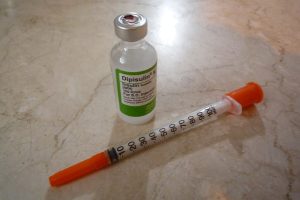
Sliding scale means that a patient’s insulin dose will vary depending on their blood sugar level. For patients in a hospital, there will be orders in the chart for the nurse to check and provide the correct dose of insulin to the patient. A blood sugar reading is taken before any ordered insulin dose is given, and the amount of insulin is determined by the orders provided in the sliding scale.
Table 4.16. Medications
| ABBREVIATION | MEANING |
| D/S, D/W | dextrose in saline or water |
| D5W | 5% dextrose in water |
| g | gram |
| gtt | drop or drops |
| h, hr | hour |
| h.s. | at bedtime |
| H20 | water |
| i, ii, iii, iv | one two three four |
| ID | initial dose |
| IM | intramuscular |
Key Concepts
The abbreviation for drops (gtt) may be seen in a few different situations. It could potentially be used for eye drops, but it could also be seen with intravenous medications. If a programmable intravenous machine is not used to administer IV fluids, then often drops (gtt) is used to determine the rate at which fluids are to be given.
D5W (5% dextrose in water) is just one example of an abbreviation for IV fluids, and others will vary depending on the amount of dextrose in the fluid. For example, you may see D10W (10% dextrose in water) or D5S (5% dextrose in saline), with the number indicating the percentage of dextrose and W or S indicating water or saline.
Examples of medication orders:
- D5W at 150mL/hr to begin at h.s.
- 2 gtt Bimatoprost to each eye bid, ID tomorrow am
Explanation of medication orders:
- 5% dextrose in water at 150 millilitres per hour to begin at bedtime.
- Two drops Bimatoprost to each eye twice a day, initial dose tomorrow morning.
Table 4.17. Medications
| ABBREVIATION | MEANING |
| INH | Isoniazid (medication used to treat tuberculosis) |
| IV | intravenous |
| kg | kilogram |
| kJ | kilojoule |
| L | litre |
| Lax | laxative |
| LD | last dose |
| m | metre |
Key Concepts
IV (intravenous) is a very common abbreviation in medical settings. As stated above, there are a number of different IV solutions, and many, if not most, patients within the hospital will have an IV at some point during their admission.
The abbreviation LD (last dose) pertains to patients’ medication. It is a warning to medical professionals that this is the last dose of a medication to be given to a patient. In some cases, the medication is reordered, but in other instances, the patient’s condition is simply monitored after they finish their last dose.
Examples of medication orders:
- Gravol 50 mg IV bid prn
- Morphine 2-10 mg sc qid, LD May 18/2022 1800
Explanation of medication orders:
- Gravol 50 milligrams intravenous two times a day as needed.
- Morphine 2–10 milligrams subcutaneous four times a day. Last dose is May 18, 2022, at 6 o’clock in the evening.
Table 4.18. Medications
| ABBREVIATION | MEANING |
| MAR | medication administration record |
| mcg | microgram |
| mg | milligram |
| ml | millilitre |
| mm | millimetre |
| NG | nasogastric |
| NKA | no known allergies |
| NS | normal saline |
| NSAID | nonsteroidal anti-inflammatory drug |
Key Concepts
The medication administration record (MAR) can be found on hospital units and is the record of the medications ordered and given to a patient. Unit clerks update the MAR, and nurses make notes in it when medication is given to a patient.
NG (nasogastric) tubes are seen on many units in a hospital. An NG tube is inserted through the patient’s nose and down into the stomach (Carter & Rutherford, 2020). The nurse is often the medical professional who inserts the NG tube and fixes it in place. An NG tube can be attached to suction to remove stomach contents, or it can be used to provide nutrition or medication. The medication would be crushed and then added to some form of liquid to be administered through the NG tube.
Examples of medication orders:
- NS 500 mL/hr
- NG to low Gomco suction (a suction device on the wall in the hospital)
Explanation of medication orders:
- Normal saline 500 millilitres per hour.
- Nasogastric tube to low Gomco suction.
Table 4.19. Medications
| ABBREVIATION | MEANING |
| pc | after a meal |
| pm | evening |
| po | orally, by mouth |
| PPN | partial/peripheral parenteral nutrition |
| pr | per rectum |
| prn | as necessary |
| pv | per vagina |
| qh.s. | every night at bedtime |
Key Concept
Parenteral nutrition is often used to help patients with Crohn’s disease, cancer, short bowel syndrome, or ischemic bowel (Healthline, 2022). It is administered from a bag containing the nutrients that the patient needs through tubing attached to either a needle or catheter. If parenteral nutrition is only needed temporarily, then partial parenteral nutrition (PPN) is used. This type of parenteral nutrition is given through an intravenous line and provides all the nutrition the patient requires (Healthline, 2022).
Examples of medication orders:
- Zantac 10 mg po pc prn
- PPN q.h.s. x 7 days
Explanation of medication orders:
- Zantac 10 milligrams by mouth after meals as needed.
- Partial parenteral nutrition every night at bedtime for seven days.
Table 4.20. Medications
| ABBREVIATION | MEANING |
| q1h, q2h, q3h, … | every hour, every two hours, every three hours, … |
| qam | every morning |
| qid | four times a day |
| RL | ringers lactate |
| Rx | prescription |
| sc | subcutaneous |
| sl | sublingual, under the tongue |
Key Concept
Sublingual (sl) is a common medication route, and it is important to differentiate this from po (orally) because the two are different. Medication that is given sublingually is specifically designed to dissolve under the tongue and is processed faster through the body compared to oral medication, which dissolves in the stomach or intestines.
Examples of medication orders:
- 2 mg Ativan sl q2h prn
- Morphine 5 mg sc qid prn
Explanation of medication orders:
- 2 milligrams Ativan sublingual every two hours as needed.
- Morphine 5 milligrams subcutaneous four times a day as needed.
Table 4.21. Medications
| ABBREVIATION | MEANING |
| STAT | immediately |
| supp | suppository |
| tab | tablet |
| tid | three times a day |
| TKVO | to keep vein open |
| TPN | total parenteral nutrition |
| ungt | ointment |
| v/o | verbal order |
Key Concepts
Another form of parenteral nutrition is total parenteral nutrition (TPN). With TPN, a catheter is placed in a large vein, the superior vena cava, that goes to the heart (Healthline, 2022). A port, such as a needleless access port, may also be placed, which makes intravenous feeding easier so it can be done at home (Healthline, 2022).
Orders in the hospital that are labelled STAT (immediately) must be processed right away. These orders are time sensitive and are a priority in the hospital.
Examples of medication orders:
- NS 100 mL/hr until 1800 TKVO
- 500 mg tab Tylenol tid STAT
Explanation of medication orders:
- Normal saline 100 millilitres per hour until six o’clock in the evening to keep the vein open.
- 500 milligram tablet of Tylenol three times a day immediately.
COMPONENTS OF A MEDICATION ORDER
Medication orders are written by doctors and use specific components, including directions for the person giving the drug.
The components of a medication order are the following:
- Medication name
Examples of medication orders that indicate a specific form of medication:
- Neosporin ointment ophthalmic
- Aspirin EC
- Aspirin supp
Note that medication name may also include the form of the drug, as can be seen in the example above (given in italics).
- Administration route
Medications may be given through different routes, though any medication may be prepared to be administered by different methods. Examples include po (oral), sl (sublingual), sc (subcutaneous), and IV (intravenous).
- Administration frequency
All hospitals have a schedules of hours for the administration of medications. You must learn the schedule for your particular hospital unit. Military time (the 24-hour clock) is used in place of standard time in the healthcare system.
4. Medication dose
This is the amount of medication to be given. Quantities can be specified in many different forms; for example, in L, mL, mg, and mcg, among others.
- Qualifying phrases
Qualifying phrases are used when the doctor wants the medication to be administered for a specific reason or condition.
Examples of qualifying phrases:
- For severe pain
- For stomach spasm
- For N&V (nausea and vomiting)
- For insomnia
- While awake only
Examples of medication orders:
- Ampicillin 500 mg bid po x 10 days for toe infection
- Benadryl 50 mg bid po
Explanation of medication orders:
- Ampicillin 500 milligrams twice a day by mouth for 10 days for a toe infection
- Benadryl 50 milligrams twice a day by mouth
Types of Medication Orders
Scheduled medication orders: These orders must be recorded on the medication administration record (MAR) and have times or frequencies assigned. The orders specify that medications are to be given once a day, twice a day, or at a certain time.
PRN orders: These orders do not have times or frequencies assigned. They are given as needed; for example, when the patient is in pain or experiencing nausea.
One time or short series orders: These orders are for medication that is given one time only or for a limited number of doses; for example, two doses in 24 hours.
STAT orders: This type of order is for medications that are ordered right away from the pharmacy by phone or computer and followed up with a pharmacy requisition.
Verbal orders: These are orders given by a physician over the phone or sometimes in person, usually to a charge nurse, who then documents the order to be signed by the physician at a later time. Often this occurs in the evening, when the physician is away, so that the medication can be ordered and given to the patient prior to the physician returning to the unit.
Standing/Preprinted orders: These orders vary among units and are created for common procedures or patient conditions so that a physician can simply check off their desired order and sign the document. This helps to make ordering medications easier for both the physician and other medical professionals who process the orders.
Exercises
Attribution
Unless otherwise indicated, material on this page has been adapted from the following resource:
Ernstmeyer, K., & Christman, E. (Eds.). (2020). Nursing pharmacology. Chippewa Valley Technical College. https://wtcs.pressbooks.pub/pharmacology/ licensed under CC BY 4.0
References
Carter, K., & Rutherford, M. (2020). Building a medical terminology foundation. eCampusOntario. https://ecampusontario.pressbooks.pub/medicalterminology/ licensed under CC BY 4.0
Healthline. (2022). Parenteral nutrition. https://www.healthline.com/health/parenteral-nutrition
Image Credits (images are listed in order of appearance)