

14.7: Nervous System Worksheet Answers
- Page ID
- 2841

\( \newcommand{\vecs}[1]{\overset { \scriptstyle \rightharpoonup} {\mathbf{#1}} } \)
\( \newcommand{\vecd}[1]{\overset{-\!-\!\rightharpoonup}{\vphantom{a}\smash {#1}}} \)
\( \newcommand{\dsum}{\displaystyle\sum\limits} \)
\( \newcommand{\dint}{\displaystyle\int\limits} \)
\( \newcommand{\dlim}{\displaystyle\lim\limits} \)
\( \newcommand{\id}{\mathrm{id}}\) \( \newcommand{\Span}{\mathrm{span}}\)
( \newcommand{\kernel}{\mathrm{null}\,}\) \( \newcommand{\range}{\mathrm{range}\,}\)
\( \newcommand{\RealPart}{\mathrm{Re}}\) \( \newcommand{\ImaginaryPart}{\mathrm{Im}}\)
\( \newcommand{\Argument}{\mathrm{Arg}}\) \( \newcommand{\norm}[1]{\| #1 \|}\)
\( \newcommand{\inner}[2]{\langle #1, #2 \rangle}\)
\( \newcommand{\Span}{\mathrm{span}}\)
\( \newcommand{\id}{\mathrm{id}}\)
\( \newcommand{\Span}{\mathrm{span}}\)
\( \newcommand{\kernel}{\mathrm{null}\,}\)
\( \newcommand{\range}{\mathrm{range}\,}\)
\( \newcommand{\RealPart}{\mathrm{Re}}\)
\( \newcommand{\ImaginaryPart}{\mathrm{Im}}\)
\( \newcommand{\Argument}{\mathrm{Arg}}\)
\( \newcommand{\norm}[1]{\| #1 \|}\)
\( \newcommand{\inner}[2]{\langle #1, #2 \rangle}\)
\( \newcommand{\Span}{\mathrm{span}}\) \( \newcommand{\AA}{\unicode[.8,0]{x212B}}\)
\( \newcommand{\vectorA}[1]{\vec{#1}} % arrow\)
\( \newcommand{\vectorAt}[1]{\vec{\text{#1}}} % arrow\)
\( \newcommand{\vectorB}[1]{\overset { \scriptstyle \rightharpoonup} {\mathbf{#1}} } \)
\( \newcommand{\vectorC}[1]{\textbf{#1}} \)
\( \newcommand{\vectorD}[1]{\overrightarrow{#1}} \)
\( \newcommand{\vectorDt}[1]{\overrightarrow{\text{#1}}} \)
\( \newcommand{\vectE}[1]{\overset{-\!-\!\rightharpoonup}{\vphantom{a}\smash{\mathbf {#1}}}} \)
\( \newcommand{\vecs}[1]{\overset { \scriptstyle \rightharpoonup} {\mathbf{#1}} } \)
\(\newcommand{\longvect}{\overrightarrow}\)
\( \newcommand{\vecd}[1]{\overset{-\!-\!\rightharpoonup}{\vphantom{a}\smash {#1}}} \)
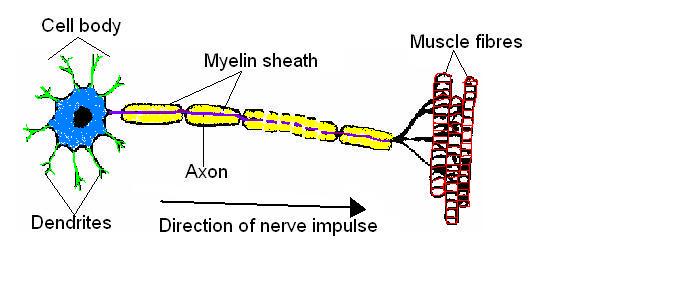
\(\newcommand{\avec}{\mathbf a}\) \(\newcommand{\bvec}{\mathbf b}\) \(\newcommand{\cvec}{\mathbf c}\) \(\newcommand{\dvec}{\mathbf d}\) \(\newcommand{\dtil}{\widetilde{\mathbf d}}\) \(\newcommand{\evec}{\mathbf e}\) \(\newcommand{\fvec}{\mathbf f}\) \(\newcommand{\nvec}{\mathbf n}\) \(\newcommand{\pvec}{\mathbf p}\) \(\newcommand{\qvec}{\mathbf q}\) \(\newcommand{\svec}{\mathbf s}\) \(\newcommand{\tvec}{\mathbf t}\) \(\newcommand{\uvec}{\mathbf u}\) \(\newcommand{\vvec}{\mathbf v}\) \(\newcommand{\wvec}{\mathbf w}\) \(\newcommand{\xvec}{\mathbf x}\) \(\newcommand{\yvec}{\mathbf y}\) \(\newcommand{\zvec}{\mathbf z}\) \(\newcommand{\rvec}{\mathbf r}\) \(\newcommand{\mvec}{\mathbf m}\) \(\newcommand{\zerovec}{\mathbf 0}\) \(\newcommand{\onevec}{\mathbf 1}\) \(\newcommand{\real}{\mathbb R}\) \(\newcommand{\twovec}[2]{\left[\begin{array}{r}#1 \\ #2 \end{array}\right]}\) \(\newcommand{\ctwovec}[2]{\left[\begin{array}{c}#1 \\ #2 \end{array}\right]}\) \(\newcommand{\threevec}[3]{\left[\begin{array}{r}#1 \\ #2 \\ #3 \end{array}\right]}\) \(\newcommand{\cthreevec}[3]{\left[\begin{array}{c}#1 \\ #2 \\ #3 \end{array}\right]}\) \(\newcommand{\fourvec}[4]{\left[\begin{array}{r}#1 \\ #2 \\ #3 \\ #4 \end{array}\right]}\) \(\newcommand{\cfourvec}[4]{\left[\begin{array}{c}#1 \\ #2 \\ #3 \\ #4 \end{array}\right]}\) \(\newcommand{\fivevec}[5]{\left[\begin{array}{r}#1 \\ #2 \\ #3 \\ #4 \\ #5 \\ \end{array}\right]}\) \(\newcommand{\cfivevec}[5]{\left[\begin{array}{c}#1 \\ #2 \\ #3 \\ #4 \\ #5 \\ \end{array}\right]}\) \(\newcommand{\mattwo}[4]{\left[\begin{array}{rr}#1 \amp #2 \\ #3 \amp #4 \\ \end{array}\right]}\) \(\newcommand{\laspan}[1]{\text{Span}\{#1\}}\) \(\newcommand{\bcal}{\cal B}\) \(\newcommand{\ccal}{\cal C}\) \(\newcommand{\scal}{\cal S}\) \(\newcommand{\wcal}{\cal W}\) \(\newcommand{\ecal}{\cal E}\) \(\newcommand{\coords}[2]{\left\{#1\right\}_{#2}}\) \(\newcommand{\gray}[1]{\color{gray}{#1}}\) \(\newcommand{\lgray}[1]{\color{lightgray}{#1}}\) \(\newcommand{\rank}{\operatorname{rank}}\) \(\newcommand{\row}{\text{Row}}\) \(\newcommand{\col}{\text{Col}}\) \(\renewcommand{\row}{\text{Row}}\) \(\newcommand{\nul}{\text{Nul}}\) \(\newcommand{\var}{\text{Var}}\) \(\newcommand{\corr}{\text{corr}}\) \(\newcommand{\len}[1]{\left|#1\right|}\) \(\newcommand{\bbar}{\overline{\bvec}}\) \(\newcommand{\bhat}{\widehat{\bvec}}\) \(\newcommand{\bperp}{\bvec^\perp}\) \(\newcommand{\xhat}{\widehat{\xvec}}\) \(\newcommand{\vhat}{\widehat{\vvec}}\) \(\newcommand{\uhat}{\widehat{\uvec}}\) \(\newcommand{\what}{\widehat{\wvec}}\) \(\newcommand{\Sighat}{\widehat{\Sigma}}\) \(\newcommand{\lt}{<}\) \(\newcommand{\gt}{>}\) \(\newcommand{\amp}{&}\) \(\definecolor{fillinmathshade}{gray}{0.9}\)1. The diagram below is of a nerve cell or neurone.
- i. Add the following labels to the diagram.
- Axon; Myelin sheath; Cell body; Dendrites; Muscle fibres;
- ii. If you like, colour in the diagram as suggested below.
- Axon - purple;
- Myelin sheath - yellow;
- Cell body - blue;
- Dendrites - green;
- Muscle fibres – red;
- iii. Now indicate the direction that the nerve impulse travels.
2. There are three different kinds of neurone or nerve cell. Match each kind with its function.
- A. Motor neuron; B. Sensory neuron; C. Relay neuron;
| Kind of neurone | Function |
|---|---|
| B. Sensory neuron |
The nerve cell that carries impulses from a sense receptor to the brain or spinal cord. |
| C. Relay neuron | The nerve cell that connects sensory and motor neurons |
| A. Motor neuron |
The nerve cell that transmits impulses from the brain or spinal cord to a muscle or gland |
3. Match the descriptions in the table below with the terms in the list.
| Term | Function |
|---|---|
| B. Axon | 1. The long fibre that carries the nerve impulses. |
| J. Nerve | 2. A bundle of axons. |
| A. Synapse | 3. The connection between adjacent neurons. |
| K. Neurotransmitter | 4. The chemical secreted into the gap between neurons at a synapse. |
| G.Reflex | 5. A rapid automatic response to a stimulus. |
| C. Myelin sheath |
6. The covering of fatty material that speeds up the passage of nerve impulses. |
| L. Axon terminal |
7. The structure at the end of an axon that produces neurotransmitters to transmit the nerve impulse across the synapse. |
| D. Nerve impulse | 8. The high speed signals that pass along the axons of nerve cells. |
| I. Dendrites | 9. The branching filaments that conduct nerve impulses towards the cell. |
| E. Sense receptor |
10. The sense organ or cells that receive stimuli from within and outside the body. |
| F. Response | 11. The reaction to a stimulus by a muscle or gland. |
| H. Cell body | 12.The part of the nerve cell containing the nucleus. |
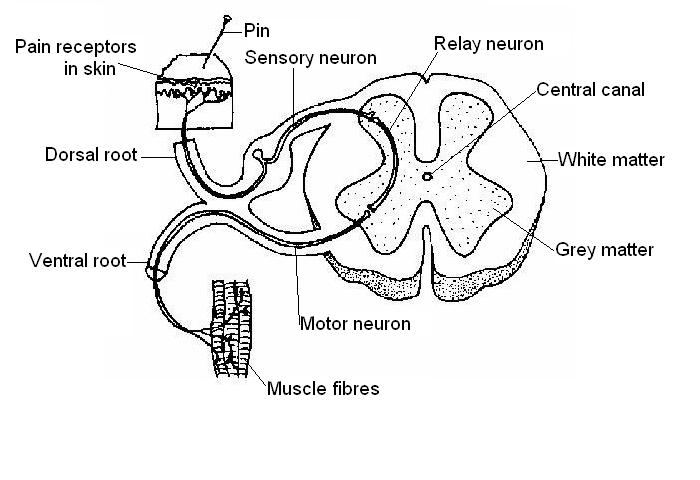
4. The diagram below shows a cross-section of the spinal cord. Add the following labels to the diagram.
- Central canal; White matter; Dorsal root; Grey matter; Ventral root; Skin;
- Muscle; Sensory neuron; Relay neuron; Motor neuron; Pain receptors in skin
5.
- a) List in order the 3 different neurons involved in a reflex arc from the stimulus to the response.
| Stimulus | sensory neuron | relay neuron | motor neuron | Response |
|---|
- b) Name 3 different reflexes found in animals.
Reflex 1. Blink reflex.
Reflex 2. Paw pinch reflex.
Reflex 3. Swallowing reflex, plus many others.
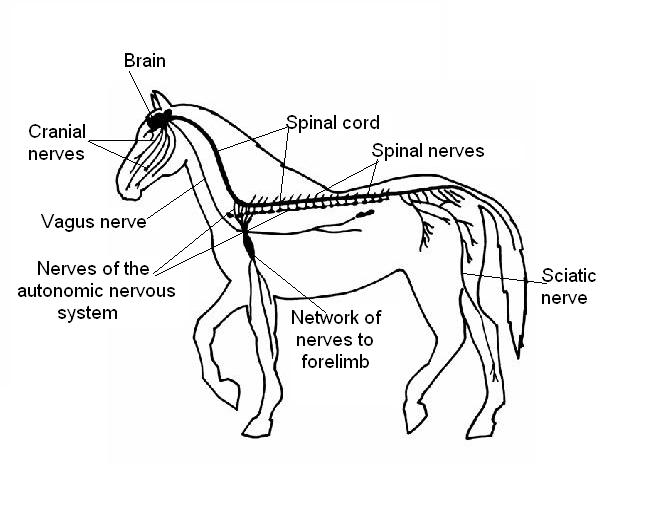
6. The diagram below shows the nervous system of a horse. Add the following labels.
- Brain; Spinal cord; Cranial nerves; Spinal nerves; Sciatic nerve; Nerves of the autonomic nervous system; Vagus nerve; Network of nerves to forelimb.
7. Indicate whether the following parts of the nervous system are part
of the Central Nervous System CNS) or the Peripheral Nervous System (PNS).
| Part of nervous system | CNS or PNS? |
|---|---|
| Brain | CNS |
| Autonomic nervous system | PNS |
| Spinal nerves | PNS |
| Spinal cord | CNS |
| Cranial nerves | PNS |
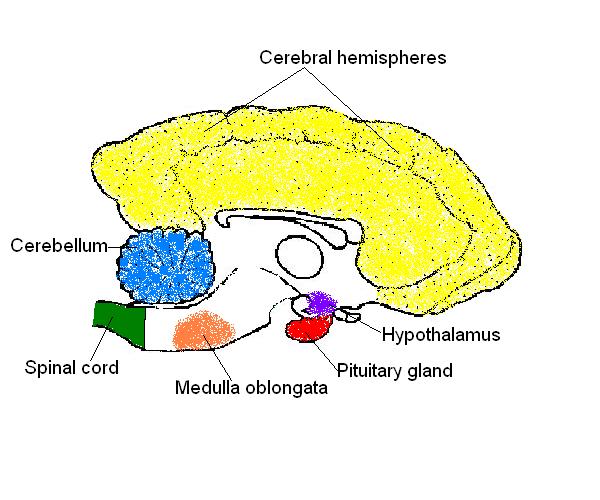
8. The diagram below shows a section of a dog’s brain. Add the labels
in the list below and, if you like, colour in the diagram as suggested.
- Cerebellum - blue;
- Spinal cord - green;
- Medulla oblongata - orange;
- Hypothalamus - purple;
- Pituitary gland - red;
- Cerebral hemispheres – yellow.
9. Match the descriptions below with the terms in the list. You may need to use some terms more than once.
| Term | Description |
|---|---|
| E. Hypothalamus | 1. Controls water balance and body temperature. |
| D.Medulla oblongata | 2. Where the respiratory rate is controlled. |
| C. Cerebellum | 3. Where posture, balance and voluntary muscle movements are controlled. |
| A. Cerebral hemispheres |
4. Contains centres governing mental activity, including intelligence, memory, and learning. |
| H. Meninges | 5. The tough fibrous envelope enclosing the brain and spinal cord. |
| F. Pituitary | 6. The “master” gland of the endocrine system. |
| Cerebral hemispheres/cortex | 7. Responsible for instigating voluntary movements. |
| J. Cerebrospinal fluid | 8. The fluid that surrounds the brain and spinal cord. |
| G. Grey matter | 9. Composed of cell bodies and nuclei. |
| B. White matter | 10. Composed of axons. |
| Cerebral hemispheres/cortex | 11. Where the sensations of sight, sound, taste etc. are interpreted. |
| I. Ventricles | 12. Spaces in the brain filled with cerebral spinal fluid. |
| K. Sulcus | 13. A fold in the cerebral cortex. |
| L. Carotid artery | 14. The artery that supplies the brain with oxygenated blood. |
10. Match the descriptions below with the parts of the nervous
system in the list. You may need to use some terms more than once.
| Description | Part of the nervous system |
|---|---|
|
1. Part of the nervous system that is composed of the brain and the spinal cord. |
B. Central nervous system |
|
2. Part of the nervous system that is composed of the cranial and spinal nerves. |
C. Peripheral nervous system |
|
3. The part of the peripheral nervous system that regulates the activity of the heart and smooth muscle. |
A. Autonomic nervous system |
|
4. The part of the autonomic nervous system that increases heart and respiratory rates, increases blood flow to the skeletal muscles and dilates the pupils of the eye. |
E. Sympathetic nervous system |
|
5. The part of the autonomic nervous system that increases gut activity and decreases heart and respiratory rates. |
D. Parasympathetic nervous system |
11. Name the nerves described below using the choices in the list.
| Nerve | Description |
|---|---|
| Vestibular nerve |
1. The 8th cranial nerve that carries impulses from the organs of balance and hearing to the brain. |
| Optic nerve |
2. The 2nd cranial nerve that carries nervous impulses from the retina of the eye to the brain. |
| Sciatic nerve | 3. The largest nerve in the body serving the muscles of the leg. |
| Olfactory nerve |
4. The 1st cranial nerve that carries impulses from the organ of smell in the nose to the brain. |
| Vagus nerve |
5. The 10th cranial nerve that supplies the pharynx, lungs, heart, stomach and most of the abdominal organs. |