

6.9: Alcohol Metabolism
- Page ID
- 135725

\( \newcommand{\vecs}[1]{\overset { \scriptstyle \rightharpoonup} {\mathbf{#1}} } \)
\( \newcommand{\vecd}[1]{\overset{-\!-\!\rightharpoonup}{\vphantom{a}\smash {#1}}} \)
\( \newcommand{\dsum}{\displaystyle\sum\limits} \)
\( \newcommand{\dint}{\displaystyle\int\limits} \)
\( \newcommand{\dlim}{\displaystyle\lim\limits} \)
\( \newcommand{\id}{\mathrm{id}}\) \( \newcommand{\Span}{\mathrm{span}}\)
( \newcommand{\kernel}{\mathrm{null}\,}\) \( \newcommand{\range}{\mathrm{range}\,}\)
\( \newcommand{\RealPart}{\mathrm{Re}}\) \( \newcommand{\ImaginaryPart}{\mathrm{Im}}\)
\( \newcommand{\Argument}{\mathrm{Arg}}\) \( \newcommand{\norm}[1]{\| #1 \|}\)
\( \newcommand{\inner}[2]{\langle #1, #2 \rangle}\)
\( \newcommand{\Span}{\mathrm{span}}\)
\( \newcommand{\id}{\mathrm{id}}\)
\( \newcommand{\Span}{\mathrm{span}}\)
\( \newcommand{\kernel}{\mathrm{null}\,}\)
\( \newcommand{\range}{\mathrm{range}\,}\)
\( \newcommand{\RealPart}{\mathrm{Re}}\)
\( \newcommand{\ImaginaryPart}{\mathrm{Im}}\)
\( \newcommand{\Argument}{\mathrm{Arg}}\)
\( \newcommand{\norm}[1]{\| #1 \|}\)
\( \newcommand{\inner}[2]{\langle #1, #2 \rangle}\)
\( \newcommand{\Span}{\mathrm{span}}\) \( \newcommand{\AA}{\unicode[.8,0]{x212B}}\)
\( \newcommand{\vectorA}[1]{\vec{#1}} % arrow\)
\( \newcommand{\vectorAt}[1]{\vec{\text{#1}}} % arrow\)
\( \newcommand{\vectorB}[1]{\overset { \scriptstyle \rightharpoonup} {\mathbf{#1}} } \)
\( \newcommand{\vectorC}[1]{\textbf{#1}} \)
\( \newcommand{\vectorD}[1]{\overrightarrow{#1}} \)
\( \newcommand{\vectorDt}[1]{\overrightarrow{\text{#1}}} \)
\( \newcommand{\vectE}[1]{\overset{-\!-\!\rightharpoonup}{\vphantom{a}\smash{\mathbf {#1}}}} \)
\( \newcommand{\vecs}[1]{\overset { \scriptstyle \rightharpoonup} {\mathbf{#1}} } \)
\(\newcommand{\longvect}{\overrightarrow}\)
\( \newcommand{\vecd}[1]{\overset{-\!-\!\rightharpoonup}{\vphantom{a}\smash {#1}}} \)
\(\newcommand{\ket}[1]{\left| #1 \right>}\)
\(\newcommand{\bra}[1]{\left< #1 \right|}\)
\(\newcommand{\braket}[2]{\left< #1 \vphantom{#2} \right| \left. #2 \vphantom{#1} \right>}\)
\(\newcommand{\braopket}[3]{\left< #1 \vphantom{#2}\vphantom{#3} \right| #2 \vphantom{#1}\vphantom{#3} \left| #3 \vphantom{#1}\vphantom{#2} \right>}\)
\(\newcommand{\qmvec}[1]{\mathbf{\vec{#1}}}\)
\(\newcommand{\op}[1]{\hat{\mathbf{#1}}}\)
\(\newcommand{\expect}[1]{\langle #1 \rangle}\)
\(\newcommand{\dfn}[1]{\emph{\textbf{#1}}}\)
Metabolism of alcohol occurs primarily in the liver through two different oxidative pathways. The activity of each pathway depends on the ethanol concentration and the frequency of ethanol consumption.

Figure \(\PageIndex{1}\): Overview of ethanol metabolism. Ethanol is broken down into acetaldehyde in the cytosol, producing an NADH. Acetaldehyde then crosses into the mitochondria and is converted into acetate, producing another NADH. Acetate can be converted to acetyl CoA, which then enters the TCA cycle. (CC BY 4.0; Kindred Grey via Internet Archive)
At low concentrations, oxidation of ethanol is a two-step process that occurs in both the cytosol and the mitochondria (Figure \(\PageIndex{1}\)). The first step of the reaction by alcohol dehydrogenase (ADH) occurs in the cytosol and produces acetaldehyde. Acetaldehyde is converted into acetate in the mitochondria by acetaldehyde dehydrogenase (ALDH) and can be transported in the blood to be used as an energy source for peripheral tissues (Figure \(\PageIndex{1}\)). The acetate can be converted to acetyl-CoA by acetyl-CoA synthetase (Figure \(\PageIndex{2}\)), and this will be oxidized in the TCA cycle. Each step in the oxidation of ethanol produces NADH, thereby increasing the NADH/NAD+ ratio. An increase in this ratio can alter the metabolism of other substrates and cause metabolic dysfunction, as discussed below.

Figure \(\PageIndex{2}\): Overview of alcohol metabolism. In the liver, ethanol is broken down by the enzyme ADH into acetaldehyde, which then gets converted to acetate by ALDH. Acetate can be transported in the blood to be used as an energy source in peripheral tissues, where acetate is converted to acetyl CoA, which can enter the TCA cycle. (CC BY 4.0; Kindred Grey via Internet Archive)
Consequences of Ethanol Metabolism in the Liver
At each step in ethanol oxidation, NADH is generated in both the mitochondrial and cytosolic compartments. This can have major metabolic ramifications depending on the underlying metabolic environment.
The use of NAD+ to metabolize alcohol means less NAD+ is available for other metabolic processes like glycolysis, the citric acid cycle, and the electron transport chain. The elevated NADH levels resulting from ethanol metabolism will negatively impact flux through the citric acid cycle, ultimately resulting in a build-up of acetyl CoA which gets converted into fatty acids (increasing triglyceride stores).
Additionally, acetaldehyde is highly toxic, and as levels rise it can bind to other proteins and DNA, potentially disrupting their function.
Excessive Alcohol Consumption
At higher ethanol concentrations, the microsomal ethanol-oxidizing system (MEOS) becomes activated. This microsomal-ethanol oxidizing system also detoxifies drugs such as barbiturates (Figure \(\PageIndex{3}\)). When a person consumes a large amount of alcohol, the MEOS serves as the overflow pathway, metabolizing ethanol to acetaldehyde. It is estimated that the MEOS metabolizes 20% of ethanol (Whitney & Rolfes, 2008), with the other 80% being metabolized by alcohol dehydrogenase.
Though both ADH and MEOS metabolize ethanol into acetaldehyde, the MEOS differs from ADH in that it uses oxidizes nicotinamide adenine dinucleotide phosphate (NADPH + H+) as an electron donor and oxidizes it to NADP+. Whereas the primary ADH pathway generates NADH (which can contribute to ATP production), MEOS does not provide this same potential contribution to ATP production. The action of the MEOS is shown in the figure below.
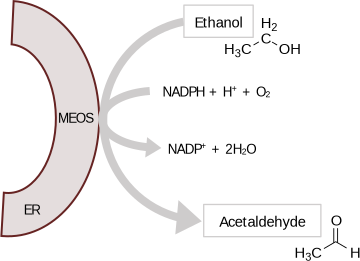
Figure \(\PageIndex{3}\): Ethanol detoxification by MEOS. In the presence of oxygen, the MEOS enzyme metabolizes ethanol into acetaldehyde using NADPH + H+ as an electron donor, resulting in NADP+ and 2H20. (CC BY-NC-SA; M. Lieberman & A. Peet)
At high intakes or with repeated exposure, there is increased synthesis of MEOS enzymes, resulting in more efficient metabolism, also known as increased tolerance. ADH levels do not increase based on alcohol exposure. MEOS also metabolizes a variety of other compounds (drugs, fatty acids, steroids), and alcohol competes for the enzyme's action. This can slow drug metabolism and potentially lead to harmful levels in the body (Whitney & Rolfes, 2008).
Of note, females have lower stomach ADH activity and lower body water concentration. As a result, a larger proportion of ethanol reaches circulation. Thus, in general, females have a lower tolerance for alcohol. Additionally, certain populations--particularly those of East Asian decent--are more likely to have polymorphisms in the ALDH enzymes, which cause the enzyme to have low activity (Zakhari, 2006, ALDH section, para. 1). This leads to acetaldehyde buildup and undesirable symptoms such as flushing, dizziness, nausea, and headaches (Byrd-Bredbenner et al., 2009).
References
Byrd-Bredbenner, C., Moe, G., Beshgetoor, D., & Berning, J. (2009). Wardlaw's perspectives in nutrition (8th ed.). McGraw-Hill Education.
Ferrier, D. R. (2017). Lippincott illustrated reviews: Biochemistry (7th ed.). Lippincott Williams & Wilkins.
Le, T., Bhushan, V., Sochat, M., Chavda, Y., & Zureick, A. (2018). First aid for the USMLE step 1. McGraw-Hill Education.
Lieberman, M. A., & Peet, A. (2017). Marks' basic medical biochemistry: A clinical approach (5th ed.). Lippincott Williams & Wilkins.
Whitney, E., & Rolfes, S. R. (2008). Understanding nutrition (11th ed.). Thomson Wadsworth.
Zakhari, S. (2006). Overview: How is alcohol metabolized by the body? Alcohol Research and Health: The Journal of the National Institute on Alcohol Abuse and Alcoholism, 29(4) 245-254.