

10.1: Introduction to Nutrition and Physical Fitness
- Page ID
- 14569
\( \newcommand{\vecs}[1]{\overset { \scriptstyle \rightharpoonup} {\mathbf{#1}} } \)
\( \newcommand{\vecd}[1]{\overset{-\!-\!\rightharpoonup}{\vphantom{a}\smash {#1}}} \)
\( \newcommand{\dsum}{\displaystyle\sum\limits} \)
\( \newcommand{\dint}{\displaystyle\int\limits} \)
\( \newcommand{\dlim}{\displaystyle\lim\limits} \)
\( \newcommand{\id}{\mathrm{id}}\) \( \newcommand{\Span}{\mathrm{span}}\)
( \newcommand{\kernel}{\mathrm{null}\,}\) \( \newcommand{\range}{\mathrm{range}\,}\)
\( \newcommand{\RealPart}{\mathrm{Re}}\) \( \newcommand{\ImaginaryPart}{\mathrm{Im}}\)
\( \newcommand{\Argument}{\mathrm{Arg}}\) \( \newcommand{\norm}[1]{\| #1 \|}\)
\( \newcommand{\inner}[2]{\langle #1, #2 \rangle}\)
\( \newcommand{\Span}{\mathrm{span}}\)
\( \newcommand{\id}{\mathrm{id}}\)
\( \newcommand{\Span}{\mathrm{span}}\)
\( \newcommand{\kernel}{\mathrm{null}\,}\)
\( \newcommand{\range}{\mathrm{range}\,}\)
\( \newcommand{\RealPart}{\mathrm{Re}}\)
\( \newcommand{\ImaginaryPart}{\mathrm{Im}}\)
\( \newcommand{\Argument}{\mathrm{Arg}}\)
\( \newcommand{\norm}[1]{\| #1 \|}\)
\( \newcommand{\inner}[2]{\langle #1, #2 \rangle}\)
\( \newcommand{\Span}{\mathrm{span}}\) \( \newcommand{\AA}{\unicode[.8,0]{x212B}}\)
\( \newcommand{\vectorA}[1]{\vec{#1}} % arrow\)
\( \newcommand{\vectorAt}[1]{\vec{\text{#1}}} % arrow\)
\( \newcommand{\vectorB}[1]{\overset { \scriptstyle \rightharpoonup} {\mathbf{#1}} } \)
\( \newcommand{\vectorC}[1]{\textbf{#1}} \)
\( \newcommand{\vectorD}[1]{\overrightarrow{#1}} \)
\( \newcommand{\vectorDt}[1]{\overrightarrow{\text{#1}}} \)
\( \newcommand{\vectE}[1]{\overset{-\!-\!\rightharpoonup}{\vphantom{a}\smash{\mathbf {#1}}}} \)
\( \newcommand{\vecs}[1]{\overset { \scriptstyle \rightharpoonup} {\mathbf{#1}} } \)
\(\newcommand{\longvect}{\overrightarrow}\)
\( \newcommand{\vecd}[1]{\overset{-\!-\!\rightharpoonup}{\vphantom{a}\smash {#1}}} \)
\(\newcommand{\ket}[1]{\left| #1 \right>}\)
\(\newcommand{\bra}[1]{\left< #1 \right|}\)
\(\newcommand{\braket}[2]{\left< #1 \vphantom{#2} \right| \left. #2 \vphantom{#1} \right>}\)
\(\newcommand{\braopket}[3]{\left< #1 \vphantom{#2}\vphantom{#3} \right| #2 \vphantom{#1}\vphantom{#3} \left| #3 \vphantom{#1}\vphantom{#2} \right>}\)
\(\newcommand{\qmvec}[1]{\mathbf{\vec{#1}}}\)
\(\newcommand{\op}[1]{\hat{\mathbf{#1}}}\)
\(\newcommand{\expect}[1]{\langle #1 \rangle}\)
\(\newcommand{\dfn}[1]{\emph{\textbf{#1}}}\)
Physical fitness is a general state of health and well-being and, more specifically, the ability to perform aspects of sports, occupations and daily activities. Physical fitness is generally achieved through proper nutrition, moderate-vigorous physical exercise, physical activity, and sufficient rest. Before the industrial revolution, fitness was defined as the capacity to carry out the day’s activities without undue fatigue. However, with automation and changes in lifestyles physical fitness is now considered a measure of the body's ability to function efficiently and effectively in work and leisure activities, to be healthy, to resist hypokinetic diseases, and to meet emergency situations.

Fitness
Fitness is defined as the quality or state of being fit. Around 1950, perhaps consistent with the Industrial Revolution and the treatise of World War II, the term "fitness" increased in western vernacular by a factor of ten. Modern definition of fitness describe either a person or machine's ability to perform a specific function or a holistic definition of human adaptability to cope with various situations. This has led to an interrelation of human fitness and attractiveness which has mobilized global fitness and fitness equipment industries. Regarding specific function, fitness is attributed to personnel who possess significant aerobic or anaerobic ability, i.e. strength or endurance. A holistic definition of fitness is described by Greg Glassman in the CrossFit journal as an increased work capacity across broad times and modal domains; mastery of several attributes of fitness including strength, endurance, power, speed, balance and coordination and being able to improve the amount of work done in a given time with any of these domains. A well rounded fitness program will improve a person in all aspects of fitness, rather than one, such as only cardio/respiratory endurance or only weight training.
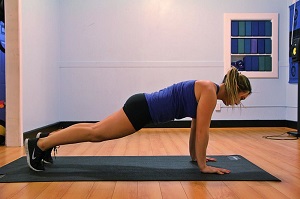
A comprehensive fitness program tailored to an individual typically focuses on one or more specific skills, and on age- or health-related needs such as bone health. Many sources also cite mental, social and emotional health as an important part of overall fitness. This is often presented in textbooks as a triangle made up of three points, which represent physical, emotional, and mental fitness. Physical fitness can also prevent or treat many chronic health conditions brought on by unhealthy lifestyle or aging. Working out can also help some people sleep better and possibly alleviate some mood disorders in certain individuals.
Developing research has demonstrated that many of the benefits of exercise are mediated through the role of skeletal muscle as an endocrine organ. That is, contracting muscles release multiple substances known as myokines which promote the growth of new tissue, tissue repair, and various anti-inflammatory functions, which in turn reduce the risk of developing various inflammatory diseases.
Activity guidelines
The Physical Activity Guidelines for Americans was created by the Office of Disease Prevention and Health Promotion. This publication suggests that all adults should avoid inactivity to promote good health mentally and physically. For substantial health benefits, adults should participate in at least 150 minutes (two hours and 30 minutes) a week of moderate-intensity, or 75 minutes (1 hour and 15 minutes) a week of vigorous-intensity aerobic physical activity, or an equivalent combination of moderate- and vigorous-intensity aerobic activity. Aerobic activity should be performed in episodes of at least 10 minutes, and preferably, it should be spread throughout the week. For additional and more extensive health benefits, adults should increase their aerobic physical activity to 300 minutes (5 hours) a week of moderate-intensity, or 150 minutes a week of vigorous-intensity aerobic physical activity, or an equivalent combination of moderate- and vigorous-intensity activity. Additional health benefits are gained by engaging in physical activity beyond this amount. Adults should also do muscle-strengthening activities that are moderate or high intensity and involve all major muscle groups on 2 or more days a week, as these activities provide additional health benefits.
How to Determine Intensity Level using Heart Rate and Talk Test
There are many ways to determine Intensity Level but let's use Heart Rate as one way to determine how intensely you are working out. First of all, as you are sitting here reading this eBook you have a certain heart rate. If you put your two fingers on your neck, you can feel your pulse. If you count the number of beats in one minute you will have an approximation of your resting heart rate. The truth is, the exact measurement of the resting heart rate requires a a much more precise measurement but we will use this as your resting heart rate for now. Please take a minute and count your approximate resting heart rate right now! Chances are, your resting heart rate was probably anywhere from 60-90 beats per minute, right? The more physically fit your heart and lungs are, the LOWER than number will be! Why? Because your heart doesn't have to work as hard to pump the blood throughout your body so it takes fewer heart beats if you are fit.
You have probably seen heart rate monitors on treadmills and stair climber machines. You have probably seen people wearing various types of heart rate monitors on devices like the "Apple Watch" and the "fit bit" etc... these devices are estimating how intensely you are exercising by how many beats your heart has to make in a minute. The device estimates your "Maximum heart rate" as 220- your Age in years. So if you are 20 years old, the device estimates your highest heart rate as 220-20 = 200 beats per minute. Your maximum heart rate is far too high for you to try to sustain during exercise. Instead, there are "target heart rate zones" you can shoot for. If you wish to be working out at a "moderate level of intensity" you will want your heart rate to be between 50% and 70% of your maximum. If you wish to be working out at a "vigorous" level of intensity then you will want your heart rate to be between 75-85% of your maximum. Using the 20 year old example again, if 200 is your maximum heart rate, then 200 x 0.5 = 100 beats per minute for 50% of maximum and 200 x .7 = 140 beats per minute for 70% of maximum. This tells you, if you check your pulse during exercise and you count between 100-140 beats per minute you are doing "moderate intensity" level of exercise!
Another, much easier though less precise, way to estimate intensity level is the "talk test". Basically, if you are able to carry on a breathy conversation as you exercise you are probably at a moderate level of intensity. If you can not carry on a conversation because you are too winded (out-of-breath) then you are probably at a vigorous level of exercise. Many people prefer this method because it doesn't require any equipment nor does it require you to stop to count your heart beats.
Training
Specific or task-oriented fitness is a person's ability to perform in a specific activity with a reasonable efficiency: for example, sports or military service. Specific training prepares athletes to perform well in their sports. Examples are:
- 100 m sprint: in a sprint the athlete must be trained to work anaerobically throughout the race, an example of how to do this would be interval training.
- Middle distance running: athletes require both speed and endurance to gain benefit out of this training. The hard working muscles are at their peak for a longer period of time as they are being used at that level for longer period of time.
- Marathon: in this case the athlete must be trained to work aerobically and their endurance must be built-up to a maximum.
- Many fire fighters and police officers undergo regular fitness testing to determine if they are capable of the physically demanding tasks required of the job.
- Members of armed forces will often be required to pass a formal fitness test – for example soldiers of the US Army must be able to pass the Army Physical Fitness Test (APFT).
- Hill sprints: requires a level of fitness to begin with, the exercise is particularly good for the leg muscles. The army often trains doing mountain climbing and races.
- Sand running creates less strain on leg muscles than running on grass or concrete. This is because sand collapses beneath the foot softening the landing. Sand training is an effective way to lose weight and become fit as its proven you need more effort (one and a half times more) to run on the soft sand than on a hard surface.
- Aquajogging is a form of exercise that decreases strain on joints and bones. The water supplies minimal impact to muscles and bones which is good for those recovering from injury. Furthermore, the resistance of the water as one jogs through it provides an enhanced effect of exercise (the deeper you are the greater the force needed to pull your leg through).

- Swimming: Squatting exercise helps in enhancing a swimmer's start.
In order for physical fitness to benefit the health of an individual, an unknown response in the person called a stimulus will be triggered by the exertion. When exercise is performed with the correct amount of intensity, duration and frequency, a significant amount of improvement can occur. The person may overall feel better but the physical effects on the human body take weeks or months to notice and possibly years for full development. For training purposes, exercise must provide a stress or demand on either a function or tissue. To continue improvements, this demand must eventually increase little over an extended period of time. This sort of exercise training has three basic principles: overload, specificity, and progression. These principles are related to health but also enhancement of physical working capacity.
High Intensity Interval Training consists of repeated, short bursts of exercise, completed at a high level of intensity. These sets of intense activity are followed by a predetermined time of rest or low intensity activity. Studies have shown that exercising at a higher intensity has increased cardiac benefits for humans, compared to when exercising at a low or moderate level. When your workout consists of an HIIT session, your body has to work harder to replace the oxygen it lost. Research into the benefits of HIIT have revealed that it can be very successful for reducing fat, especially around the abdominal region. Furthermore, when compared to continuous moderate exercise, HIIT proves to burn more calories and increase the amount of fat burned post- HIIT session. Lack of time is one of the main reasons stated for not exercising; HIIT is a great alternative for those people because the duration of an HIIT session can be as short as 10 minutes, making it much quicker than conventional workouts.
Cardiovascular capacity can be measured using VO2 max, a measure of the amount of oxygen the body can uptake and utilize. Cardiorespiratory training involves movement that increases the heart rate to improve the body's oxygen consumption. This form of exercise is an important part of all training regiments ranging from professional athletes to the everyday person. Also, it helps increase stamina. Examples are:
- Jogging – Running at a steady and gentle pace. This form of exercise is great for maintaining weight.
- Elliptical Training – This is a stationary exercise machine used to perform walking, or running without causing excessive stress on the joints. This form of exercise is perfect for people with achy hips, knees and ankles.
- Walking – Moving at a fairly regular pace for a short, medium or long distance.
- Treadmill training – Many treadmills have programs set up that offers a numerous amount of different workout plans. One effective cardiovascular activity would be to switch between running and walking. Typically warm up first by walking and then switch off between walking for three minutes and running for three minutes.
- Swimming – Using the arms and legs to keep oneself afloat and moving either forwards or backwards. This is a good full body exercise for those who are looking to strengthen their core while improving cardiovascular endurance.
- Cycling – Riding a bicycle typically involves longer distances than walking or jogging. This is another low stress exercise on the joints and is great for improving leg strength.
Benefits of Fitness
Physical fitness has proven to result in positive effects on the body's blood pressure because staying active and exercising regularly builds up a stronger heart. The heart is the main organ in charge of systolic blood pressure and diastolic blood pressure. Engaging in a physical activity will create a rise in blood pressure, once the activity is stopped, however, the individual’s blood pressure will return to normal. The more physical activity that one engages in, the easier this process becomes, resulting in a more ‘fit’ individual. A "normal" blood pressure is considered to be 120/80 or below. Through regular physical fitness, the heart does not have to work as hard to create a rise in blood pressure, which lowers the force on the arteries, and lowers the over all blood pressure.
Centers for disease control and prevention provide lifestyle guidelines of maintaining a balanced diet and engaging in physical activity to reduce the risk of disease. The WCRF/ American Institute for Cancer Research (AICR) published a list of recommendations that reflect the evidence they have found through consistency in fitness and dietary factors that directly relate to Cancer prevention.
Studies have shown an association between increased physical activity and reduced inflammation It produces both a short-term inflammatory response and a long-term anti-inflammatory effect. Physical activity reduces inflammation in conjunction with or independent of changes in body weight. However, the mechanisms linking physical activity to inflammation are unknown.
Physical activity boosts the immune system. This is dependent on the concentration of endogenous factors (such as sex hormones, metabolic hormones and growth hormones), body temperature, blood flow, hydration status and body position. Physical activity has shown to increase the levels of natural killer (NK) cells, NK T cells, macrophages, neutrophils and eosinophils, complements, cytokines, antibodies and T cytotoxic cells. However, the mechanism linking physical activity to immune system is not fully understood.
Physical activity affects one’s blood pressure, cholesterol levels, blood lipid levels, blood clotting factors and the strength of blood vessels. All factors that directly correlate to cardiovascular disease. It also improves the body’s use of insulin. People who are at risk for diabetes, Type 2 (insulin resistant) especially, benefit greatly from physical activity because it activates a better usage of insulin and protects the heart. Those who develop diabetes have an increased risk of developing cardiovascular disease. In a study where a sample of around ten thousand adults from the Third National Health and Nutrition Examination Survey, physical activity and metabolic risk factors such as insulin resistance, inflammation, dyslipidemia were assessed. The study adjusted basic confounders with moderate/vigorous physical activity and the relation with CVD mortality. The results displayed physical activity being associated with a lower risk of CVD mortality that was independent of traditional metabolic risk factors.
The American Heart Association recommendations include the same findings as provided in the WCRF/ AICR recommendations list for people who are healthy. In regards to people with lower blood pressure or cholesterol, the association recommends that these individuals aim for around forty minutes of moderate to vigorous physical activity around three or four times a week.
Achieving resilience through physical fitness promotes a vast and complex range of health related benefits. Individuals who keep up physical fitness levels generally regulate their distribution of body fat and stay away from obesity. Abdominal fat, specifically visceral fat, is most directly affected by engaging in aerobic exercise. Strength training has been known to increase the amount of muscle in the body, however it can also reduce body fat. Sex steroid hormones, insulin, and an appropriate immune response are factors that mediate metabolism in relation to the abdominal fat. Therefore, physical fitness provides weight control through regulation of these bodily functions.
Regular exercise is effective for preventing the age-related decline in cognition and improving overall neuropsychological function. The increased synthesis of neurotrophic factors in the body and brain and the resulting neurogenesis in various brain structures is largely responsible for these effects. Exercise also has persistent antidepressant effects and has been found to serve as both a means to prevent and treat drug addictions, particularly psychostimulant addictions.
Menopause is the term that is used to refer to the stretch of both before and after a woman's last menstrual cycle. there are an instrumental amount of symptoms connected to menopause, most of which can affect the quality of life of the women involved in this stage of her life. One way to reduce the severity of the symptoms is exercise and keeping a healthy level of fitness. Pre or during menopause as the women body changes there can be physical, physiological or internal changes to the body. These changes can be prevented or the reduced with the use of regular exercise.
Contributors and Attributions
- Wikipedia