

9.2: Trace Minerals
- Page ID
- 156639

\( \newcommand{\vecs}[1]{\overset { \scriptstyle \rightharpoonup} {\mathbf{#1}} } \)
\( \newcommand{\vecd}[1]{\overset{-\!-\!\rightharpoonup}{\vphantom{a}\smash {#1}}} \)
\( \newcommand{\dsum}{\displaystyle\sum\limits} \)
\( \newcommand{\dint}{\displaystyle\int\limits} \)
\( \newcommand{\dlim}{\displaystyle\lim\limits} \)
\( \newcommand{\id}{\mathrm{id}}\) \( \newcommand{\Span}{\mathrm{span}}\)
( \newcommand{\kernel}{\mathrm{null}\,}\) \( \newcommand{\range}{\mathrm{range}\,}\)
\( \newcommand{\RealPart}{\mathrm{Re}}\) \( \newcommand{\ImaginaryPart}{\mathrm{Im}}\)
\( \newcommand{\Argument}{\mathrm{Arg}}\) \( \newcommand{\norm}[1]{\| #1 \|}\)
\( \newcommand{\inner}[2]{\langle #1, #2 \rangle}\)
\( \newcommand{\Span}{\mathrm{span}}\)
\( \newcommand{\id}{\mathrm{id}}\)
\( \newcommand{\Span}{\mathrm{span}}\)
\( \newcommand{\kernel}{\mathrm{null}\,}\)
\( \newcommand{\range}{\mathrm{range}\,}\)
\( \newcommand{\RealPart}{\mathrm{Re}}\)
\( \newcommand{\ImaginaryPart}{\mathrm{Im}}\)
\( \newcommand{\Argument}{\mathrm{Arg}}\)
\( \newcommand{\norm}[1]{\| #1 \|}\)
\( \newcommand{\inner}[2]{\langle #1, #2 \rangle}\)
\( \newcommand{\Span}{\mathrm{span}}\) \( \newcommand{\AA}{\unicode[.8,0]{x212B}}\)
\( \newcommand{\vectorA}[1]{\vec{#1}} % arrow\)
\( \newcommand{\vectorAt}[1]{\vec{\text{#1}}} % arrow\)
\( \newcommand{\vectorB}[1]{\overset { \scriptstyle \rightharpoonup} {\mathbf{#1}} } \)
\( \newcommand{\vectorC}[1]{\textbf{#1}} \)
\( \newcommand{\vectorD}[1]{\overrightarrow{#1}} \)
\( \newcommand{\vectorDt}[1]{\overrightarrow{\text{#1}}} \)
\( \newcommand{\vectE}[1]{\overset{-\!-\!\rightharpoonup}{\vphantom{a}\smash{\mathbf {#1}}}} \)
\( \newcommand{\vecs}[1]{\overset { \scriptstyle \rightharpoonup} {\mathbf{#1}} } \)
\(\newcommand{\longvect}{\overrightarrow}\)
\( \newcommand{\vecd}[1]{\overset{-\!-\!\rightharpoonup}{\vphantom{a}\smash {#1}}} \)
\(\newcommand{\ket}[1]{\left| #1 \right>}\)
\(\newcommand{\bra}[1]{\left< #1 \right|}\)
\(\newcommand{\braket}[2]{\left< #1 \vphantom{#2} \right| \left. #2 \vphantom{#1} \right>}\)
\(\newcommand{\braopket}[3]{\left< #1 \vphantom{#2}\vphantom{#3} \right| #2 \vphantom{#1}\vphantom{#3} \left| #3 \vphantom{#1}\vphantom{#2} \right>}\)
\(\newcommand{\qmvec}[1]{\mathbf{\vec{#1}}}\)
\(\newcommand{\op}[1]{\hat{\mathbf{#1}}}\)
\(\newcommand{\expect}[1]{\langle #1 \rangle}\)
\(\newcommand{\dfn}[1]{\emph{\textbf{#1}}}\)
Trace minerals, also called microminerals, are essential nutrients required by the body in much smaller amounts than major minerals, but their impact on health is just as significant. Despite being needed in tiny quantities, trace minerals play critical roles in a wide range of biological processes, including oxygen transport, immune function, hormone production, antioxidant defense, and enzyme activity. There are eight essential trace minerals, including iron, copper, iodine, selenium, chromium, manganese, molybdenum, and zinc. Other trace minerals, such as fluoride, are not technically essentially nutrients, but may influence health.
Iron
Iron exists in two forms in food - heme and nonheme iron. Heme iron is iron bound to a heme group. Heme is an iron-containing prosthetic (nonprotein) group that is a component of complex proteins such as hemoglobin and myoglobin (in red blood cells). Nonheme iron is iron that is not a component of a heme molecule. Whether iron is heme vs. nonheme impacts its bioavailability.
Important Roles
Iron is essential for the formation of hemoglobin in red blood cells, which transports oxygen throughout the body. In the hemoglobin molecule, iron is the site of oxygen binding; therefore, required for oxygen to be transported. Iron is also a cofactor for nonheme containing enzymes in the electron transport chain, citric acid cycle, and gluconeogenesis. Iron is a cofactor for cytochrome P450 enzymes as well, which help to metabolize drugs and toxins.
Dietary Sources
The RDA for iron is 18 mg/day for women (27 mg/day if pregnant) and 8 mg/day for men. Women have an increased requirement for iron intake due to the loss of blood, and therefore iron, through monthly menstruation. Pregnancy significantly increases a woman’s iron needs, as there is an increase in the woman’s blood volume as the body produces more blood to support the growing fetus and placenta.
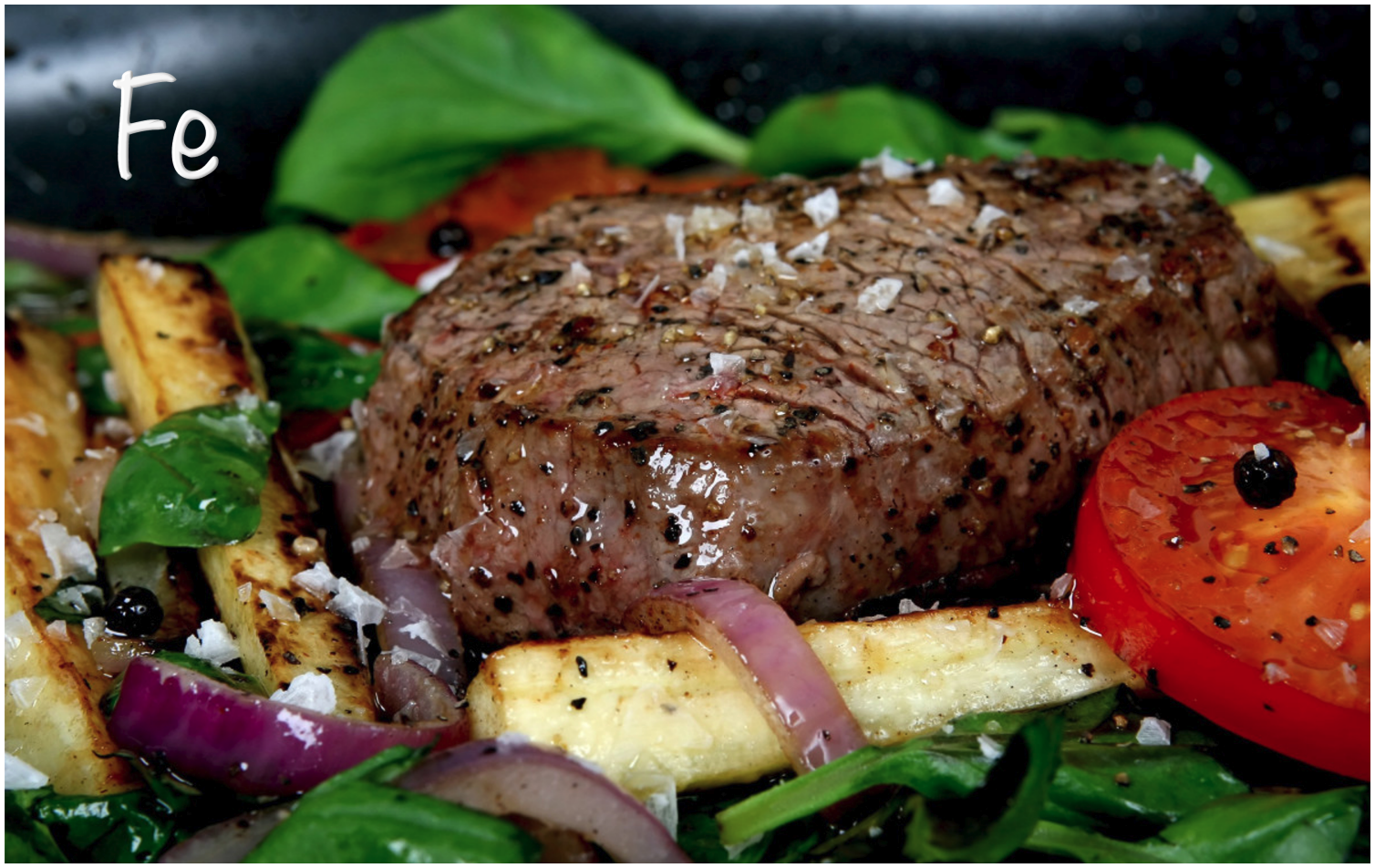
Heme iron is most abundantly found in shellfish, beef, poultry, and organ meats, while nonheme iron is typically found in plant sources such as green leafy vegetables, mushrooms, and legumes, as well as fortified cereals (Figure 9.8). Nonheme iron accounts for approximately 85% of the iron consumed by an average individual.
Heme iron is 2-3 times more bioavailable than nonheme iron, with absorption of heme iron typically being high, depending on how much iron the body needs (iron status of the individual). One of the most important factors for nonheme iron is its ionic state — ferric iron (Fe3+) is a more oxidized state and ferrous iron (Fe2+) is a more reduced state — and ferrous iron is more bioavailable.
The amount of iron in the body is regulated by absorption at the small intestine. Heme iron can be transported across the brush border and basolateral membrane of the intestinal enterocytes without being modified. However, nonheme iron needs to be reduced to its ferrous form prior to transport. Reducing agents like vitamin C increase the bioavailability of nonheme iron — one of the benefits of eating a diverse diet.
Consequences of Deficiency and Toxicity
Hepcidin is a liver-derived hormone that regulates (decreases) synthesis of transport proteins (for iron homeostasis). High levels of hepcidin lead to decreased transport protein production and low levels of hepcidin lead to increased transport protein production. If an individual is iron deficient, the liver releases less hepcidin to increase the production of iron transport proteins, so transport of iron into and across the enterocytes increases to get more iron into circulation. In an individual has excess iron, hepcidin levels will increase, decreasing transport protein production, and retaining more iron in the cells.
Despite it being the most studied mineral, iron is the most common micronutrient deficiency worldwide. Iron deficiency causes anemia (lack of healthy red blood cells) and is especially common in women in general, but also those of childbearing age, infants, and adolescents. Symptoms include reduced energy, fatigue, inability to heal, chronic recurrent infection, weakness, pale skin, and impaired cognitive function (Figure 9.9). If an individual has iron deficiency anemia, it is typically suggested to supplement with ferrous iron, as it is readily available for absorption.

Iron overload is often from supplemental overdose or genetic abnormalities like hemochromatosis. Hereditary hemochromatosis is a condition in which there is a defect in one of a number of genes that code for hepcidin or an intestinal iron transport protein — either way, this leads to large amounts of iron being absorbed into the blood. Iron toxicity symptoms typically include vomiting, diarrhea, black stools, and can cause organ damage due to iron deposits in the liver and heart.
Iron is crucial for oxygen transport in the blood.
Iron-rich foods paired with vitamin C (like in oranges) help your body absorb more iron!
Zinc
Zinc is an essential trace mineral needed for growth, reproduction, immunity, and protein synthesis. Absorption of zinc in the small intestine requires two proteins — the first, a zinc transport protein for transport across the brush border into the enterocyte. Metallothionine then binds zinc once inside the cell, regulating how much zinc gets transported across the basolateral membrane depending on the zinc status of the individual and physiological needs. Metallothionine synthesis decreases during periods of low zinc (allowing more zinc to be released into the blood) and increases if zinc is in excess (holding it in the cell). Any excess zinc bound to metallothionine is excreted in the feces when enterocytes get sloughed off every few days.
Important Roles
Zinc supports immune function, helping the body fight invading pathogens by supporting the growth and normal functioning of immune cells. Zinc is also involved in the repair and growth of tissues, making it essential for wound healing. It is important for cell division, cell growth, DNA synthesis, and particularly during pregnancy and periods of development. Zinc is also a cofactor for hundreds of enzymes involved in various metabolic processes, and is a component of an enzyme needed for the proper sense of taste and smell.
Dietary Sources
Zinc has an RDA of 8 mg/day for women and 11 mg/day for men. It is abundant in shellfish such as oysters, but can also be found in meat, dairy, legumes, whole grains, seeds, and fortified cereals (Figure 9.10).

Bioavailability of zinc is generally influenced by dietary factors similar to iron. Animal foods are greater sources of zinc than plant sources, which often have phytates that interfere with absorption. Excessive intake of other minerals, such as iron or copper, can decrease absorption of zinc. Though, acidic substances tend to increase absorption. Absorption in the small intestine requires two proteins — the first, a zinc transport protein for transport across the brush border into the enterocyte. Metallothionine then binds zinc once inside the cell, regulating how much zinc gets transported across the basolateral membrane depending on the zinc status of the individual and physiological needs. Metallothionine synthesis decreases during periods of low zinc (allowing more zinc to be released into the blood) and increases if zinc is in excess (holding it in the cell). Any excess zinc bound to metallothionine is excreted in the feces when enterocytes get sloughed off every few days.
Consequences of Deficiency and Toxicity
Most individuals eating a balanced diet are able to intake sufficient zinc, though medical conditions or restrictive diets may impact zinc status. Mild zinc deficiency decreases the ability to taste and smell, impairs immune function, delays wound healing, and leads to hair loss. A more severe deficiency can lead to developmental delays in children and delayed sexual maturation.
Zinc supports wound healing and immune function.
Zinc lozenges are popular during cold season, but oysters are the top zinc food!
Copper
There are two oxidation states of copper — cupric (Cu2+) and cuprous (Cu1+), with cupric compounds being generally more readily bioavailable than cuprous. Like other minerals, copper is majorly absorbed in the small intestine; however, it is able to be absorbed in the stomach to a lesser extent depending on the overall copper status of the individual. Excess copper in the body is typically incorporated into bile and eliminated in the feces.
Important Roles
Copper aids in iron metabolism, supports antioxidant activity, and is important for nerve function and collagen synthesis. Copper is intricately linked with iron absorption, metabolism and utilization in the body. Copper is essential for the functioning of several enzymes, including those involved in the absorption and mobilization of iron. Furthermore, ceruloplasmin, a copper-containing protein, acts as a ferroxidase (enzyme) to oxidize ferrous iron (Fe2+) to ferric iron (Fe3+). This conversion is necessary for iron to bind to transferrin, the protein that transports iron in the blood. Copper acts as a cofactor in many redox reactions, needed for the proper functioning of many enzymes, including those that help convert food into energy and those that help form neurotransmitters for nerve signal transmission, for example.
Dietary Sources
The RDA established for copper intake is 900 µg/day for both women and men. It is found abundantly in organ meats such as beef liver, as well as shellfish, nuts, seeds, whole grains, and legumes (Figure 9.11).

Consequences of Deficiency and Toxicity
Deficiency can cause weakened immune function. Importantly, due to the role of copper in the absorption, transport, and utilization of iron in the body, a copper deficiency can lead to a secondary iron deficiency. Excess copper can cause nausea, cramping, and diarrhea.
Copper helps form red blood cells and supports the immune and nervous systems.
You only need 900 µg per day, but too much zinc can block its absorption.
Iodine
Iodine is an essential component of thyroid hormones, which regulate metabolism, growth, development, and reproduction, to name a few. Iodine is essential in the biosynthesis of thyroid hormones. It combines with the protein thyroglobulin in the follicle of the thyroid to produce thyroxine (T4), which then gets converted into triiodothyronine (T3).
In the normal regulatory axis of thyroid hormone production, thyrotropin-releasing hormone (TRH) is released from the hypothalamus when thyroid hormone levels are low in the blood (or iodine is low in the blood). This stimulates the anterior pituitary gland to release thyroid-stimulating hormone (TSH). TSH then stimulates the thyroid gland to take up iodine and product the thyroid hormones T3 and T4 (Figure 9.12).

Important Roles
The thyroid hormones T3 (triiodothyronine) and T4 (thyroxine) affect virtually every cell and organ of the body. They influence our basal metabolic rate, stimulate metabolism of carbohydrates, proteins, and fats, and are essential for proper development of the brain, spinal cord, and skeleton during fetal growth and in periods of growth in children. Thyroid hormones help maintain body temperature, raising or lowering body temperature in response to the body’s needs. Thyroid hormones impact female menstrual cycles and fertility, playing a role in reproductive health.
Dietary Sources
The RDA established for iodine is 150 µg/day for both women and men. Perhaps the richest source of iodine is iodized table salt. It can also be found in foods such as seafood, dairy like yogurt, cheese, and milk, some beans, and seaweed.
Consequences of Deficiency and Toxicity
Cases of iodine deficiency are most prevalent in countries without iodized salt and not near an ocean for access to seafood rich in iodine. Deficiency can cause goiter, where the thyroid gland becomes enlarged; this can occur in children and adults. This results from low levels of iodine leading to low levels of thyroid hormone production. This then signals the anterior pituitary gland to release TSH and increase production of T3 and T4 hormones. However, because there is no iodine, thyroglobulin is produced and enlarges the thyroid, but with no thyroid hormone production. If a mother is iodine deficient during pregnancy, this may lead to cretinism in the baby. Cretinism typically results in severe physical and mental developmental delays in infants. Excessive iodine can also impair thyroid function, and can cause iodine poisoning with symptoms of nausea, vomiting, and diarrhea.
Iodine is essential for thyroid hormone production and metabolism.
The United States added iodine to salt in the 1920s to fight goiter!
Selenium
Selenium is a trace mineral that is crucial for antioxidant activity, thyroid function, and reproductive health. Selenium acts as a component of various enzymes, including those involved in supporting the immune system. It is found abundantly in the soil.
Important Roles
Selenium is a key component of selenoproteins, which act as antioxidant enzymes by neutralizing free radicals and protecting cells from oxidative damage. It is also essential for the production and metabolism of thyroid hormones. Selenium plays a role in reproductive health, including sperm motility.
Dietary Sources
The RDA for selenium is established as 55 µg/ day for both women and men. It is found in very high levels in Brazil nuts (over 500 µg for 1 oz. nuts). Selenium can also be found in seafood, meats, and whole grains (Figure 9.13).

Consequences of Deficiency and Toxicity
Selenium deficiency may contribute to Keshan disease, a type of cardiomyopathy found particularly in regions with low selenium in the soil. It is characterized by heart muscle damage and enlargement that can lead to heart failure. Selenosis results from selenium toxicity, with symptoms like garlic breath odor, hair loss, and nausea.
Selenium acts as an antioxidant and supports thyroid function.
Just one Brazil nut can provide your daily selenium needs.
Fluoride
Fluoride is a nonessential trace mineral, though is considered important due to evidence showing it positively impacts health (Figure 9.14).

Important Roles
Fluoride is incorporated into the matrix of the bone and teeth, adding strength to tooth enamel as well as bone structure. It has been demonstrated that teeth that contain extra fluoride are more resistant to bacterial breakdown and the development of dental cavities. The topical application of fluoride-containing toothpaste works on bacteria to decrease acid production, resulting in fewer cavities.
Dietary Sources
Foods provide very little fluoride, so it is often added to water. It can be found in tea, fish with bones, and some dental products such as toothpaste and mouth rinses.
Consequences of Deficiency and Toxicity
Deficiency of fluoride increases the risk of dental cavities, particularly in children. Conversely, excess fluoride can cause dental fluorosis, which leads to spotting of the teeth. Toxicity is generally only a concern if there is chronic swallowing of fluoridated toothpaste.
Fluoride strengthens tooth enamel and helps prevent cavities.
Many communities add fluoride to water supplies to reduce dental decay.
Chromium
Chromium was designated as an essential nutrient because scientists found that deficiency in animals caused a diabetic-like state. Chromium enhances the action of insulin, helping regulate blood glucose levels.
Important Roles
Studies suggest that chromium is needed for insulin to function properly. It is also required for growth and development in children. Interestingly, it has been suggested that chromium helps increase lean mass and decrease fat mass. All this considered, chromium supplements have been promoted as an ergogenic aid for athletes or to help regulate blood glucose.
Dietary Sources
The adequate intake level established for chromium is 25 µg/day for women and 35 µg/day for men. It can be found in whole grain products, fruits, and vegetables. Chromium content in foods tends to vary greatly by the content in the soil of the food source.
The majority of chromium that is consumed is excreted. However, the bioavailability of chromium is significantly increased in the presence of vitamin C.
Consequences of Deficiency and Toxicity
Chromium deficiency is rare, though if present, may impair glucose tolerance. There is no known toxicity from food, though there has been evidence of toxicity from environmental exposure in those who weld steel.
Chromium enhances insulin action and helps regulate blood sugar.
Chromium is found in broccoli, whole grains, and even grape juice!
Manganese
Manganese is an essential mineral with diverse functions and found in various plant and animal foods. Most individuals can obtain sufficient manganese through a balanced diet.
Important Roles
Manganese is crucial for the metabolism of carbohydrates, amino acids, and cholesterol, as it is a cofactor for enzymes involved in gluconeogenesis. Manganese is also involved in the synthesis of cartilage and bone. It is important for energy metabolism, as well as working with vitamin K in the blood clotting cascade.
Dietary Sources
The RDA for manganese is established as 1.8 mg/day for women and 2.3 mg/day for men. It can be found in dietary sources including whole grain products, pineapples, spinach and other leafy vegetables, nuts, and legumes. Any excess manganese in the body is typically delivered to the liver, incorporated into bile, and excreted.
Consequences of Deficiency and Toxicity
Manganese deficiency is extremely rare, but could cause scaly skin, poor bone growth, and altered carbohydrate and fat metabolism. Toxicity associated with manganese is typically related to excessive environmental exposure (mainly from inhalation in occupational settings); this may cause neurological symptoms.
Manganese supports bone formation and antioxidant defenses.
Tea is one of the richest sources of manganese in the diet.
Molybdenum
Molybdenum is an essential trace mineral that plays a crucial role in various bodily functions due to its action as a cofactor for several important enzymes.
Important Roles
Molybdenum is a cofactor for four enzymes in the body (aldehyde oxidase, sulfite oxidase, xanthine oxidase, and mitochondrial amidoxime-reducing component). These enzymes are involved in the metabolism of sulfur-containing amino acids, the breakdown of certain drugs and toxins, the breakdown of purines (components of DNA and RNA), and the production of uric acid.
Dietary Sources
The RDA of molybdenum for both adult men and women is 45 µg/day. It is primarily found in legumes, grains, and nuts (Figure 9.15).

Consequences of Deficiency and Toxicity
Deficiency of molybdenum is extremely rare; likely only possible in individuals with genetic mutations that lead to molybdenum cofactor deficiency. High intakes of molybdenum may cause gout-like symptoms due to increased uric acid production.
Minerals, both major and trace, are vital to the structure and function of the human body. Though needed in different amounts, each mineral plays a unique and irreplaceable role in processes such as building strong bones, maintaining fluid balance, supporting nerve and muscle function, and enabling enzyme activity and hormone production. A balanced, varied diet that includes fruits, vegetables, whole grains, lean proteins, and dairy products is the best way to meet mineral needs and support overall health.
Molybdenum acts as a cofactor for enzymes involved in detoxifying sulfites.
You need only micrograms a day —molybdenum is truly “small but mighty!”