

4.2: Epithelial Tissue
- Page ID
- 128033

\( \newcommand{\vecs}[1]{\overset { \scriptstyle \rightharpoonup} {\mathbf{#1}} } \)
\( \newcommand{\vecd}[1]{\overset{-\!-\!\rightharpoonup}{\vphantom{a}\smash {#1}}} \)
\( \newcommand{\dsum}{\displaystyle\sum\limits} \)
\( \newcommand{\dint}{\displaystyle\int\limits} \)
\( \newcommand{\dlim}{\displaystyle\lim\limits} \)
\( \newcommand{\id}{\mathrm{id}}\) \( \newcommand{\Span}{\mathrm{span}}\)
( \newcommand{\kernel}{\mathrm{null}\,}\) \( \newcommand{\range}{\mathrm{range}\,}\)
\( \newcommand{\RealPart}{\mathrm{Re}}\) \( \newcommand{\ImaginaryPart}{\mathrm{Im}}\)
\( \newcommand{\Argument}{\mathrm{Arg}}\) \( \newcommand{\norm}[1]{\| #1 \|}\)
\( \newcommand{\inner}[2]{\langle #1, #2 \rangle}\)
\( \newcommand{\Span}{\mathrm{span}}\)
\( \newcommand{\id}{\mathrm{id}}\)
\( \newcommand{\Span}{\mathrm{span}}\)
\( \newcommand{\kernel}{\mathrm{null}\,}\)
\( \newcommand{\range}{\mathrm{range}\,}\)
\( \newcommand{\RealPart}{\mathrm{Re}}\)
\( \newcommand{\ImaginaryPart}{\mathrm{Im}}\)
\( \newcommand{\Argument}{\mathrm{Arg}}\)
\( \newcommand{\norm}[1]{\| #1 \|}\)
\( \newcommand{\inner}[2]{\langle #1, #2 \rangle}\)
\( \newcommand{\Span}{\mathrm{span}}\) \( \newcommand{\AA}{\unicode[.8,0]{x212B}}\)
\( \newcommand{\vectorA}[1]{\vec{#1}} % arrow\)
\( \newcommand{\vectorAt}[1]{\vec{\text{#1}}} % arrow\)
\( \newcommand{\vectorB}[1]{\overset { \scriptstyle \rightharpoonup} {\mathbf{#1}} } \)
\( \newcommand{\vectorC}[1]{\textbf{#1}} \)
\( \newcommand{\vectorD}[1]{\overrightarrow{#1}} \)
\( \newcommand{\vectorDt}[1]{\overrightarrow{\text{#1}}} \)
\( \newcommand{\vectE}[1]{\overset{-\!-\!\rightharpoonup}{\vphantom{a}\smash{\mathbf {#1}}}} \)
\( \newcommand{\vecs}[1]{\overset { \scriptstyle \rightharpoonup} {\mathbf{#1}} } \)
\(\newcommand{\longvect}{\overrightarrow}\)
\( \newcommand{\vecd}[1]{\overset{-\!-\!\rightharpoonup}{\vphantom{a}\smash {#1}}} \)
\(\newcommand{\ket}[1]{\left| #1 \right>}\)
\(\newcommand{\bra}[1]{\left< #1 \right|}\)
\(\newcommand{\braket}[2]{\left< #1 \vphantom{#2} \right| \left. #2 \vphantom{#1} \right>}\)
\(\newcommand{\braopket}[3]{\left< #1 \vphantom{#2}\vphantom{#3} \right| #2 \vphantom{#1}\vphantom{#3} \left| #3 \vphantom{#1}\vphantom{#2} \right>}\)
\(\newcommand{\qmvec}[1]{\mathbf{\vec{#1}}}\)
\(\newcommand{\op}[1]{\hat{\mathbf{#1}}}\)
\(\newcommand{\expect}[1]{\langle #1 \rangle}\)
\(\newcommand{\dfn}[1]{\emph{\textbf{#1}}}\)
- Explain the structure and function of epithelial tissue
- Distinguish between tight junctions, anchoring junctions, and gap junctions
- Distinguish between simple epithelia and stratified epithelia, as well as between squamous, cuboidal, and columnar epithelia
- Describe the function of endocrine and exocrine glands and their respective secretions
Most epithelial tissues are essentially large sheets of cells covering all the surfaces of the body exposed to the outside world and lining the outside of organs. Epithelium also forms much of the glandular tissue of the body. Skin is not the only area of the body exposed to the outside. Other areas include the airways, the digestive tract, as well as the urinary and reproductive systems, all of which are lined by an epithelium. Hollow organs and body cavities that do not connect to the exterior of the body, which includes, blood vessels and the heart, are lined by endothelium (plural = endothelia), which is a type of epithelium.
Generalized Functions of Epithelial Tissue
- Physical Protection: Epithelial tissues provide the body’s first line of protection from physical, chemical, and biological wear and tear.
- Selective Permeability: The cells of an epithelium can act as gatekeepers of the body controlling permeability and allowing selective transfer of materials across a physical barrier. All substances that enter the body must cross an epithelium. Some epithelia often include structural features that allow the selective transport of molecules and ions across their cell membranes.
- Secretion: Many epithelial cells are capable of producing substances and releasing (secreting) them onto their apical surfaces. The epithelium of the small intestine releases digestive enzymes, for example. Cells lining the respiratory tract secrete mucous that traps incoming microorganisms and particles. A glandular epithelium may contain many secretory cells, such as the alpha and beta cells of the pancreas that produce hormones.
- Sensation: Some epithelial tissues also provide sensation. Nerve supply to epithelial tissues can alert the body to pressure, pain, and temperature from external or internal stimuli. This can help the body to maintain homeostasis or avoid harmful situations in the environment.
Epithelium Structure
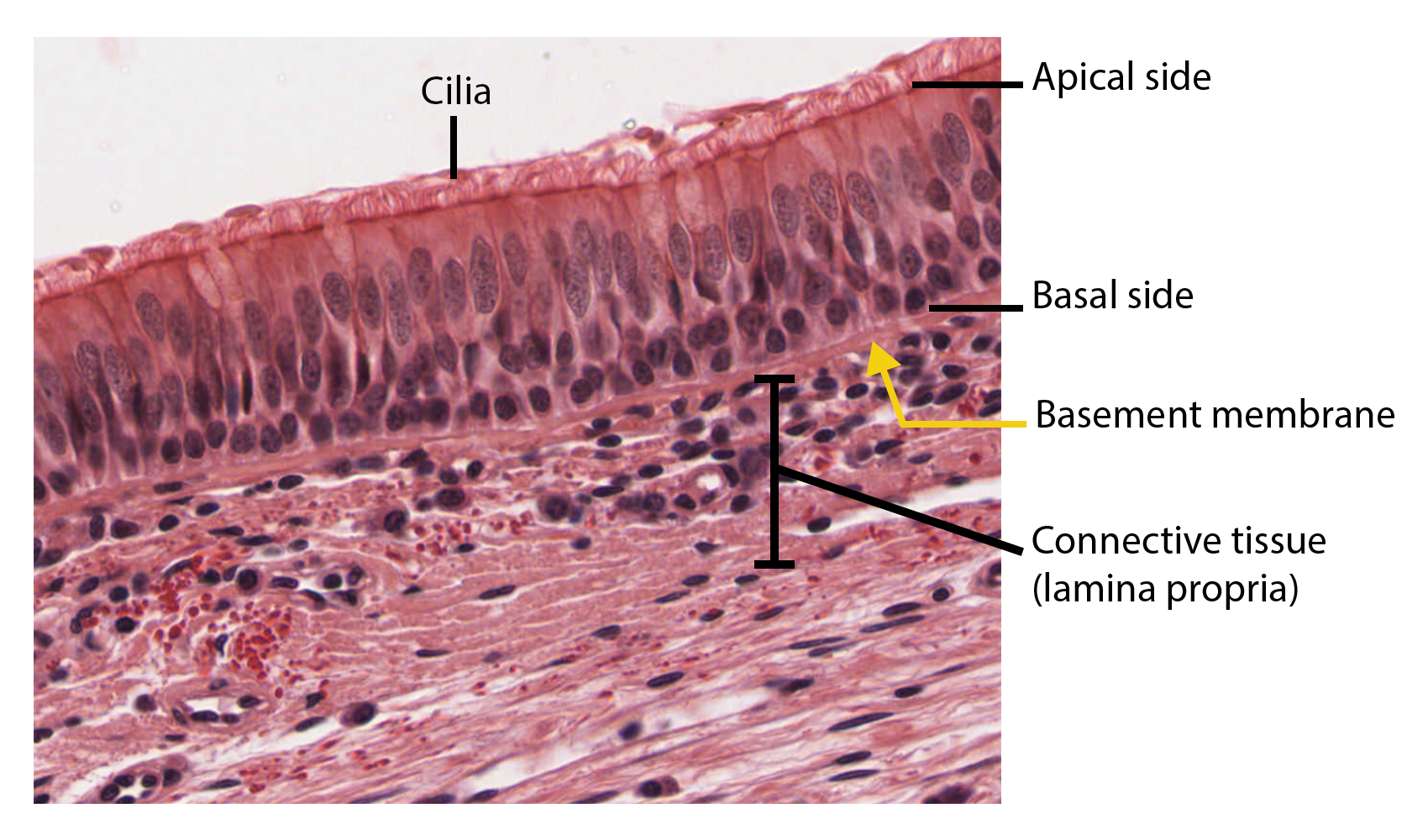
Since epithelia are located at all free surfaces, they separate the outside of the body from the inside of the body and have distinct structural specializations that allow them to fulfill this unique role. Both the individual cells and the sheet of cells exhibit a characteristic polarity: they have an apical surface that is exposed and is in contact with the outside as well as a basal surface that is attached to an underlying proteinaceous layer called the basement membrane. This membrane allows the epithelial cells to hook onto one side of it and the underlying connective tissue, called the lamina propria, to attach to the other (Figure \(\PageIndex{1}\)). This keeps the epithelium firmly anchored in place and helps prevent distortions and tearing.

Epithelial cells also have a polarized distribution of organelles and membrane-bound proteins between their basal and apical surfaces. Particular structures found in some epithelial cells are an adaptation to specific functions. Certain organelles are segregated to the basal sides, whereas other organelles and extensions, such as cilia, when present, are on the apical surface. The transport channels within the cell membranes also differ between the two sides. For example, if you want to absorb a glucose molecule you need two transporters - one to bring the molecule into the cell on the apical side and another to kick it out of the cell so it can enter into the bloodstream. If both transporters were exactly the same you could only move sugar into the cell but not transport it to the rest of the body.
Cell to Cell Junctions
Cells of epithelia are closely connected and are not separated by intracellular material. Three basic types of connections allow varying degrees of interaction between the cells: tight junctions, anchoring junctions, and gap junctions (Figure \(\PageIndex{2}\)).

- At one end of the spectrum is the tight junction, which separates the cells into apical and basal compartments. Tight junctions essentially "stitch" adjacent cell together, forming an impermeable barrier.
- An anchoring junction includes several types of cell junctions that help stabilize epithelial tissues. Anchoring junctions are common on the lateral and basal surfaces of cells where they provide strong and flexible connections.
- A gap junction forms an intercellular passageway between the membranes of adjacent cells to facilitate the movement of small molecules and ions between the cytoplasm of adjacent cells. These junctions allow electrical and metabolic coupling of adjacent cells, which coordinates function in large groups of cells.
Classification of Epithelial Tissues
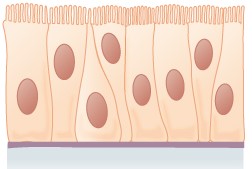
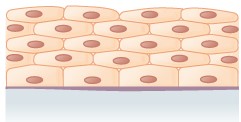
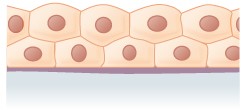
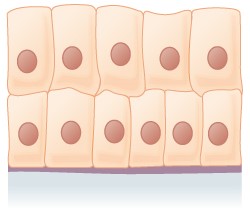
Epithelial tissues are classified according to the shape of the cells and number of the cell layers formed (Figure \(\PageIndex{3}\)). Cell shapes can be squamous (flattened and thin), cuboidal (boxy, as wide as it is tall), or columnar (rectangular, taller than it is wide). Similarly, the number of cell layers in the tissue can be one layer—where every cell rests on the basal lamina—called a simple epithelium, or more than one layer, called a stratified epithelium and only the basal layer of cells rests on the basal lamina. Pseudostratified (pseudo- = “false”) describes tissue with a single layer of irregularly shaped cells that give the appearance of more than one layer. Transitional describes a form of specialized stratified epithelium in which the shape of the cells can vary.

Simple Epithelia
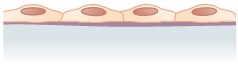
The shape of the cells in the single cell layer of simple epithelium reflects the functioning of those cells. The cells in simple squamous epithelium (Figure \(\PageIndex{3}\) and Figure \(\PageIndex{4}\)) have the appearance of thin scales. Squamous cell nuclei tend to be flat, horizontal, and elliptical, mirroring the form of the cell. The endothelium is the epithelial tissue that lines vessels of the lymphatic and cardiovascular system, and it is made up of a single layer of squamous cells. Simple squamous epithelium, because of the thinness of the cell, is present where rapid passage of chemical compounds is observed. The alveoli of lungs where gases diffuse, segments of kidney tubules, and the lining of capillaries are also made of simple squamous epithelial tissue. The mesothelium is a simple squamous epithelium that forms the surface layer of the serous membrane that lines body cavities and internal organs. Its primary function is to provide a smooth and protective surface. Mesothelial cells are squamous epithelial cells that secrete a fluid that lubricates the mesothelium.


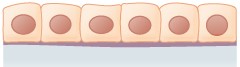
In simple cuboidal epithelium (Figure \(\PageIndex{3}\) and Figure \(\PageIndex{4}\)), the nucleus of the box-like cells appears round and is generally located near the center of the cell. These epithelia are active in the secretion and absorption of molecules. Simple cuboidal epithelia are observed in the lining of the kidney tubules and in the ducts of glands.
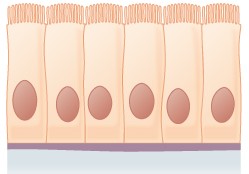
In simple columnar epithelium (Figure \(\PageIndex{3}\) and Figure \(\PageIndex{4}\)), the nucleus of the tall column-like cells tends to be elongated and located in the basal end of the cells. Like the cuboidal epithelia, this epithelium is active in the absorption and secretion of molecules. Simple columnar epithelium forms the lining of some sections of the digestive system and parts of the female reproductive tract. Ciliated columnar epithelium is composed of simple columnar epithelial cells with cilia on their apical surfaces. These epithelial cells are found in the lining of the Fallopian tubes and parts of the respiratory system, where the beating of the cilia helps remove particulate matter.
Pseudostratified columnar epithelium (Figure \(\PageIndex{3}\) and Figure \(\PageIndex{5}\)) is a type of epithelium that appears to be stratified but instead consists of a single layer of irregularly shaped and differently sized columnar cells. In pseudostratified epithelium, nuclei of neighboring cells appear at different levels rather than clustered toward the basal side. The arrangement gives the appearance of stratification; but in fact all the cells are in contact with the basement membrane, although some do not reach the apical surface. Pseudostratified columnar epithelium is found in the respiratory tract, where some of these cells have cilia.
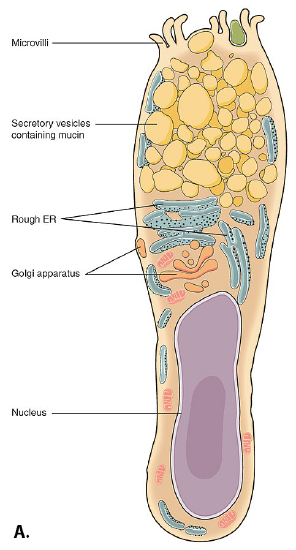
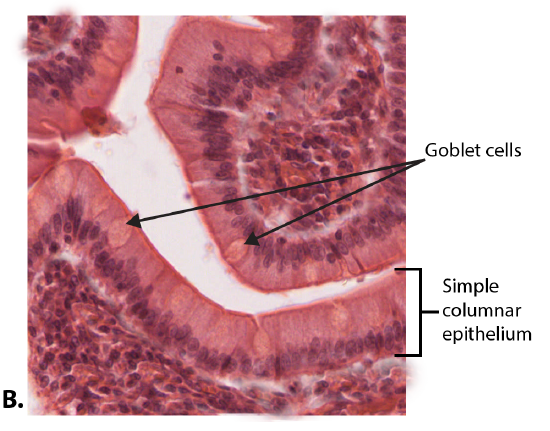
Both simple and pseudostratified columnar epithelia can include additional types of cells interspersed among the epithelial cells. For example, a goblet cell is a mucous-secreting unicellular “gland” interspersed between the columnar epithelial cells of mucous membranes (Figure \(\PageIndex{6}\)).
Stratified Epithelia
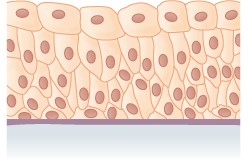
A stratified epithelium consists of several stacked layers of cells. This epithelium protects against physical and chemical wear and tear. The stratified epithelium is named by the shape of the most apical layer of cells, closest to the free space.
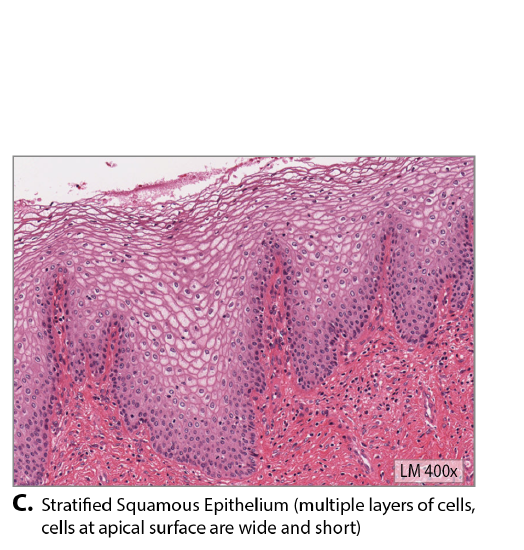
Stratified squamous epithelium (Figure \(\PageIndex{7C}\)) is the most common type of stratified epithelium in the human body. The apical cells are squamous, whereas the basal layer appears either columnar or cuboidal. The top layer may be covered with dead cells filled with the protein keratin. The epidermis of mammalian skin is an example of this dry, keratinized, stratified squamous epithelium. The lining of the oral cavity is an example of an non-keratinized, stratified squamous epithelium.
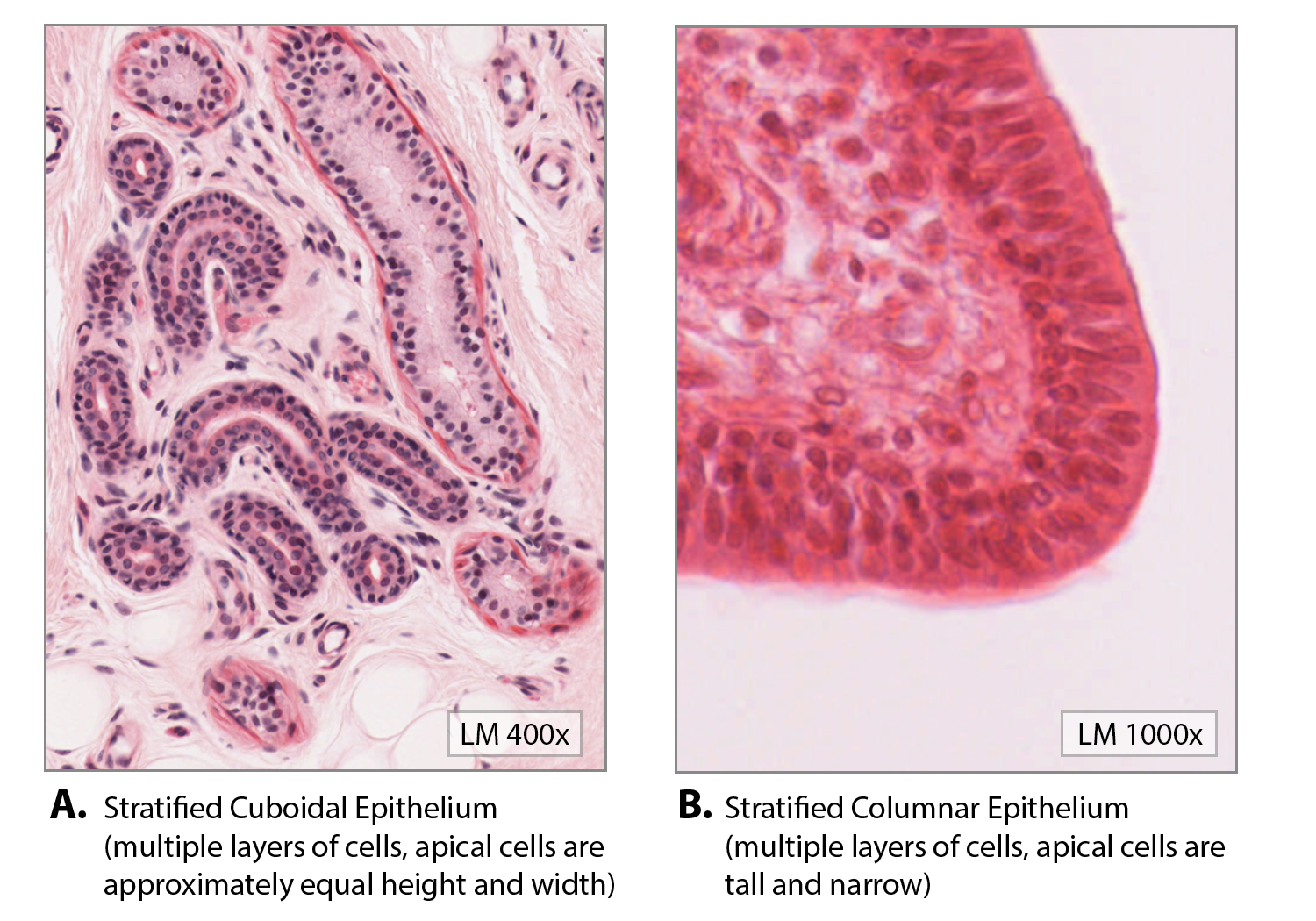
Stratified cuboidal epithelium and stratified columnar epithelium (Figure \(\PageIndex{7.A.B}\)) can be found in certain glands and ducts. Both are uncommon in the human body.
Another kind of stratified epithelium is transitional epithelium (Figure \(\PageIndex{8}\)), so-called because of the gradual changes in the shapes of the apical cells as the bladder fills with urine. It is found only in the urinary system, specifically the ureters and urinary bladder. When the bladder is empty, this epithelium is convoluted and has cuboidal apical cells with convex, umbrella shaped, apical surfaces. As the bladder fills with urine, this epithelium loses its convolutions and the apical cells transition from cuboidal to squamous. It appears thicker and more multi-layered when the bladder is empty, and more stretched out and less stratified when the bladder is full and distended.

| Tissue | Location | Function |
|---|---|---|
|
Simple Squamous Epithelium
|
Air sacs of lungs, tubules of the kidneys, and lining of the heart, blood vessels, and lymphatic vessels. | Allows material to pass through by diffusion and filtration, and secretes lubricating substance |
|
Simple Cuboidal Epithelium
|
In ducts and secretory portions of small glands and in the kidney tubules | Secretes and absorbs |
|
Simple Columnar Epithelium
|
Ciliated tissues are in bronchi, uterine tubes, and uterus Smooth (nonciliated tissues) are in the digestive tract, gallbladder |
Absorbs; it also secretes mucous and enzymes May have goblet cells |
|
Pseudostratified Columnar Epithelium
|
Ciliated tissue lines the trachea and much of the upper respiratory tract Nonciliated tissue is found in the middle regions of the male urethra |
Secretes mucus, ciliated tissue moves mucus Has goblet cells |
|
Stratified Squamous Epithelium
|
Lines the esophagus, mouth, anus, vagina, and distal urethra; forms epidermis of the skin |
Protects against abrasion |
|
Stratified Cuboidal Epithelium
|
Sweat glands, salivary glands, and the mammary glands | Secretory tissue |
|
Stratified Columnar Epithelium
|
The ducts of some glands | Secretes and protects |
|
Transitional Epithelium
|
Lines the urinary bladder, proximal urethra, and the ureters | Allows the urinary organs to expand and stretch |
Glandular Epithelium
A gland is a structure made up of one or more cells modified to synthesize and secrete chemical substances. Most glands consist of groups of epithelial cells. A gland can be classified as an endocrine gland, a ductless gland that releases secretions directly into surrounding tissues and fluids such as blood (endo- = “inside”), or an exocrine gland whose secretions leave through a duct that opens directly, or indirectly, to the external environment (exo- = “outside”).
Endocrine Glands
The secretions of endocrine glands are called hormones. Hormones are released into the interstitial fluid, diffused into the bloodstream, and delivered to targets, in other words, cells that have receptors to bind the hormones. The endocrine system is part of a major regulatory system coordinating the regulation and integration of body responses. A few examples of endocrine glands include the anterior pituitary, thymus, adrenal cortex, and gonads (ovaries and testes).
Exocrine Glands
Exocrine glands release their contents through a duct that leads to the epithelial surface. Mucous, sweat, saliva, and breast milk are all examples of secretions from exocrine glands. They are all discharged through tubular ducts. Secretions into the lumen of the gastrointestinal tract, technically outside of the body, are of the exocrine category.

Contributors and Attributions
OpenStax Anatomy & Physiology (CC BY 4.0). Access for free at https://openstax.org/books/anatomy-and-physiology