

13.5: Blood Typing
- Page ID
- 125416

\( \newcommand{\vecs}[1]{\overset { \scriptstyle \rightharpoonup} {\mathbf{#1}} } \)
\( \newcommand{\vecd}[1]{\overset{-\!-\!\rightharpoonup}{\vphantom{a}\smash {#1}}} \)
\( \newcommand{\dsum}{\displaystyle\sum\limits} \)
\( \newcommand{\dint}{\displaystyle\int\limits} \)
\( \newcommand{\dlim}{\displaystyle\lim\limits} \)
\( \newcommand{\id}{\mathrm{id}}\) \( \newcommand{\Span}{\mathrm{span}}\)
( \newcommand{\kernel}{\mathrm{null}\,}\) \( \newcommand{\range}{\mathrm{range}\,}\)
\( \newcommand{\RealPart}{\mathrm{Re}}\) \( \newcommand{\ImaginaryPart}{\mathrm{Im}}\)
\( \newcommand{\Argument}{\mathrm{Arg}}\) \( \newcommand{\norm}[1]{\| #1 \|}\)
\( \newcommand{\inner}[2]{\langle #1, #2 \rangle}\)
\( \newcommand{\Span}{\mathrm{span}}\)
\( \newcommand{\id}{\mathrm{id}}\)
\( \newcommand{\Span}{\mathrm{span}}\)
\( \newcommand{\kernel}{\mathrm{null}\,}\)
\( \newcommand{\range}{\mathrm{range}\,}\)
\( \newcommand{\RealPart}{\mathrm{Re}}\)
\( \newcommand{\ImaginaryPart}{\mathrm{Im}}\)
\( \newcommand{\Argument}{\mathrm{Arg}}\)
\( \newcommand{\norm}[1]{\| #1 \|}\)
\( \newcommand{\inner}[2]{\langle #1, #2 \rangle}\)
\( \newcommand{\Span}{\mathrm{span}}\) \( \newcommand{\AA}{\unicode[.8,0]{x212B}}\)
\( \newcommand{\vectorA}[1]{\vec{#1}} % arrow\)
\( \newcommand{\vectorAt}[1]{\vec{\text{#1}}} % arrow\)
\( \newcommand{\vectorB}[1]{\overset { \scriptstyle \rightharpoonup} {\mathbf{#1}} } \)
\( \newcommand{\vectorC}[1]{\textbf{#1}} \)
\( \newcommand{\vectorD}[1]{\overrightarrow{#1}} \)
\( \newcommand{\vectorDt}[1]{\overrightarrow{\text{#1}}} \)
\( \newcommand{\vectE}[1]{\overset{-\!-\!\rightharpoonup}{\vphantom{a}\smash{\mathbf {#1}}}} \)
\( \newcommand{\vecs}[1]{\overset { \scriptstyle \rightharpoonup} {\mathbf{#1}} } \)
\(\newcommand{\longvect}{\overrightarrow}\)
\( \newcommand{\vecd}[1]{\overset{-\!-\!\rightharpoonup}{\vphantom{a}\smash {#1}}} \)
\(\newcommand{\ket}[1]{\left| #1 \right>}\)
\(\newcommand{\bra}[1]{\left< #1 \right|}\)
\(\newcommand{\braket}[2]{\left< #1 \vphantom{#2} \right| \left. #2 \vphantom{#1} \right>}\)
\(\newcommand{\braopket}[3]{\left< #1 \vphantom{#2}\vphantom{#3} \right| #2 \vphantom{#1}\vphantom{#3} \left| #3 \vphantom{#1}\vphantom{#2} \right>}\)
\(\newcommand{\qmvec}[1]{\mathbf{\vec{#1}}}\)
\(\newcommand{\op}[1]{\hat{\mathbf{#1}}}\)
\(\newcommand{\expect}[1]{\langle #1 \rangle}\)
\(\newcommand{\dfn}[1]{\emph{\textbf{#1}}}\)
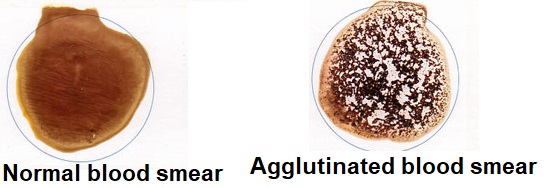
When blood from one person is mixed with plasma from another person with an incompatible blood type, the blood cells will agglutinate, or clump together. Blood type is determined by the presence or absence of A and/or B antigens on the surface of red blood cells. These antigens will react with antibodies in the plasma of an incompatible blood type. Agglutination can be dangerous if someone receives a blood transfusion of an incompatible blood type. Blood vessels can become obstructed and damaged, restricting blood flow to the body's organs. This is why it is important to determine blood types before a blood transfusion.
Type A individual produces type A antigens on the surface of their red blood cells and Anti-B antibodies in the plasma. Type B individuals have type B antigens and Anti-A antibodies. Type AB individuals produce both antigens A and B on the surface of their red blood cells but have no Anti-A nor Anti-B antibodies in their blood plasma. Type O individuals do not have A or B antigens on the surface of their red blood cells, but they do have both Anti-A and Anti-B antibodies in their plasma.
Another type of antigen is called Rh factor. The Rh factor is found on the red blood cell membranes of approximately 85% of the people in the United States. The presence of this antigen on the red blood cells makes the blood type Rh positive. Individuals who don’t have the antigen on their red blood cells are Rh negative. So for example, an individual who has the A antigen and the Rh antigen on their red blood cells would be blood type A+. An individual who has the A and B antigens on their red blood cells but no Rh antigen would be AB-. O+ and A+ blood types are the most common blood types in the US. AB- is the least common blood type.
Instructions for Blood Typing Experiment
You will find the blood types for four different people: Ms. Brown. Mr. Green, Mr. Jones and Mr Plate. Follow the instructions for the experiment.
- Use a clean plate for each individual and discard the toothpicks after each use.
- Add a few drops of artificial blood to each well of each plate.
- Put a few drops of anti-A serum in the “A” well on the plate, a few drops of anti-B serum in “B” well, and a few drops of anti-Rh serum in the “Rh”well.
- Mix the wells with a toothpick, using a new toothpick for each well. Do not cross contaminate!!
- Wait 30 seconds to 1 minute and observe if agglutination occurs in the well during and after mixing.
- Record the blood type for each individual in the RESULTS section.