

5.6: Protein and Health
- Page ID
- 135656

\( \newcommand{\vecs}[1]{\overset { \scriptstyle \rightharpoonup} {\mathbf{#1}} } \)
\( \newcommand{\vecd}[1]{\overset{-\!-\!\rightharpoonup}{\vphantom{a}\smash {#1}}} \)
\( \newcommand{\dsum}{\displaystyle\sum\limits} \)
\( \newcommand{\dint}{\displaystyle\int\limits} \)
\( \newcommand{\dlim}{\displaystyle\lim\limits} \)
\( \newcommand{\id}{\mathrm{id}}\) \( \newcommand{\Span}{\mathrm{span}}\)
( \newcommand{\kernel}{\mathrm{null}\,}\) \( \newcommand{\range}{\mathrm{range}\,}\)
\( \newcommand{\RealPart}{\mathrm{Re}}\) \( \newcommand{\ImaginaryPart}{\mathrm{Im}}\)
\( \newcommand{\Argument}{\mathrm{Arg}}\) \( \newcommand{\norm}[1]{\| #1 \|}\)
\( \newcommand{\inner}[2]{\langle #1, #2 \rangle}\)
\( \newcommand{\Span}{\mathrm{span}}\)
\( \newcommand{\id}{\mathrm{id}}\)
\( \newcommand{\Span}{\mathrm{span}}\)
\( \newcommand{\kernel}{\mathrm{null}\,}\)
\( \newcommand{\range}{\mathrm{range}\,}\)
\( \newcommand{\RealPart}{\mathrm{Re}}\)
\( \newcommand{\ImaginaryPart}{\mathrm{Im}}\)
\( \newcommand{\Argument}{\mathrm{Arg}}\)
\( \newcommand{\norm}[1]{\| #1 \|}\)
\( \newcommand{\inner}[2]{\langle #1, #2 \rangle}\)
\( \newcommand{\Span}{\mathrm{span}}\) \( \newcommand{\AA}{\unicode[.8,0]{x212B}}\)
\( \newcommand{\vectorA}[1]{\vec{#1}} % arrow\)
\( \newcommand{\vectorAt}[1]{\vec{\text{#1}}} % arrow\)
\( \newcommand{\vectorB}[1]{\overset { \scriptstyle \rightharpoonup} {\mathbf{#1}} } \)
\( \newcommand{\vectorC}[1]{\textbf{#1}} \)
\( \newcommand{\vectorD}[1]{\overrightarrow{#1}} \)
\( \newcommand{\vectorDt}[1]{\overrightarrow{\text{#1}}} \)
\( \newcommand{\vectE}[1]{\overset{-\!-\!\rightharpoonup}{\vphantom{a}\smash{\mathbf {#1}}}} \)
\( \newcommand{\vecs}[1]{\overset { \scriptstyle \rightharpoonup} {\mathbf{#1}} } \)
\(\newcommand{\longvect}{\overrightarrow}\)
\( \newcommand{\vecd}[1]{\overset{-\!-\!\rightharpoonup}{\vphantom{a}\smash {#1}}} \)
\(\newcommand{\ket}[1]{\left| #1 \right>}\)
\(\newcommand{\bra}[1]{\left< #1 \right|}\)
\(\newcommand{\braket}[2]{\left< #1 \vphantom{#2} \right| \left. #2 \vphantom{#1} \right>}\)
\(\newcommand{\braopket}[3]{\left< #1 \vphantom{#2}\vphantom{#3} \right| #2 \vphantom{#1}\vphantom{#3} \left| #3 \vphantom{#1}\vphantom{#2} \right>}\)
\(\newcommand{\qmvec}[1]{\mathbf{\vec{#1}}}\)
\(\newcommand{\op}[1]{\hat{\mathbf{#1}}}\)
\(\newcommand{\expect}[1]{\langle #1 \rangle}\)
\(\newcommand{\dfn}[1]{\emph{\textbf{#1}}}\)
A healthy diet incorporates all nutrients in moderation, meaning that there’s neither too little nor too much. As with all nutrients, having too little or too much protein can have health consequences.
The Acceptable Macronutrient Distribution Range (AMDR) for protein for adults is between 10 and 35% of kilocalories (Institute of Medicine, 2005). That’s a fairly wide range, and it encompasses typical protein intakes of many traditional human cultures.

Figure \(\PageIndex{1}\): Diverse human cultures have survived on different levels of dietary protein. The photo on the left shows Inuit families sharing frozen, aged walrus meat. Their traditional diet is very dependent on meat and high in both protein and fat. On the right is a traditional vegetarian meal in India, high in carbohydrates yet still providing adequate protein. Walrus meat 1 1999-04-01. (CC BY-SA 2.5; Ansgar Walk via Wikimedia Commons) and Vegetarian Curry. (CC BY 2.0; GracinhaMarco Abundo via Wikimedia Commons)
Protein intake below the RDA is inadequate to support the body’s needs for synthesis of structural and functional proteins. On the other hand, there are some concerns that high protein intake is associated with chronic disease. However, as we’ll discuss, it’s not just the quantity of protein that matters, but also the nutritional package that it comes in.
According to a study published in the American Journal of Clinical Nutrition, most Americans get enough protein, averaging about 88 grams per day, and "14 to 16%" of caloric intake (Berryman et al., 2018, Results section). The study also found that diets with protein above 35% of caloric intake, the upper end of the AMDR, were extremely rare (Berryman et al., 2018).
Health Consequences of Protein Deficiency
Although severe protein deficiency is rare in the developed world, it is a leading cause of death in children in many poor, underdeveloped countries. There are two main syndromes associated with protein deficiencies: Kwashiorkor and Marasmus.
Kwashiorkor affects millions of children worldwide. When it was first described in 1933, more than 90% of children with Kwashiorkor died (Kwashiorkor, 2026). Although the associated mortality is slightly lower now, most children still die after the initiation of treatment.
The name Kwashiorkor comes from a language in Ghana and means “rejected one.” The syndrome was named because it occurs most commonly in children recently weaned from breastfeeding, usually because the mother had a new baby, and the older child is switched to a diet of watery porridge made from low-protein grains. The child may consume enough calories but not enough protein.
Kwashiorkor is characterized by swelling (edema) of the feet and abdomen, poor skin health, poor growth, low muscle mass, and liver malfunction. Recall that one of the roles of protein in the body is fluid balance. Diets extremely low in protein do not provide enough amino acids for the synthesis of the protein albumin. One of albumin's functions is to retain water in the blood vessels, so lower blood albumin concentrations cause water to move out of the blood vessels and into tissues, leading to swelling. The primary symptoms of Kwashiorkor include not only swelling, but also diarrhea, fatigue, peeling skin, and irritability. Severe protein deficiency, in addition to other micronutrient deficiencies, such as folate, iodine, iron, and vitamin C, contributes to the many health manifestations of this syndrome.
Children and adults with marasmus are protein-deficient, but at the same time, they’re also not taking in enough calories. Body weights of children with Marasmus may be up to 80% less than that of a healthy child of the same age. Marasmus is a Greek word meaning “starvation.” The syndrome affects more than fifty million children under age five worldwide. It is characterized by an extreme emaciated appearance, poor skin health, poor growth, and increased risk of infection. The symptoms are acute fatigue, hunger, and diarrhea.
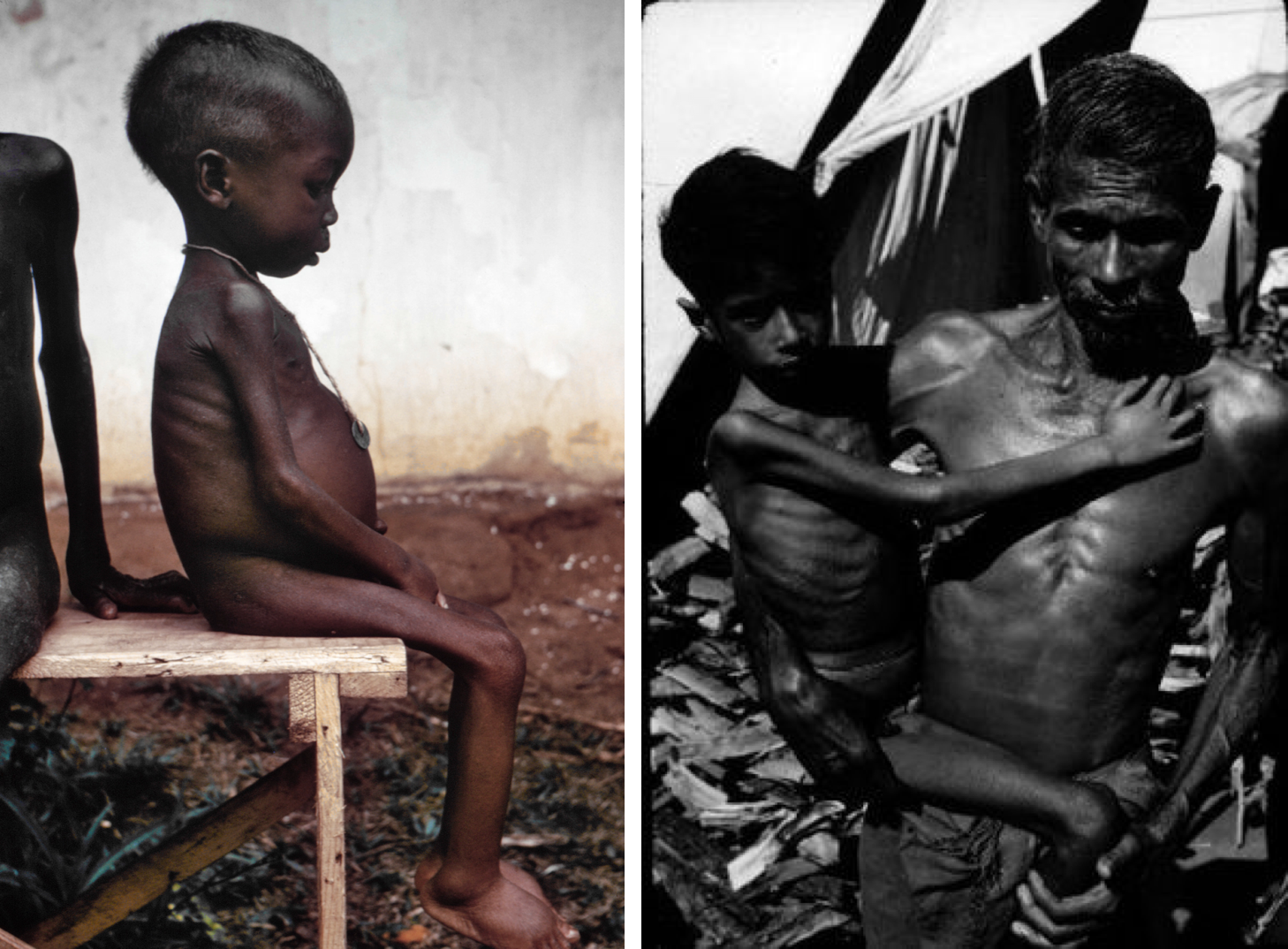
Figure \(\PageIndex{2}\): The photo on the left shows a child suffering from kwashiorkor (note the swollen belly) in the late 1960's in a Nigerian relief camp during the Nigerian-Biafran War. The photo on the right shows an Indian child suffering from marasmus, showing very thin limbs and visible ribs, and no swollen belly. Child with kwashiorkor. (Public Domain; Dr. Lyle Conrad via U.S. Centers for Disease Control and Prevention (CDC): Public Health Image Library (PHIL)) and Child suffering with Marasmus in India. (Public Domain; Don Eddins via CDC: PHIL)
Kwashiorkor and marasmus often coexist as a combined syndrome termed marasmic kwashiorkor. Children with the combined syndrome have variable amounts of edema and the characteristics and symptoms of marasmus. Although organ system function is compromised by undernutrition, the ultimate cause of death is usually infection. Undernutrition is intricately linked with suppression of the immune system at multiple levels, so undernourished children commonly die from severe diarrhea and/or pneumonia resulting from bacterial or viral infection. According to UNICEF (2019), nearly half of all deaths of children under age five are related to undernutrition (p. 36). That translates to about 3 million child deaths each year.
While severe protein deficiency is rare in the U.S., several groups are at risk of low protein intake. A study (2018) found that "23%" of U.S. adolescent girls ("aged 14 to 18" years old) and "11%" of adolescent boys were consuming below the RDA for protein, which may compromise their growth and development (Berryman et al., Discussion section, para. 5). This is thought to be related to the growing independence in food choices and the high prevalence of dieting in this group.
Low protein intake is also a concern for the elderly in the U.S. The same study (2018) found that among those 71 years and older, "19.21%" of women and "13.17%" of men consume less protein than the RDA (Berryman et al., 2018, Table 3) This is a particular concern in this age group, as loss of muscle is accelerated with aging, and that can lead to greater frailty, loss of balance, and greater risk of falls. Some researchers argue that older adults actually need more protein than recommended by the RDA in order to "[maintain] muscle mass and function" (Traylor et al., 2018, Aging and Protein Requirements: Observational Data section).
Health Consequences of Too Much Protein in the Diet
When the Institute of Medicine wrote the Dietary Reference Intakes (DRI) for macronutrients (2005), they concluded that there wasn’t enough evidence to establish an Upper Limit for protein. The high end of the AMDR, 35% of kilocalories for protein, was set to ensure the total diet was well balanced with carbohydrates and fat (Institute of Medicine, 2005). Higher levels of protein intake haven’t been well studied, but over the years, there have been many concerns with high-protein diets. However, current evidence indicates it’s large amounts of animal protein (particularly from red meat or processed meats) that can be problematic, not high amounts of protein per se (Harvard T.H. Chan School of Public Health, n.d.).
For example, a diet containing lots of steak, bacon, and sausage would be high in protein, but it also might be high in saturated fat, cholesterol, salt, and nitrates. Eating more red meat and processed red meat is linked to an increased risk of heart disease, stroke, and cancer (especially colorectal, stomach, pancreatic, prostate, and breast cancers) (Harvard T.H. Chan School of Public Health, n.d., Research on Protein and Health section). This link doesn’t seem to be caused by the protein itself but rather by the nutritional package it comes in. In addition, the link to cancer may be related to the carcinogens that can form when meat is cooked at high temperatures, particularly when it’s charred by grilling (Harvard T.H. Chan School of Public Health, n.d.).
On the other hand, studies show that when protein comes from lean meat and plant sources, the risk of chronic diseases may be reduced. For example, a 2015 study found that frequent consumption of red meat in adolescence was associated with a higher risk of breast cancer later in life, whereas consuming "poultry, fish, legumes, and nuts" instead lowered risk (Farvid et al., 2014, Discussion section, para. 1). Other studies have shown that higher protein diets can reduce the risk of heart disease, provided the protein comes from healthier sources (Williamson, 2026, Higher Protein Intake and Heart Health section).

Figure \(\PageIndex{3}\): The image shows four different foods providing different protein packages, with nutritional information given below. Compare several different “protein packages.” The steak and bacon provide protein but also large amounts of saturated fat and sodium. Salmon provides as much protein as the steak but with less saturated fat and more polyunsaturated fats. Lentils are a good source of protein, are low in fat, and are a great source of fiber. Sirloin Steak Outback Steakhouse March 13, 20112. (CC BY 2.0; Steven Depolo via flickr); bacon. (CC BY 2.0; Bradley Gordon via flickr); Wild Salmon Dinner. (CC BY-SA 2.0; Ketzirah Lesser & Art Drauglis via flickr); and ASCF1853. (CC BY-NC-ND 2.0; Lucas Falcao via flickr) Link to accessible text-only version of figure data.
Several other concerns about high-protein diets haven’t turned out to be problematic after all:
- Osteoporosis: High protein diets were once thought to increase the risk of osteoporosis, because researchers noticed that urinary calcium excretion increases when people consume high amounts of protein. However, a systematic review and meta-analysis from the National Osteoporosis Foundation found that this is not a concern, and some studies even show that "higher protein intake" is associated with greater bone mineral density (Shams-White et al., 2017, Cohort studies section).
- Kidney function: Another concern was that high-protein diets would strain the kidneys because of the increased need to filter and excrete nitrogen. A meta-analysis concluded that this is not a concern (Devries et al., 2018). However, people who already have chronic kidney disease should avoid high-protein diets and maintain protein intake around the RDA of 0.8 g/kg, a lower intake than many Americans consume (Devries et al., 2014, Introduction section, para. 2). A 2009 study tested a very low protein diet of 0.6 g/kg protein per day in people with chronic kidney disease and found that it did not prevent the development of kidney failure but did increase the risk of death, underscoring the importance of adequate protein even in people with kidney disease (Menon et al., 2009).
From all of this research, there’s little evidence that a high-protein diet is inherently harmful, so long as the protein doesn’t come packaged with a lot of saturated fat and red meat consumption is limited. Still, there’s little research directly testing the health effects of very high protein diets, including those achieved using protein supplements of purified protein, so it’s probably wise to keep protein balanced with the other macronutrients, focusing on whole foods from all the food groups.
References
Berryman, C. E., Lieberman, H. R., Fulgoni, V. L., III, & Pasiakos, S. M. (2018). Protein intake trends and conformity with the Dietary Reference Intakes in the United States: Analysis of the National Health and Nutrition Examination Survey, 2001-2014. The American Journal of Clinical Nutrition, 108(2), 405–413.
Devries, M. C., Sithamparapillai, A., Brimble, K. S., Banfield, L., Morton, R. W., & Phillips, S. M. (2018). 'Changes in kidney function do not differ between healthy adults consuming higher- Compared with lower- or normal-protein diets: A systematic review and meta-analysis. The Journal of Nutrition, 148(11), 1760–1775.
Farvid, M. S., Cho, E., Chen, W. Y., Eliassen, A. H., & Willett, W. C. (2014). Adolescent meat intake and breast cancer risk. International Journal of Cancer, 136(8), 1909–1920.
Harvard T.H. Chan School of Public Health. (n.d.). Protein. The Nutrition Source.
Institute of Medicine. (2005). Dietary reference intakes for energy, carbohydrate, fiber, fat, fatty acids, cholesterol, protein, and amino acids. The National Academies Press.
Kwashiorkor. (2026, March 12). In Wikipedia.
Menon, V., Kopple, J. D., Wang, X., Beck, G. J., Collins, A. J., Kusek, J. W., Greene, T., Levey, A. S., & Sarnak, M. J. (2009). Effect of a very low-protein diet on outcomes: Long-term follow-up of the Modification of Diet in Renal Disease (MDRD) Study. American Journal of Kidney Diseases, 53(2), 208–217.
Shams-White, M. M., Chung, M., Du, M., Fu, Z., Insogna, K. L., Karlsen, M. C., LeBoff, M. S., Shapses, S. A., Sackey, J., Wallace, T. C., & Weaver, C. M. (2017). Dietary protein and bone health: A systematic review and meta-analysis from the National Osteoporosis Foundation. The American Journal of Clinical Nutrition, 105(6), 1528–1543.
Traylor, D. A., Gorissen, S. H. M., & Phillips, S. M. (2018). Perspective: Protein requirements and optimal intakes in aging: Are we ready to recommend more than the recommended daily allowance? Advances in Nutrition, 9(3), 171–182.
UNICEF. (October, 2019). The state of the world’s children 2019. Children, food and nutrition: Growing well in a changing world.
Williamson, E. (2026, July 20). Protein intake and cardiovascular health: Separating signal from noise. American College of Cardiology.
Attributions
Kansas State University Human Nutrition (FNDH 400) Flexbook © by Brian Lindshield is licensed under CC BY-NC-SA 4.0.
6.5 Diseases Involving Proteins (opens in new window) © by Maureen Zimmerman and Beth Snow is licensed under CC BY-NC-SA 3.0.