

8.5: Vitamin C
- Page ID
- 135813

\( \newcommand{\vecs}[1]{\overset { \scriptstyle \rightharpoonup} {\mathbf{#1}} } \)
\( \newcommand{\vecd}[1]{\overset{-\!-\!\rightharpoonup}{\vphantom{a}\smash {#1}}} \)
\( \newcommand{\dsum}{\displaystyle\sum\limits} \)
\( \newcommand{\dint}{\displaystyle\int\limits} \)
\( \newcommand{\dlim}{\displaystyle\lim\limits} \)
\( \newcommand{\id}{\mathrm{id}}\) \( \newcommand{\Span}{\mathrm{span}}\)
( \newcommand{\kernel}{\mathrm{null}\,}\) \( \newcommand{\range}{\mathrm{range}\,}\)
\( \newcommand{\RealPart}{\mathrm{Re}}\) \( \newcommand{\ImaginaryPart}{\mathrm{Im}}\)
\( \newcommand{\Argument}{\mathrm{Arg}}\) \( \newcommand{\norm}[1]{\| #1 \|}\)
\( \newcommand{\inner}[2]{\langle #1, #2 \rangle}\)
\( \newcommand{\Span}{\mathrm{span}}\)
\( \newcommand{\id}{\mathrm{id}}\)
\( \newcommand{\Span}{\mathrm{span}}\)
\( \newcommand{\kernel}{\mathrm{null}\,}\)
\( \newcommand{\range}{\mathrm{range}\,}\)
\( \newcommand{\RealPart}{\mathrm{Re}}\)
\( \newcommand{\ImaginaryPart}{\mathrm{Im}}\)
\( \newcommand{\Argument}{\mathrm{Arg}}\)
\( \newcommand{\norm}[1]{\| #1 \|}\)
\( \newcommand{\inner}[2]{\langle #1, #2 \rangle}\)
\( \newcommand{\Span}{\mathrm{span}}\) \( \newcommand{\AA}{\unicode[.8,0]{x212B}}\)
\( \newcommand{\vectorA}[1]{\vec{#1}} % arrow\)
\( \newcommand{\vectorAt}[1]{\vec{\text{#1}}} % arrow\)
\( \newcommand{\vectorB}[1]{\overset { \scriptstyle \rightharpoonup} {\mathbf{#1}} } \)
\( \newcommand{\vectorC}[1]{\textbf{#1}} \)
\( \newcommand{\vectorD}[1]{\overrightarrow{#1}} \)
\( \newcommand{\vectorDt}[1]{\overrightarrow{\text{#1}}} \)
\( \newcommand{\vectE}[1]{\overset{-\!-\!\rightharpoonup}{\vphantom{a}\smash{\mathbf {#1}}}} \)
\( \newcommand{\vecs}[1]{\overset { \scriptstyle \rightharpoonup} {\mathbf{#1}} } \)
\(\newcommand{\longvect}{\overrightarrow}\)
\( \newcommand{\vecd}[1]{\overset{-\!-\!\rightharpoonup}{\vphantom{a}\smash {#1}}} \)
\(\newcommand{\ket}[1]{\left| #1 \right>}\)
\(\newcommand{\bra}[1]{\left< #1 \right|}\)
\(\newcommand{\braket}[2]{\left< #1 \vphantom{#2} \right| \left. #2 \vphantom{#1} \right>}\)
\(\newcommand{\braopket}[3]{\left< #1 \vphantom{#2}\vphantom{#3} \right| #2 \vphantom{#1}\vphantom{#3} \left| #3 \vphantom{#1}\vphantom{#2} \right>}\)
\(\newcommand{\qmvec}[1]{\mathbf{\vec{#1}}}\)
\(\newcommand{\op}[1]{\hat{\mathbf{#1}}}\)
\(\newcommand{\expect}[1]{\langle #1 \rangle}\)
\(\newcommand{\dfn}[1]{\emph{\textbf{#1}}}\)
Vitamin C is well known for being a water-soluble antioxidant. Humans are one of the few mammals that do not synthesize vitamin C, making it an essential micronutrient. Other mammals that do not synthesize vitamin C include primates, guinea pigs, and other less prevalent species (Stipanuk, 2006). This means that some species, such as rats, mice, dogs, and cats, are not ideal for human vitamin C research, since vitamin C is not essential for them.
Vitamin C's scientific names are ascorbic acid or ascorbate, and the oxidized form is dehydroascorbic acid or dehydroascorbate. The structure of vitamin C is shown below.

When ascorbic acid is oxidized, it forms semidehydroascorbate (1 degree of oxidation) and then dehydroascorbate (2 degrees of oxidation). The structure of dehydroascorbic acid is shown below.

The figure below shows the reaction through which ascorbic acid can stabilize or quench two free radicals. The two circled hydrogens are lost and replaced by double bonds when ascorbic acid is oxidized to dehydroascorbic acid. Reducing dehydroascorbic acid back to ascorbic acid is the opposite reaction.

Ascorbic acid is believed to be a part of an antioxidant network (shown below) where it is oxidized to reduce alpha-tocopherol radicals. Dehydroascorbic acid can be reduced by thioredoxin reductase, a selenoenzyme, to regenerate ascorbic acid.

Enzymatic Functions
In addition to its antioxidant function, vitamin C is also a cofactor for a number of enzymes and contributes to reducing a cofactor in others. Proline hydroxylase and lysyl hydroxylase are two enzymes for which vitamin C is needed to carry out their catalytic function. These enzymes are important in the formation of the protein collagen. Hydroxylase means that the enzymes add alcohol (hydroxyl, \(\ce{-OH}\)) to the amino acids proline and lysine, as shown below.


As shown below, prolyl and lysyl hydroxylases require ferrous iron (\(\ce{Fe^2+}\)) to function. But in the course of the hydroxylating proline or lysine, ferrous iron (\(\ce{Fe^2+}\)) is oxidized to ferric iron (\(\ce{Fe^3+}\)). Ascorbic acid is required to reduce \(\ce{Fe^3+}\) to \(\ce{Fe^2+}\), forming semidehydroascorbic acid in the process. With \(\ce{Fe^2+}\), the enzyme is then able to continue to hydroxylate proline and lysine.

Why should you care about collagen formation? Because collagen is estimated to account for "30% or more of total" body proteins (Di Lullo et al., 2002, para. 1). Collagen contains a number of hydroxylated prolines and lysines that are needed for collagen strands to properly cross-link. This cross-linking is important for collagen to wind together like a rope, forming the strong triple helix known as tropocollagen. This process is shown in the figure below.

But if there is not enough ascorbic acid available, the collagen strands are under-hydroxylated, and instead of forming strong tropocollagen, the under-hydroxylated collagen is degraded as shown below.

This weak collagen then results in the symptoms seen in the vitamin C deficiency, scurvy, that will be discussed in the next subsection.
Ascorbic Acid is also needed for:
- carnitine synthesis
- tyrosine synthesis and catabolism
- serotonin (neurotransmitter) synthesis
- other hormone and neurotransmitter synthesis (Gropper et al., 2008)
The figure below shows how ascorbic acid is needed for dopamine hydroxylase, which ultimately produces the hormone epinephrine.

Dietary Sources of Vitamin C
Fruits and vegetables are great sources of vitamin C. Some of the best sources include "bell peppers", citrus, "broccoli, strawberries," "Brussels sprouts," and cantaloupe (National Institutes of Health: Office of Dietary Supplements [NIH: ODS], 2025, Recommended Intakes section).
Because vitamin C is water-soluble, it leaches away from foods considerably during cooking, freezing, thawing, and canning. Up to 50% of vitamin C can be lost during boiling. Therefore, eating fruits and vegetables raw or lightly steamed maximizes their vitamin C content.
Vitamin C Deficiency (Scurvy)
Why should you care about the details of prolyl and lysyl hydroxylases and their actions on collagen hydroxylation and tropocollagen formation? Because they explain the symptoms of vitamin C deficiency. While it is rare in the United States, vitamin C deficiency, known as scurvy, displays symptoms that are a result of weak tropocollagen, which in turn weakens connective tissue throughout the body. Symptoms of scurvy include skin disorders, bleeding gums, pinpoint hemorrhages, joint pain, and weakness—all of which may be related to vitamin C’s role in collagen synthesis. Additional symptoms of scurvy include abnormally thickened skin, fatigue, depression, iron deficiency anemia, and increased susceptibility to infections.

Additional symptoms include impaired wound and fracture healing, easy bruising, and loose or decaying teeth. Scurvy can be fatal if not treated. Scurvy was first discovered as a nutritional deficiency in 1746 by James Lind, who is shown below (Gropper et al., 2008).

At the time, it was unfounded to suggest that scurvy was due to a dietary deficiency. This is because the concept of vitamins and compounds that would become vitamins was not proposed until around 150 years later.
Lind was a surgeon on a British navy ship. During long voyages, sailors (whose diets were devoid of fruits and vegetables for many months) would frequently develop scurvy for reasons that were not understood at the time. It was known that citrus fruits could cure or prevent scurvy, but it was believed this was due to their acidity. Lind conducted clinical trials comparing citrus juice with dilute sulfuric acid and vinegar, and found that only citrus juice led to sailors' recovery. As a result, British sailors became known as "Limeys" because they carried sacks of limes onto ships and drank lime juice to prevent the disease (Carpenter, 2003). It was not until 1932 that scientists demonstrated that vitamin C was the essential nutrient responsible for this cure (NIH: ODS, 2025, Vitamin C Deficiency section).
Scurvy is prevented by even a low intake of fruits and vegetables, and it takes at least a month of consuming very little or no vitamin C for scurvy symptoms to develop. Thus, scurvy is rare in developed countries today. Diet surveys show that most Americans meet the Recommended Dietary Allowance (RDA) for vitamin C (NIH: ODS, 2025, Vitamin C Intakes and Status section). When vitamin C deficiency occurs today, it is in people who consume a very "limited food variety," such as those with mental illness, "people who abuse alcohol or drugs," people on very restrictive diets, and impoverished people with limited fruit and vegetable access (NIH: ODS, 2025, Individuals with limited food variety subsection). People who smoke also require more vitamin C to counter the free radicals generated by smoking (NIH: ODS, 2025, People who smoke and those exposed to secondhand smoke subsection).
Vitamin C Toxicity, Linus Pauling, & the Common Cold
Vitamin C does not have a toxicity, per se, but in some people, over 2 grams/day can lead to diarrhea and gastrointestinal distress. In addition, high intake of vitamin C increases excretion of uric acid (urate) and oxalic acid (oxalate). The structures of these 2 compounds are shown below.
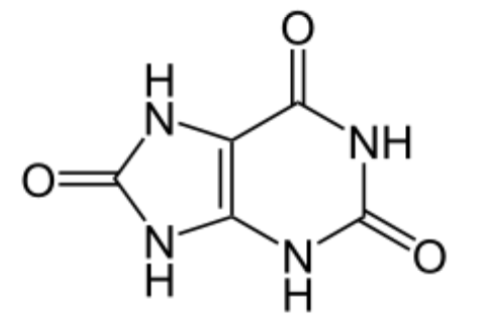
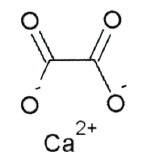
These compounds are the primary components of 2 types of kidney stones (Massey, 2005). The figure below shows the most common sites of pain in someone with kidney stones.

The following video describes what kidney stones are and the symptoms that can occur if someone has kidney stones. The video also shows some pictures of kidney stones.
Researchers have found that riding roller coasters may help pass kidney stones! But what are kidney stones, and what causes them?
Video produced by DNews, all rights reserved. It is not openly licensed but freely available to all.
Calcium oxalate is one of the primary forms of kidney stones, with uric acid stones being more rare. However, a link between excretion of these compounds and actual stone formation has not been established. Nevertheless, "high-dose [vitamin C] supplementation" should be approached with caution, as it is unclear whether it increases the risk of kidney stone formation (Massey, 2005, Discussion section, paras. 7-8).
The risk of vitamin C toxicity from foods is essentially nonexistent because the body can adjust intestinal absorption and urinary excretion to maintain a healthy vitamin C level. However, high doses of vitamin C have been reported to cause numerous problems, including gastrointestinal upset and diarrhea (NIH: ODS, 2025, Health Risks from Excessive Vitamin C section). To prevent these discomforts, the Tolerable Upper Intake Level (UL) for vitamin C is set at 2,000 milligrams per day for adults (NIH: ODS, 2025, Table 3). The UL is more than 20 times the RDA, which is 90 milligrams per day for men and 75 milligrams per day for women (NIH: ODS, 2025, Table 1).
At very high doses, when combined with iron, vitamin C has sometimes been found to increase oxidative stress, reaffirming that getting your antioxidants from foods is better than from supplements. There is also some evidence that taking vitamin C supplements at high doses increases the likelihood of developing kidney stones (Ferraro et al., 2015, Discussion section, para. 7).
Can Vitamin C Supplements Prevent the Common Cold?
Many people believe that taking a vitamin C supplement can prevent the common cold or decrease its symptoms. This idea was popularized by Linus Pauling in the 1970's, and it’s continuously promoted today in the form of over-the-counter supplements such as Emergen-C and Airborne. These typically contain doses of 1000 mg of vitamin C, far higher than normal dietary levels and enough to reach the UL of 2000 mg if a person takes two doses per day.

Do these high-dose vitamin C supplements do anything to prevent or treat the misery of the common cold? A systematic review and meta-analysis published in 2013 by the Cochrane Collaboration summarized the results of 29 studies conducted on this question (Hemilä & Chalker, 2013). The review concluded that for most people, these supplements don’t prevent the common cold but can reduce the duration of symptoms by "8%" in adults and "14%" in children (Hemilä & Chalker, 2013, Main results section, para. 2)—amounting to a day or two of relief—but only if they’re taken consistently every day and before cold symptoms begin. If taken after symptom onset, a vitamin C supplement does not seem to reduce symptom duration or severity. Some research shows that vitamin C supplements may be more effective at preventing colds in athletes and those in extreme physical conditions, such as "marathon runners," endurance "skiers," and soldiers (Hemilä & Chalker, 2013, Vitamin C for preventing and treating the common cold section, para. 3).
The person who popularized taking megadoses of vitamin C was Dr. Linus Pauling. Dr. Pauling was a chemist and is the only person to receive two unshared Nobel Prizes. The Nobel Prize is a prestigious award, and Dr. Pauling was close to solving the structure of DNA. This would have likely netted him another Nobel prize, but Watson and Crick beat him to it.

Later in his life, Pauling became convinced that megadoses of vitamin C could prevent the common cold. In 1970, his book Vitamin C and the Common Cold was released and became a bestseller. Later, he came to believe that vitamin C could prevent cardiovascular disease and cancer and combat aging (Linus Pauling Institute, 1994, Vitamin C section, para. 2). However, critics of his beliefs countered that all megadose supplementation did was produce "expensive urine." This refers to the fact that the Recommended Dietary Allowance (RDA) is only 75-90 mg/day for adults, and Pauling recommended taking 1-2 grams of vitamin C daily (Harvard Health Publishing, 2020). Thus, because vitamin C is water-soluble, most of the vitamin C people on the regimen were paying to consume was excreted in the urine, making it "expensive."
A review of vitamin C and colds found that routine megadoses of vitamin C do not reduce the risk of the common cold in most individuals. However, there is some evidence that it might benefit people exposed to brief periods of severe physical exercise ("marathon runners") or cold environments ("skiers" and soldiers in subarctic conditions) (Hemilä & Chalker, 2013, Vitamin C for preventing and treating the common cold section, para. 3). There has been little research conducted in children, so it is not known whether vitamin C supplementation is beneficial in this age group (Hemilä & Chalker, 2013, Vitamin C for preventing and treating the common cold section, para. 4).
References
Carpenter, K. (2003). A short history of nutritional science: Part 3 (1912-1944). The Journal of Nutrition, 133(10), 3023-3032.
Di Lullo, G. A., Sweeney, S. M., Korkko, J., Ala-Kokko, L., & San Antonio, J. D. (2002). Mapping the ligand-binding sites and disease-associated mutations on the most abundant protein in the human, type I collagen. Journal of Biological Chemistry, 277(6), 4223-4231.
Gropper, S. S., Smith, J. L., & Groff, J. L. (2008). Advanced nutrition and human metabolism (5th ed.). Wadsworth Publishing.
Harvard Health Publishing. (2020, October 13). Can vitamin C prevent a cold?
Hemilä, H., & Chalker, E. (2013). Vitamin C for preventing and treating the common cold. Cochrane Database of Systematic Reviews, 31(1), CD000980.
Linus Pauling Institute. (1994). Linus Pauling biography. Oregon State University.
Ferraro, P. M., Curhan, G. C., Gambaro, G., & Taylor, E. N. (2015). Total, dietary, and supplemental vitamin C intake and risk of incident kidney stones. American Journal of Kidney Diseases, 67(3), 400-407.
Massey, L. K., Liebman, M., & Kynast-Gales, S. A. (2005). Ascorbate increases human oxaluria and kidney stone risk. The Journal of Nutrition, 135(7), 1673-1677.
National Institutes of Health: Office of Dietary Supplements. (2025, July 31). Vitamin C: Fact sheet for health professionals. National Institutes of Health. Retrieved May 28, 2026.
Stipanuk, M. H. (2006). Biochemical, physiological, and molecular aspects of human nutrition (2nd ed). Saunders Elsevier.