

14.2: Heart Anatomy
- Page ID
- 125450

\( \newcommand{\vecs}[1]{\overset { \scriptstyle \rightharpoonup} {\mathbf{#1}} } \)
\( \newcommand{\vecd}[1]{\overset{-\!-\!\rightharpoonup}{\vphantom{a}\smash {#1}}} \)
\( \newcommand{\dsum}{\displaystyle\sum\limits} \)
\( \newcommand{\dint}{\displaystyle\int\limits} \)
\( \newcommand{\dlim}{\displaystyle\lim\limits} \)
\( \newcommand{\id}{\mathrm{id}}\) \( \newcommand{\Span}{\mathrm{span}}\)
( \newcommand{\kernel}{\mathrm{null}\,}\) \( \newcommand{\range}{\mathrm{range}\,}\)
\( \newcommand{\RealPart}{\mathrm{Re}}\) \( \newcommand{\ImaginaryPart}{\mathrm{Im}}\)
\( \newcommand{\Argument}{\mathrm{Arg}}\) \( \newcommand{\norm}[1]{\| #1 \|}\)
\( \newcommand{\inner}[2]{\langle #1, #2 \rangle}\)
\( \newcommand{\Span}{\mathrm{span}}\)
\( \newcommand{\id}{\mathrm{id}}\)
\( \newcommand{\Span}{\mathrm{span}}\)
\( \newcommand{\kernel}{\mathrm{null}\,}\)
\( \newcommand{\range}{\mathrm{range}\,}\)
\( \newcommand{\RealPart}{\mathrm{Re}}\)
\( \newcommand{\ImaginaryPart}{\mathrm{Im}}\)
\( \newcommand{\Argument}{\mathrm{Arg}}\)
\( \newcommand{\norm}[1]{\| #1 \|}\)
\( \newcommand{\inner}[2]{\langle #1, #2 \rangle}\)
\( \newcommand{\Span}{\mathrm{span}}\) \( \newcommand{\AA}{\unicode[.8,0]{x212B}}\)
\( \newcommand{\vectorA}[1]{\vec{#1}} % arrow\)
\( \newcommand{\vectorAt}[1]{\vec{\text{#1}}} % arrow\)
\( \newcommand{\vectorB}[1]{\overset { \scriptstyle \rightharpoonup} {\mathbf{#1}} } \)
\( \newcommand{\vectorC}[1]{\textbf{#1}} \)
\( \newcommand{\vectorD}[1]{\overrightarrow{#1}} \)
\( \newcommand{\vectorDt}[1]{\overrightarrow{\text{#1}}} \)
\( \newcommand{\vectE}[1]{\overset{-\!-\!\rightharpoonup}{\vphantom{a}\smash{\mathbf {#1}}}} \)
\( \newcommand{\vecs}[1]{\overset { \scriptstyle \rightharpoonup} {\mathbf{#1}} } \)
\(\newcommand{\longvect}{\overrightarrow}\)
\( \newcommand{\vecd}[1]{\overset{-\!-\!\rightharpoonup}{\vphantom{a}\smash {#1}}} \)
\(\newcommand{\ket}[1]{\left| #1 \right>}\)
\(\newcommand{\bra}[1]{\left< #1 \right|}\)
\(\newcommand{\braket}[2]{\left< #1 \vphantom{#2} \right| \left. #2 \vphantom{#1} \right>}\)
\(\newcommand{\braopket}[3]{\left< #1 \vphantom{#2}\vphantom{#3} \right| #2 \vphantom{#1}\vphantom{#3} \left| #3 \vphantom{#1}\vphantom{#2} \right>}\)
\(\newcommand{\qmvec}[1]{\mathbf{\vec{#1}}}\)
\(\newcommand{\op}[1]{\hat{\mathbf{#1}}}\)
\(\newcommand{\expect}[1]{\langle #1 \rangle}\)
\(\newcommand{\dfn}[1]{\emph{\textbf{#1}}}\)
The heart is located in the mediastinum of the thoracic cavity. The apex rests on the diaphragm and points to the left. The great blood vessels are attached to the base of the heart.
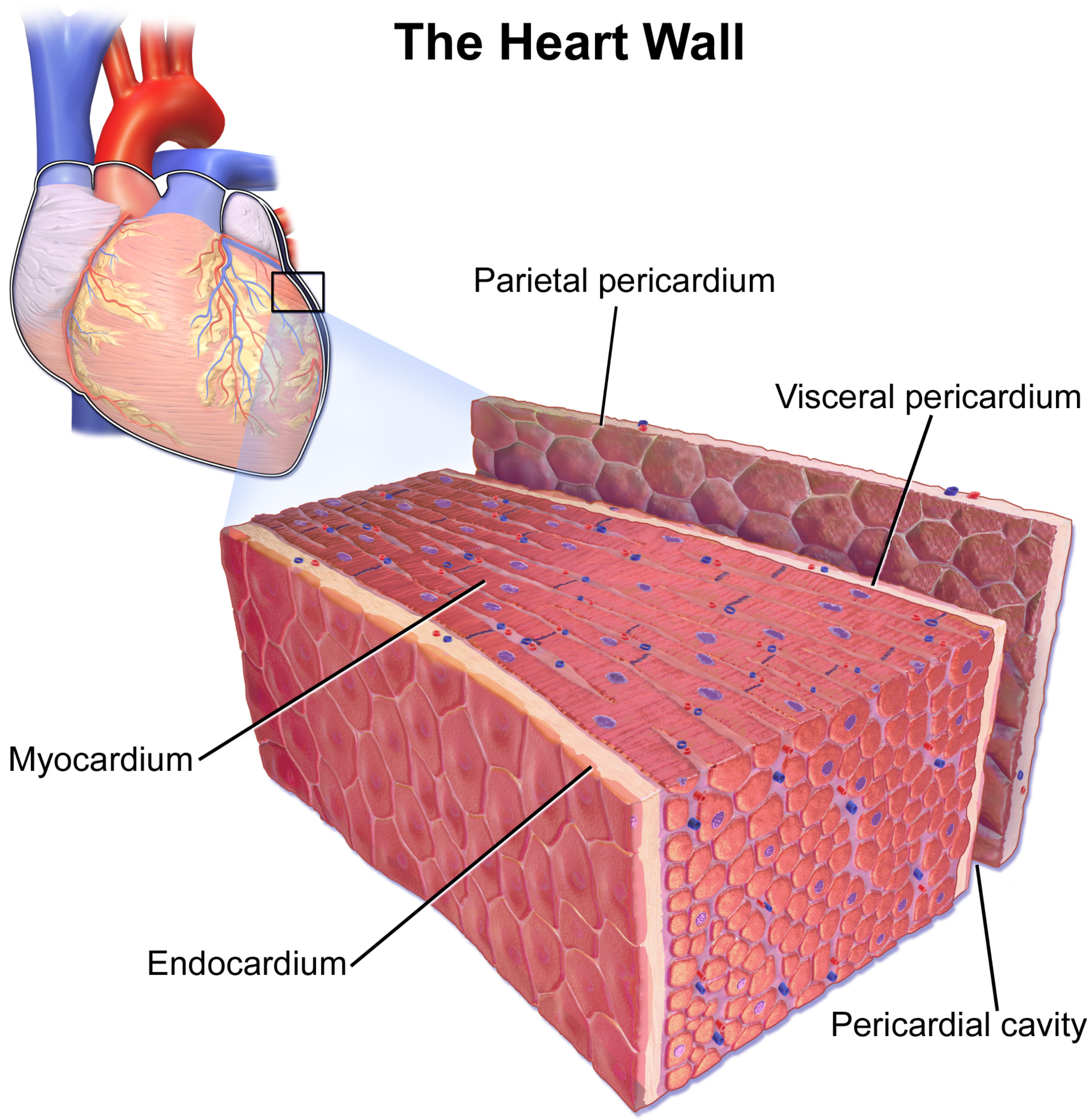
The heart is enclosed in a double membrane sac called the pericardium. The outer fibrous layer protects and anchors the heart to the surrounding structures while the inner serous layer is smooth and covers the surface of the heart as the epicardium.
The heart wall is composed of three layers: epicardium, myocardium, and endocardium. The epicardium is the second layer of the serous pericardium and most often infiltrated with fat. The myocardium or the cardiac muscle is the thickest portion of the heart wall. The endocardium, the inner most layer, lines the heart chamber which is made of simple squamous epithelium (also called endothelium).
The heart has four chambers. The smaller superior chambers are called atria and two larger inferior chambers are called ventricles. The chambers are separated by thick cardiac muscle walls called the interatrial septum and interventricular septum which separate the atria and ventricles, respectively. Between the atria and ventricles, the one-way atrioventricular (AV) valves prevent the back flow of blood. The AV valves are anchored to the papillary muscles of the ventricular wall by cords called chordae tendineae. Between the ventricles and the great vessels, the semilunar valves also serve as one-way valves to prevent back flow.
The heart functions as a double pump to deliver and receive the blood through the great vessels. The right side of the heart pumps blood into pulmonary circulation where blood picks up oxygen in the lungs and unloads carbon dioxide into the lungs to be exhaled. The left side of the heart pumps blood into systemic circulation where blood delivers oxygen and nutrients to tissues then returns carbon dioxide back to the right side of the heart. Besides the pulmonary and systemic circulations, the heart has its own coronary circulation to serve the tissues of the heart itself.

Observe the following structures on the heart model during your instructor's demonstration.
- Apex
- Base
- Right atrium
- Left atrium
- Interatrial septum
- Right ventricle
- Left ventricle
- Interventricular septum
- Right atrioventricular valve – tricuspid valve
- Left atrioventricular valve – bicuspid (mitral) valve
- Right pulmonary semilunar valve
- Left aortic semilunar valve
- Papillary muscle
- Chordae tendineae
- Superior vena cava
- Inferior vena cava
- Pulmonary trunk
- Pulmonary arteries
- Pulmonary veins
- Aorta