

12.4: Selenium
- Page ID
- 136447

\( \newcommand{\vecs}[1]{\overset { \scriptstyle \rightharpoonup} {\mathbf{#1}} } \)
\( \newcommand{\vecd}[1]{\overset{-\!-\!\rightharpoonup}{\vphantom{a}\smash {#1}}} \)
\( \newcommand{\dsum}{\displaystyle\sum\limits} \)
\( \newcommand{\dint}{\displaystyle\int\limits} \)
\( \newcommand{\dlim}{\displaystyle\lim\limits} \)
\( \newcommand{\id}{\mathrm{id}}\) \( \newcommand{\Span}{\mathrm{span}}\)
( \newcommand{\kernel}{\mathrm{null}\,}\) \( \newcommand{\range}{\mathrm{range}\,}\)
\( \newcommand{\RealPart}{\mathrm{Re}}\) \( \newcommand{\ImaginaryPart}{\mathrm{Im}}\)
\( \newcommand{\Argument}{\mathrm{Arg}}\) \( \newcommand{\norm}[1]{\| #1 \|}\)
\( \newcommand{\inner}[2]{\langle #1, #2 \rangle}\)
\( \newcommand{\Span}{\mathrm{span}}\)
\( \newcommand{\id}{\mathrm{id}}\)
\( \newcommand{\Span}{\mathrm{span}}\)
\( \newcommand{\kernel}{\mathrm{null}\,}\)
\( \newcommand{\range}{\mathrm{range}\,}\)
\( \newcommand{\RealPart}{\mathrm{Re}}\)
\( \newcommand{\ImaginaryPart}{\mathrm{Im}}\)
\( \newcommand{\Argument}{\mathrm{Arg}}\)
\( \newcommand{\norm}[1]{\| #1 \|}\)
\( \newcommand{\inner}[2]{\langle #1, #2 \rangle}\)
\( \newcommand{\Span}{\mathrm{span}}\) \( \newcommand{\AA}{\unicode[.8,0]{x212B}}\)
\( \newcommand{\vectorA}[1]{\vec{#1}} % arrow\)
\( \newcommand{\vectorAt}[1]{\vec{\text{#1}}} % arrow\)
\( \newcommand{\vectorB}[1]{\overset { \scriptstyle \rightharpoonup} {\mathbf{#1}} } \)
\( \newcommand{\vectorC}[1]{\textbf{#1}} \)
\( \newcommand{\vectorD}[1]{\overrightarrow{#1}} \)
\( \newcommand{\vectorDt}[1]{\overrightarrow{\text{#1}}} \)
\( \newcommand{\vectE}[1]{\overset{-\!-\!\rightharpoonup}{\vphantom{a}\smash{\mathbf {#1}}}} \)
\( \newcommand{\vecs}[1]{\overset { \scriptstyle \rightharpoonup} {\mathbf{#1}} } \)
\(\newcommand{\longvect}{\overrightarrow}\)
\( \newcommand{\vecd}[1]{\overset{-\!-\!\rightharpoonup}{\vphantom{a}\smash {#1}}} \)
\(\newcommand{\ket}[1]{\left| #1 \right>}\)
\(\newcommand{\bra}[1]{\left< #1 \right|}\)
\(\newcommand{\braket}[2]{\left< #1 \vphantom{#2} \right| \left. #2 \vphantom{#1} \right>}\)
\(\newcommand{\braopket}[3]{\left< #1 \vphantom{#2}\vphantom{#3} \right| #2 \vphantom{#1}\vphantom{#3} \left| #3 \vphantom{#1}\vphantom{#2} \right>}\)
\(\newcommand{\qmvec}[1]{\mathbf{\vec{#1}}}\)
\(\newcommand{\op}[1]{\hat{\mathbf{#1}}}\)
\(\newcommand{\expect}[1]{\langle #1 \rangle}\)
\(\newcommand{\dfn}[1]{\emph{\textbf{#1}}}\)
Selenium is a cofactor for enzymes that release active thyroid hormone in cells; therefore, low levels can cause signs and symptoms similar to those of iodine deficiency. The other important function of selenium is as an antioxidant.
Selenium Functions and Health Benefits
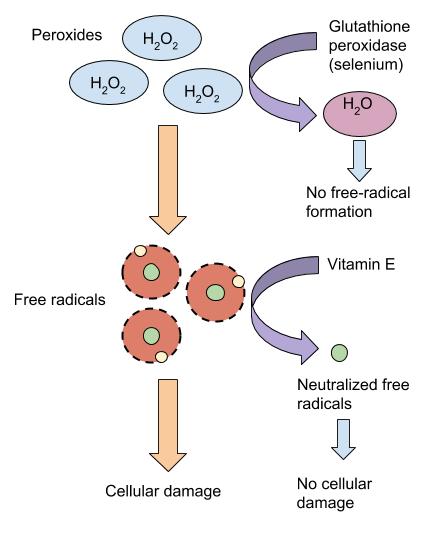
Around 25 known proteins require selenium to function. Some are enzymes involved in detoxifying free radicals, including glutathione peroxidases and thioredoxin reductase. As an integral functioning part of these enzymes, selenium aids in the regeneration of glutathione and oxidized vitamin C.

As part of glutathione peroxidase, selenium also protects lipids from free radicals. In doing so, it spares vitamin E. This is just one example of how antioxidants work together to protect the body against free-radical-induced damage. Other functions of selenium-containing proteins include protecting endothelial cells that line tissues, converting the inactive thyroid hormone to its active form in cells, and mediating inflammatory and immune system responses.
Observational studies have demonstrated that selenium deficiency is linked to an increased risk of cancer. A review of 49 observational studies published in the May 2011 issue of the Cochrane Database of Systematic Reviews concluded that higher selenium exposure reduces overall cancer incidence by about 34% in men and 10% in women, but notes these studies had several limitations, including data quality, bias, and large differences among different studies (Dennert et al., 2011). Additionally, this review states that "there is no convincing evidence" from six clinical trials that selenium supplements reduce cancer risk (Dennert et al., 2011, Author's conclusions section)
Because of its role as a lipid protector, selenium has been suspected of preventing cardiovascular disease. In some observational studies, low levels of selenium are associated with an increased risk of cardiovascular disease. However, other studies have not always confirmed this association, and clinical trials are lacking.
Dietary Sources of Selenium
Organ meats, muscle meats, and seafood have the highest selenium content. Grains and some nuts contain selenium when grown in soils rich in selenium. The selenium content of the soils used to grow animal feed can also affect the selenium content of animal products.
Selenium Deficiency and Toxicity
Selenium deficiency is very rare in the United States and other developed countries. Worldwide, people with "a primarily vegetarian diet" in areas with low soil selenium levels, including parts of China and Europe, may be at risk for selenium deficiency (National Institutes of Health: Office of Dietary Supplements [NIH: ODS], 2025, People living in selenium-deficient regions subsection)
Chronic exposure to foods grown in soils with high selenium levels (above the Tolerable Upper Intake Level (UL) of 400 micrograms per day) can cause brittle hair and nails, gastrointestinal discomfort, "skin [rashes]," halitosis, "fatigue," and "irritability" (NIH: ODS, 2025, Health Risks from Excessive Selenium section, para. 1). "Brazil nuts contain very" high levels "of selenium," so if eaten regularly, they "could cause selenium toxicity" (NIH: ODS, 2025, Health Risks from Excessive Selenium section, para. 2). Selenium at doses several thousand times the Recommended Dietary Allowance (RDA) can cause acute toxicity, and when ingested in gram quantities, can be fatal.
References
Dennert, G., Zwahlen, M., Brinkman, M., Vinceti, M., Zeegers, M. P. A., & Horneber, M. (2011). Selenium for preventing cancer. Cochrane Database of Systematic Reviews, (5).
National Institutes of Health: Office of Dietary Supplements. (2025, September 4). Selenium: Fact sheet for health professionals. National Institutes of Health. Retrieved September 2, 2026.