

12.3: Copper
- Page ID
- 136442

\( \newcommand{\vecs}[1]{\overset { \scriptstyle \rightharpoonup} {\mathbf{#1}} } \)
\( \newcommand{\vecd}[1]{\overset{-\!-\!\rightharpoonup}{\vphantom{a}\smash {#1}}} \)
\( \newcommand{\dsum}{\displaystyle\sum\limits} \)
\( \newcommand{\dint}{\displaystyle\int\limits} \)
\( \newcommand{\dlim}{\displaystyle\lim\limits} \)
\( \newcommand{\id}{\mathrm{id}}\) \( \newcommand{\Span}{\mathrm{span}}\)
( \newcommand{\kernel}{\mathrm{null}\,}\) \( \newcommand{\range}{\mathrm{range}\,}\)
\( \newcommand{\RealPart}{\mathrm{Re}}\) \( \newcommand{\ImaginaryPart}{\mathrm{Im}}\)
\( \newcommand{\Argument}{\mathrm{Arg}}\) \( \newcommand{\norm}[1]{\| #1 \|}\)
\( \newcommand{\inner}[2]{\langle #1, #2 \rangle}\)
\( \newcommand{\Span}{\mathrm{span}}\)
\( \newcommand{\id}{\mathrm{id}}\)
\( \newcommand{\Span}{\mathrm{span}}\)
\( \newcommand{\kernel}{\mathrm{null}\,}\)
\( \newcommand{\range}{\mathrm{range}\,}\)
\( \newcommand{\RealPart}{\mathrm{Re}}\)
\( \newcommand{\ImaginaryPart}{\mathrm{Im}}\)
\( \newcommand{\Argument}{\mathrm{Arg}}\)
\( \newcommand{\norm}[1]{\| #1 \|}\)
\( \newcommand{\inner}[2]{\langle #1, #2 \rangle}\)
\( \newcommand{\Span}{\mathrm{span}}\) \( \newcommand{\AA}{\unicode[.8,0]{x212B}}\)
\( \newcommand{\vectorA}[1]{\vec{#1}} % arrow\)
\( \newcommand{\vectorAt}[1]{\vec{\text{#1}}} % arrow\)
\( \newcommand{\vectorB}[1]{\overset { \scriptstyle \rightharpoonup} {\mathbf{#1}} } \)
\( \newcommand{\vectorC}[1]{\textbf{#1}} \)
\( \newcommand{\vectorD}[1]{\overrightarrow{#1}} \)
\( \newcommand{\vectorDt}[1]{\overrightarrow{\text{#1}}} \)
\( \newcommand{\vectE}[1]{\overset{-\!-\!\rightharpoonup}{\vphantom{a}\smash{\mathbf {#1}}}} \)
\( \newcommand{\vecs}[1]{\overset { \scriptstyle \rightharpoonup} {\mathbf{#1}} } \)
\(\newcommand{\longvect}{\overrightarrow}\)
\( \newcommand{\vecd}[1]{\overset{-\!-\!\rightharpoonup}{\vphantom{a}\smash {#1}}} \)
\(\newcommand{\ket}[1]{\left| #1 \right>}\)
\(\newcommand{\bra}[1]{\left< #1 \right|}\)
\(\newcommand{\braket}[2]{\left< #1 \vphantom{#2} \right| \left. #2 \vphantom{#1} \right>}\)
\(\newcommand{\braopket}[3]{\left< #1 \vphantom{#2}\vphantom{#3} \right| #2 \vphantom{#1}\vphantom{#3} \left| #3 \vphantom{#1}\vphantom{#2} \right>}\)
\(\newcommand{\qmvec}[1]{\mathbf{\vec{#1}}}\)
\(\newcommand{\op}[1]{\hat{\mathbf{#1}}}\)
\(\newcommand{\expect}[1]{\langle #1 \rangle}\)
\(\newcommand{\dfn}[1]{\emph{\textbf{#1}}}\)
Similar to zinc, there is not much storage of copper in the body. The liver is the primary site of storage. If copper is stored, it binds to thionein to form metallothionein. Copper is transported through circulation by the copper transport protein ceruloplasmin.
Copper Functions
Copper has a number of functions that are described and shown below. Two copper-containing proteins, ceruloplasmin and hephaestin, oxidize Fe2+ to Fe3+. Fe3+ is the form that binds to transferrin, as shown below (Gropper et al., 2008).

Copper's role in iron oxidation also makes it

Other functions of copper include hormone synthesis, collagen synthesis, and participation in the electron transport chain as part of the cytochrome c oxidase enzyme. See Figure \(\PageIndex{3}\) below.

Dietary Sources of Copper
Copper is distributed in many foods and is abundant in organ meats, seafoods, nuts, and seeds. Wheat bran cereals, whole grains, and cocoa products are also good sources of copper. The absorption of copper from foods may be reduced by excess intakes of zinc and the amino acid histidine in addition to high intakes of iron and fructose. Copper is also available as part of other ingredients in a multi-mineral supplement or by itself in a copper-only supplement. Dietary supplements containing copper typically range from a few micrograms to 15 mg (Institute of Medicine [IOM], 2001).
Copper Deficiency & Toxicity
Copper deficiency is rare in humans, but results in the following symptoms:
- hypochromic anemia (Red blood cells that lack hemoglobin. The lack of oxygen gives these cells a paler color.)
- Copper deficiency can result in a secondary iron deficiency, since \(\ce{Fe^2+}\) cannot be oxidized to \(\ce{Fe^3+}\) to bind to transferrin. This can cause the hypochromic anemia that occurs in iron deficiency.
- decreased white blood cell counts leading to decreased immune function
- bone abnormalities
Menkes disease is a genetic disorder that results in copper deficiency. It is believed that individuals with this disease have an ATP7A mutation that prevents copper from leaving the enterocyte, thus preventing absorption.
Copper toxicity is also rare in humans, but acute toxicity results in the following symptoms:
- nausea
- vomiting
- diarrhea
- abdominal pain
Chronic symptoms include:
- brain, neurological, liver, and kidney damage
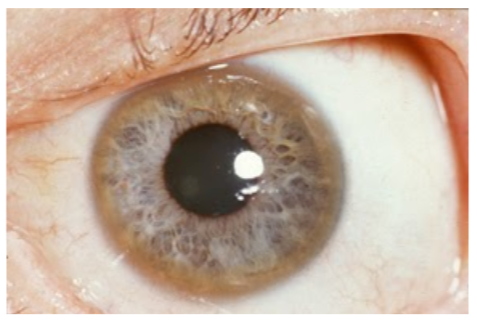
Wilson's disease is a genetic disorder where a mutation in ATP7B prevents copper excretion, resulting in copper toxicity. A notable symptom is golden-to-greenish-brown Kayser-Fleischer rings around the edges of the cornea, as shown below (Gropper et al., 2008; Byrd-Bredbenner et al., 2009).
How High Zinc Intake Can Lead to Copper & Iron Deficiencies
As you learned previously, thionein is the storage protein for zinc, but it more avidly binds copper. When it binds a mineral, it becomes metallothionein. High zinc intake increases thionein synthesis in the enterocyte. Thus, when an individual consumes high zinc levels (most likely by supplementation, unlikely from dietary sources), the enterocyte will have high levels of thionein.
The high levels of thionein will bind any copper taken up by the enterocyte (as metallothionein), "trapping" the copper in the enterocyte and preventing it from being absorbed into circulation.
The enterocytes containing the "trapped" copper move up the crypt and are sloughed off and excreted in feces. The copper consumed essentially is lost from the body through this process.
Without adequate copper being transported to the liver, no ceruloplasmin is produced and released into circulation. The lack of copper further influences iron transport by decreasing ceruloplasmin in circulation and hephaestin (another copper-containing protein) on the membrane of the enterocyte. These two proteins normally convert \(\ce{Fe^2+}\) to \(\ce{Fe^3+}\) so that iron can bind to transferrin.

Without hephaestin and ceruloplasmin, \(\ce{Fe^3+}\) is not formed from \(\ce{Fe^2+}\). As a result, \(\ce{Fe^2+}\) is "trapped" in the enterocyte because it can't bind to transferrin.
Enterocytes containing the "trapped" iron move up the crypt and are sloughed off and excreted in feces. Essentially, the body loses the iron consumed through this process.
In summary, high zinc intake increases thionein production, which traps all copper; the lack of copper decreases circulating ceruloplasmin and hephaestin, which causes all iron to be trapped as well.
References
Byrd-Bredbenner, C., Moe, G., Beshgetoor, D., & Berning, J. (2009). Wardlaw's perspectives in nutrition (8th ed.). McGraw-Hill Education.
Gropper, S. S., Smith, J. L., & Groff, J. L. (2008). Advanced nutrition and human metabolism (5th ed.). Wadsworth Publishing.
Institute of Medicine. (2001). Dietary reference intakes for vitamin A, vitamin K, arsenic, boron, chromium, copper, iodine, iron, manganese, molybdenum, nickel, silicon, vanadium, and zinc. The National Academies Press.